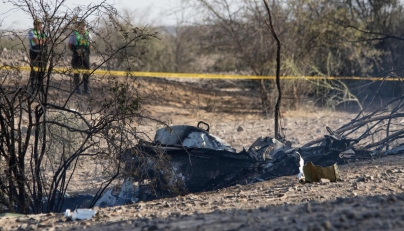
Nazca, Peru: A small plane carrying foreign tourists to view Peru's famed Nazca Lines archaeological site crashed Saturday, killing all 13 people on board, police said. Seven Italians, two Germans and two Spaniards were killed, along with two crew members, a spokesman for the transport ministry said, adding that the victims were aged between 24 and 78. The incident occurred shortly after 1:00 pm (1800 GMT) after the Cessna 208 Caravan aircraft took off from the airport in Pisco, located about 240 kilometers (150 miles) south of the capital Lima. "We have information that 11 passengers and two crew members have died," Police Major Jorge Andrade told reporters at the crash site. Police officers and forensic teams work at the scene of a small-plane crash in the Vista Alegre district of Nazca, Peru, on August 1, 2026. The accident claimed the lives of all 13 people on board.Photo by Mariajulia VAREMAN / AFP "Given the severity of the accident, there are no survivors. We have recovered four bodies so far," Andrade said, without identifying the victims or giving further details about what caused the crash. Overnight, police recovered the charred bodies and placed them in black bags for transport to the regional morgue. Firefighters and police, some wearing face masks, pored over the twisted, smoldering wreckage of the aircraft. One wheel of the plane lay near the debris, detached from the aircraft. Peru's civil aviation authority and the air accident agency will investigate the accident, the transport ministry said. Peruvian President Keiko Fujimori said her government was mulling the possible closure of the Pisco airport. 'In-flight emergency' The plane was operated by AeroDiana, which offers sightseeing trips lasting 30 minutes to an hour over the Nazca Lines, which is best seen from the air. The archaeological site features a group of geoglyphs etched into the desert sands that date back to between 500 BC and 500 AD. The meaning of the geometric shapes and animal outlines remains a mystery, with some believing they had ritual astronomical functions, according to UNESCO, which declared the area a World Heritage site in 1994. Police officers work at the scene of a small-plane crash in the Vista Alegre district of Nazca, Peru, on August 1, 2026.Photo by Mariajulia VAREMAN / AFP AeroDiana told AFP that it would soon release more information about the crash. Municipal officials in Vista Alegre, where the plane crashed, said in a statement that preliminary information indicated an "in-flight emergency" was to blame, without offering more details. One resident of Vista Alegre said the plane exploded on impact. Dozens of small planes operate from the airport in Pisco, handling a large volume of primarily foreign tourists hoping to visit the Nazca Lines. Accidents have happened before near the site. Seven people were killed in a plane crash in 2022, including two Chileans and three Dutch nationals. In October 2010, four British tourists and two Peruvian crew members died when an AirNasca plane crashed after taking the tourists to view the site.

China: The roar of engines fills the night air in China's Chongqing city as tourists awkwardly clamber onto gleaming motorbikes and cling to muscular drivers to star in personalised videos. Teams of sellers hawk their filming services to passersby, many of whom have been drawn to the city and its cyberpunk image by motorbiking videos on social media shot against the neon-lit nightscape. "I flew from Shanghai to Chongqing this morning, and the first priority is this shoot," 30-year-old Liu Changqing told AFP, dressed in one of the heavy motorcycle jackets rented to customers, despite the sweltering heat. "They even have make-up artists to help you," she said as she mounted a crimson superbike, wrapped her arms around her driver and sped off with a videographer in pursuit. While many Chinese cities have restricted motorcycling, Chongqing has embraced it and become a biker's paradise. What began with local riders snapping each other to post online exploded last year as tourism to the mega-city of 23 million spiked. Videos using a hashtag related to the trend have racked up a cumulative 1.3 billion views on Douyin -- China's version of TikTok -- helping to elevate Chongqing's motorcycle culture to national prominence and even gaining recognition overseas. This picture taken on July 21, 2026, shows Zhang Yuanming (R), a motorcycle riding instructor, talking with customers. Manufacturing hub "There is a local saying that if you put a camera at an intersection in Chongqing, every 30 seconds you'll see a motorcycle pass by," said Zhang Yuanming, a 29-year-old motorbike enthusiast and instructor. Zhang attributes biking's popularity in the city to the prevalence of manufacturers, the rugged terrain, and bad traffic. Chongqing has been an industry hub since 1979, when state-owned military equipment manufacturer Jialing began producing civilian motorcycles in the city. Motorbikes quickly became popular, and the city now accounts for more than a third of China's total motorbike production. While many Chinese cities are dominated by electric scooters, which face fewer regulations, Chongqing has remained open to petrol-powered two-wheelers. Zhang, who teaches students to race at a track on the outskirts of the city, hopes tourism will further burnish the city's biker reputation. "When (tourists) take photos and videos, they may come to like motorbikes and learn to ride, then buy a bike," he said. Zhang has also seen increased interest from students since March, when local brand ZXMoto made headlines by becoming the first Chinese manufacturer to win a race in the prestigious WorldSSP class in Portugal. "It's pushing young people to get in touch with motorcycles," he said. Roaring business For the local bikers offering videos for tourists, Chongqing's motorcycle prowess is a business opportunity. The packages of choreographed photos and videos -- in which customers are swept off their feet by dashing riders and cruise past the city's landmarks in slow motion -- cost upwards of 200 yuan ($30). "We used to just make short videos of ourselves. Later other people saw that we looked pretty handsome so they started wanting to sit on the back," 26-year-old rider Li Yan told AFP, explaining how he now earns up to 1,000 yuan a night from customers. Li's team has grown to seven members working together to advertise online and to passersby, drive the bikes, and edit the footage, with each rider attracting around six to 12 customers a night. Domestic interest has cooled from the craze's peak last year, but foreign tourists -- who now make up around a third of customers each evening -- are helping fill the gap as the news spreads overseas. "I saw it was a 'must do' in Chongqing," said Alex Schodorowska, a tourist visiting from Britain, who saw the trend on Instagram. "There's nowhere with a view like this, with all the lights," the 29-year-old told AFP as she waited her turn for a ride. "I don't think many places could have the same effect for video."
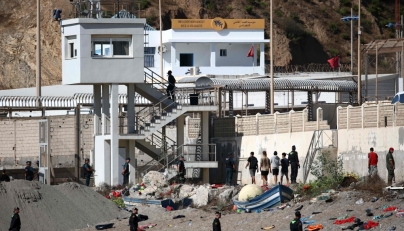
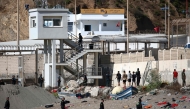
Ceuta, Spain: At least 72 people died during last week's mass influx of migrants into Spain's Ceuta enclave, when tens of thousands of people mostly swam around the border post from Morocco, local officials said on Sunday. Most of the estimated 60,000 people who rushed into Spain's north African territory have returned to Morocco since the territory's largest mass migrant crossing. "The latest figure that we have is 72," the government's delegate to Ceuta, Miguel Angel Perez Triano, told reporters, when asked about the number of fatalities. The previous toll was 67 deaths. Spanish police and troops patrolled the streets of Ceuta on Sunday as the enclave returned to normal after the sudden mass influx of migrants from Morocco. Only small groups of migrants were still walking around after most who crossed the small border barrier returned voluntarily to Morocco in 48 hours. The largest migrant rush into the enclave has caused an international crisis for Spain with European partners criticising Madrid for its immigration policies. Outside a housing project near Ceuta port, Spanish soldiers detained a group of nine tired-looking migrants who were sitting on the pavement, guarded by troops with an armoured car, an AFP reporter said. Small inflatable boats from a rescue unit scoured the waters around the border barrier that extends into the Mediterranean Sea, where a new 500-metre (1,640-feet) floating boom reinforced security. Civil Guard were also taking migrants off a bus to escort them back to the border post to return to Morocco. The border crossing was calm, with groups of workers picking up trash, clothes and rubbish left behind during the mass crossing. Rumours Spain has blamed criminal gangs for spreading rumours that a recent Spanish Supreme Court ruling on immigration would allow migrants easier passage. Some analysts suggested Morocco could allow migrants to cross the border to put diplomatic pressure on Spain, which has recently improved ties with Rabat's arch-enemy neighbouring Algeria. In 2021, around 10,000 migrants crossed into Ceuta, taking advantage of Morocco easing border controls as a way to pressure Spain. Moroccan officials have so far not offered any statement on the crisis. But some of those who crossed the border said they had heard the border was open -- a rumour quickly amplified on social media. The EU said it would hold a video call on Tuesday after 22 bloc members issued a joint open letter calling for an urgent meeting to agree a speedy coordinated response, and to prevent further uncontrolled crossings. Italy on Saturday implemented a one-month suspension of its Schengen agreement with Spain allowing for visa-free movement between borders. Spanish Prime Minister Pedro Sanchez, in a letter to EU leaders, blasted the "selfish" reaction by some EU countries.
 UAE vehemently condemns Iranian attack on Kuwait
Abu Dhabi: The United Arab Emirates has vehemently condemned the Iranian aggression against the State of Kuwait involving one-way attack drones. The Foreign Ministry said in a statement on Saturday that this aggressive attack flagrantly violates the State of Kuwait's...
 US President suspends strikes against Iran, conditional on reaching a deal
Washington: US President DonaldTrumpannounced early Sunday that he had suspended the planned US-Israeli strikes against Iran, following a request from Tehran and other countries in the Middle East, on the condition that a rapid agreement be reached. In a post...
Tourists chase high-octane thrill in China's trending biker capital
China: The roar of engines fills the night air in China's Chongqing city as tourists awkwardly clamber onto gleaming motorbikes and cling to muscular drivers to star in personalised videos. Teams of sellers hawk their filming services to passersby, many...
13 killed in small tourist plane crash in Peru
Nazca, Peru: A small plane carrying foreign tourists to view Peru's famed Nazca Lines archaeological site crashed Saturday, killing all 13 people on board, police said. Seven Italians, two Germans and two Spaniards were killed, along with two crew members,...
 Algeria bus crash kills at least 27: rescuers
Algiers, Algeria: An Algerian bus crashed into a ravine on Friday, killing at least 27 people and wounding dozens more, the country's health minister said. The bus left the road near the coastal town of Boumerdes, east of the capital...