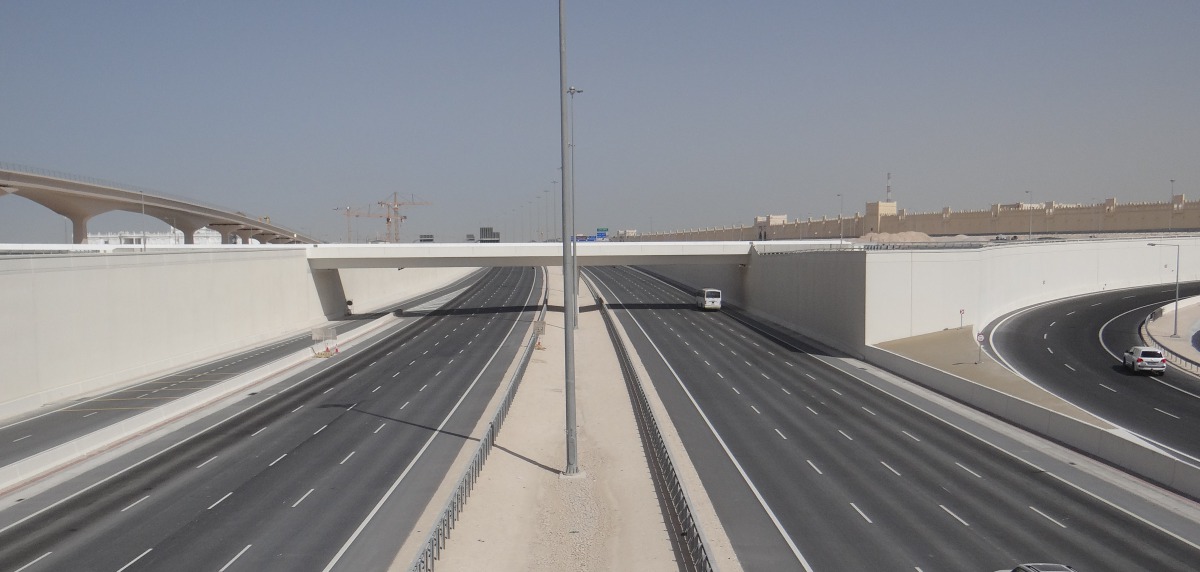
Representational photo
Doha, Qatar: Qatar’s transportation infrastructure construction industry is entering a new phase of long-term, strategy-led growth, with the sector projected to expand to $13.12bn (QR47.82bn) this year from $12.48bn (QR45.48bn) in 2025, according to a recent market analysis by Mordor Intelligence.
The report notes that it is expected to amount to $16.85bn (QR61.41bn) by 2031, reflecting a compound annual growth rate (CAGR) of 5.14 percent between 2026 and 2031, as a major catalyst for this transition is the Ministry of Transport’s 2025-2030 Strategy, which outlines 125 projects across 42 initiatives, backed by investments exceeding $330m (QR1.2bn).
The strategy also seeks to increase private-sector participation in transport development to 40 percent, highlighting Qatar’s efforts to broaden project delivery beyond traditional state-funded execution while expanding the transport sector’s contribution to the national economy.
Infrastructure spending continues to receive strong government support as Ashghal’s $22.2bn (QR80.91bn) five-year development plan for 2025-2029 is sustaining construction activity across roads, drainage systems, tunnels, and public buildings throughout both urban centres and emerging districts.
Meanwhile, the data highlights that construction sector momentum remains robust, with value-added growth reaching 9.1 percent year-on-year in the third quarter of 2025, following growth of 8.7 percent in the second quarter and 4.4 percent in the first quarter.
The country’s logistics ambitions are also strengthening transportation infrastructure demand. Qatar’s ports handled 1.46 million twenty-foot equivalent units (TEUs) in 2025, while imports of building materials through the nation’s three commercial ports increased 106 percent year-on-year, supporting continued investment in freight corridors, port access roads, and intermodal transport infrastructure.
In November 2025, the Ministry of Communications and Information Technology and the Ministry of Transport launched the ‘Transport and Logistics Digital Transformation Roadmap’, featuring 39 strategic initiatives expected to contribute approximately $76.4m (QR278.45m) to the country’s non-hydrocarbon information and communications technology output.
The roadmap aims to improve freight visibility, strengthen logistics efficiency, and enhance integration between roads, ports, and future rail networks.
Urban expansion beyond central Doha is also broadening construction opportunities as Lusail continues to serve as Qatar’s flagship transit-oriented city, with its tram network surpassing 10 million cumulative passengers since operations began.
The launch of the turquoise tram extension in 2025 further reinforced the city’s integrated mobility network.
At the same time, Ashghal reported 67 infrastructure projects underway during the first quarter of 2026, covering roads, intersections, and drainage systems across residential communities and developing districts. The wider geographic distribution of projects is creating additional opportunities for domestic contractors and specialised suppliers as transportation investment extends beyond large-scale flagship developments.
The growing adoption of intelligent transportation systems (ITS) and smart mobility technologies is also reshaping project requirements. In September 2025, Ashghal awarded contracts worth $3.3bn (QR12.03bn) covering roads, drainage, public buildings, and ITS infrastructure.
The projects incorporate artificial intelligence-powered traffic management, autonomous survey vehicles, laser-based road defect detection, and advanced monitoring technologies.
As Qatar shifts toward long-term economic diversification, transportation infrastructure is evolving into a central pillar supporting urban development, logistics competitiveness, and smart mobility. The market’s next growth phase is expected to be driven by sustained public investment, expanding private-sector participation, and the integration of digital technologies across the nation’s transport network.