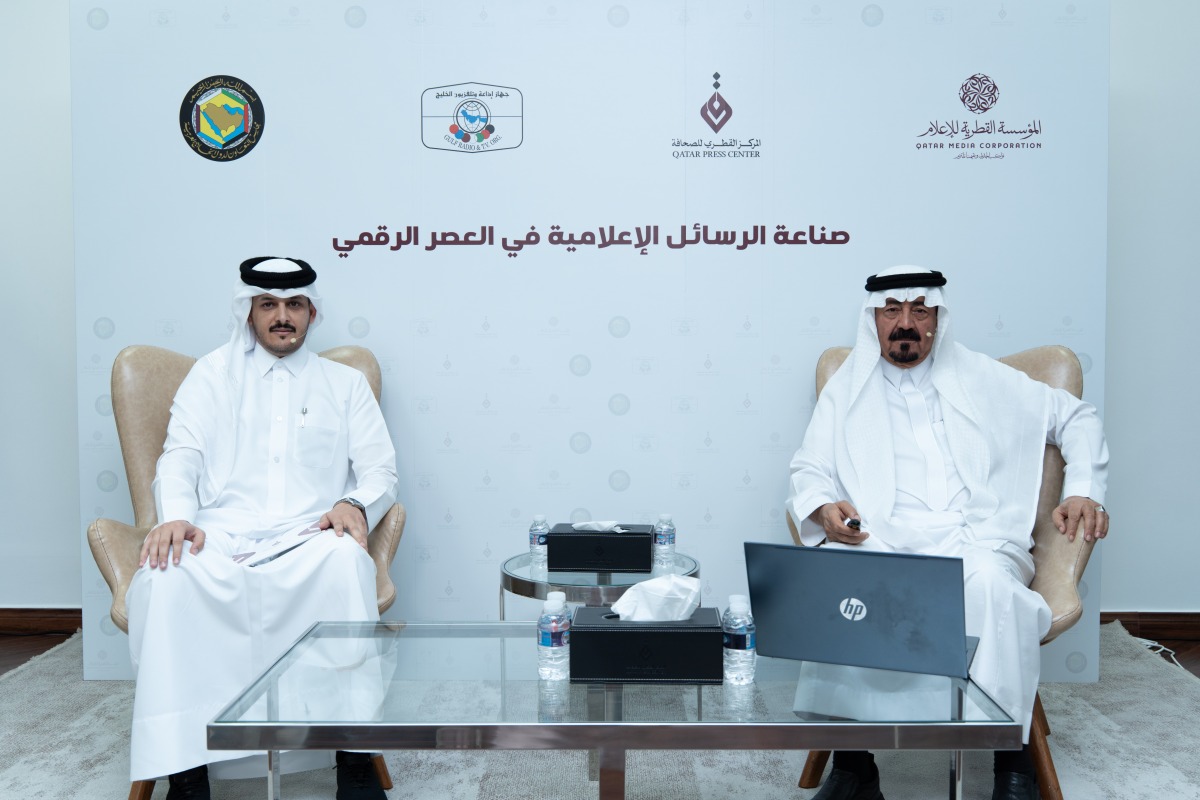
Director-General of the Gulf Radio and Television Organization of the Gulf Cooperation Council H E Dr. Abdulrahman bin Abdulaziz Al-Hazzaa (right) during the event.
Doha, Qatar: The Qatar Press Center organised a specialised seminar titled “Crafting Media Messages in the Digital Age,” featuring Director-General of the Gulf Radio and Television Organization of the Gulf Cooperation Council (GCC) H E Dr. Abdulrahman bin Abdulaziz Al-Hazzaa.
Held at the Center’s headquarters, the event brought together officials from the Qatar Media Corporation, media professionals, academics, content creators, and individuals interested in the media sector. The seminar was moderated by Qatar TV presenter Tariq Al-Ajji.
The seminar examined the major transformations shaping media messaging amid rapid technological advancements, the proliferation of digital platforms, and changing audience consumption habits. Discussions also focused on the key skills required for future media professionals and the mechanisms needed to enhance the impact and credibility of media messages in the digital environment.
Opening the seminar, Dr. Al-Hazzaa stressed that successful media messages in the digital era are no longer measured solely by publication, but by their ability to create impact, build trust, and reach target audiences through appropriate language, style, and platforms. He noted that ongoing technological developments have created a new reality for media institutions, requiring them to modernize their tools and approaches to meet audience expectations.
He outlined the core characteristics of effective media messages, including clarity, accuracy, credibility, objectivity, attractiveness, audience awareness, and appropriate timing. He emphasized that timing has become a critical factor, as delays in delivering information can reduce its influence and limit audience engagement.
Dr. Al-Hazzaa explained that clarity does not mean oversimplifying content at the expense of professionalism, but rather presenting information in a direct and understandable manner. He underscored that accuracy and credibility remain the foundation of media work, particularly in a digital landscape where misinformation and unverified content can spread rapidly.
Highlighting the importance of audience segmentation, he said media professionals must understand audience characteristics and interests before producing content. Such understanding helps determine the most suitable message, language, and platform. Today’s audiences, he noted, are diverse in age, culture, education, and social background, making tailored communication essential.
He added that media organizations can only build trust by respecting audiences’ intelligence and delivering content that addresses their interests and needs without exaggeration or misinformation.
Addressing audience influence, Dr. Al-Hazzaa said effective media messages combine cognitive, emotional, and behavioral dimensions. Cognitive influence is achieved through accurate information, verified facts, and reliable data, while emotional engagement is strengthened through human stories, impactful imagery, and authentic testimonies.
He noted that some media campaigns also seek to encourage positive behavioral change, requiring the presentation of successful role models and influential examples. Credibility, he stressed, remains the decisive factor behind any media message’s success because it is rooted in transparency, objectivity, and balanced reporting.
Dr. Al-Hazzaa further observed that digital audiences are more informed and engaged than ever before. Rather than being passive recipients, they actively participate in communication through comments, sharing, reposting, and even content creation, placing greater responsibility on media institutions to maintain transparency and accuracy.
Discussing content creation in the digital era, he highlighted how competition is no longer limited to traditional media organizations. Individuals, influencers, and independent content creators now compete for audience attention across various digital platforms.