
By Stephanie Nebehay
GENEVA: The United Nations plans to make its first air drops of food aid in Syria, to Deir al-Zor, an eastern town of 200,000 besieged by Islamic State militants, the chair of a U.N. humanitarian task force said on Thursday.
U.N. aid agencies do not have direct access to areas held by Islamic State, including Deir al-Zor, where civilians face severe food shortages and sharply deteriorating conditions.
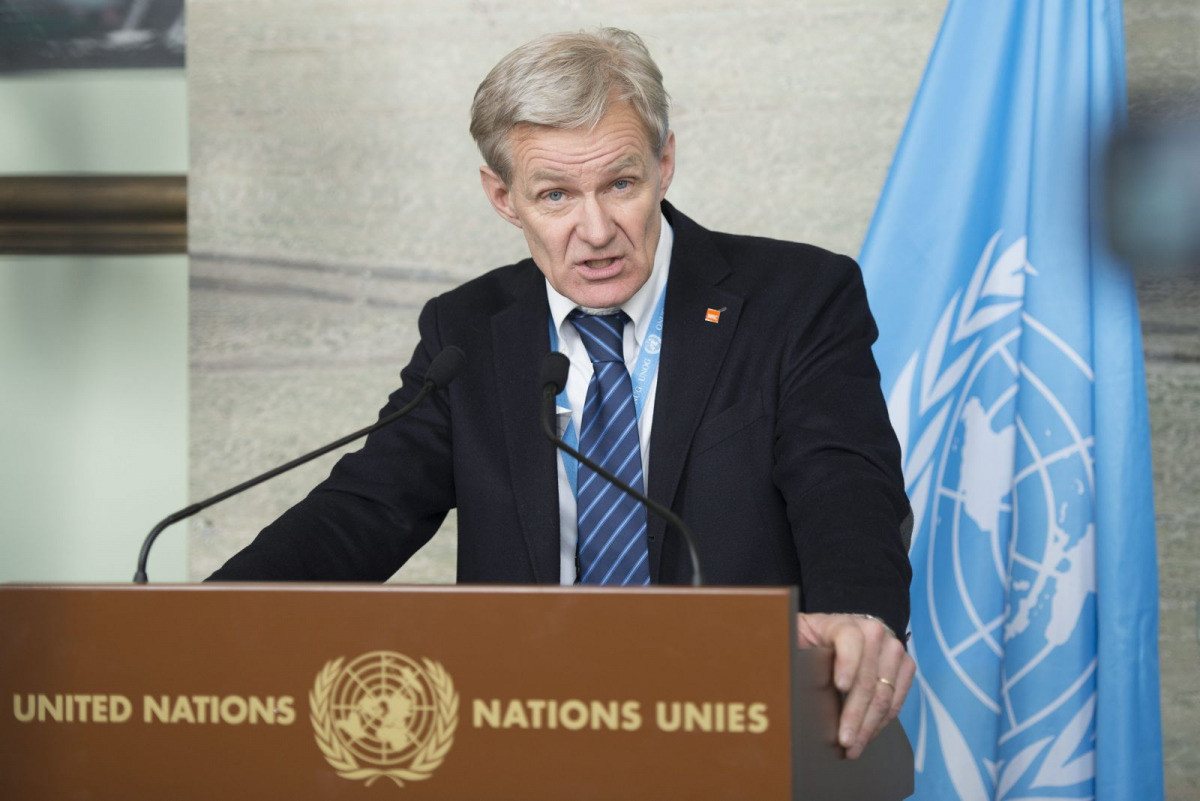
Jan Egeland, speaking to reporters in Geneva a day after U.N. aid convoys reached five areas, some besieged by government forces and others by rebels, said the U.N.’s World Food Programme (WFP) had a “concrete plan” for carrying out the Deir al-Zor drop in coming days.
He said the WFP hoped to make progress reaching “the poor people inside Deir al-Zor, which is besieged by Islamic State. That can only be done by air drops,” said Egeland.
“It’s a complicated operation and would be in many ways the first of its kind,” Egeland said, giving no details of the air operation, which is far more costly than land convoys.
Egeland, who is head of the Norwegian Refugee Council, later told Reuters in Oslo: “It is either airdrops or nothing. Airdrops are a desperate measure in desperate times.”
A WFP official was not available to comment on where cargo planes would depart from or what they would carry.
U.N. Syria envoy Staffan de Mistura suggested air drops could also relieve civilians in other besieged areas.
“Air drops in Deir al-Zor has become a very concrete proposal,” he said. “But not only there, even eastern Aleppo, even in fact in Daraya in Eastern Ghouta, many other places including Kefraya and Foua, where people are in need of help.”
It was unclear if the Syrian government would allow such flights over Aleppo or close to Damascus, areas where its air force and Russian jets are operating.
STARVING CIVILIANS
Deir al-Zor is the main town in a province of the same name. The province links Islamic State’s de facto capital in the Syrian city of Raqqa with territory controlled by the militant group in neighbouring Iraq.
Egeland chaired a three-hour meeting of the humanitarian task force on Syria, where he said that many member states pledged support for the attempt to reach Deir al-Zor.
Russia is Syria’s main ally in the five-year war, while Western and Arab states support rebels fighting to topple President Bashar al-Assad.
The U.N. estimates there are 486,700 people in around 15 besieged areas of Syria, and 4.6 million in hard-to-reach areas. In some, starvation deaths and severe malnutrition have been reported.
“We hope to be able to reach the remaining areas in the next days,” Egeland said, adding the group would meet again in a week.
Britain’s foreign minister Philip Hammond said in a statement: “Starvation of civilians as a method of combat is unacceptable. The international community and particularly Russia, which has unique influence, must put pressure on the Assad regime to lift sieges and grant full humanitarian access.”
In the past 24 hours, 114 U.N. trucks delivered life-saving food and medical supplies to 80,000 people in five besieged areas, enough for one month, Egeland said.
These were Madaya, Zabadani and Mouadamiya al-Sham near Damascus, which are under siege by government forces, and the villages of al-Foua and Kefraya in Idlib province, surrounded by rebel fighters.
But some “vital medical items” were not delivered, he said.
A spokesman for the World Health Organization (WHO) said that government forces had removed some medicines for emergency and trauma care from supplies bound for Mouadamiya, but had allowed a hemodialysis machine for diabetics, medicines and nutritional supplements.
REUTERS