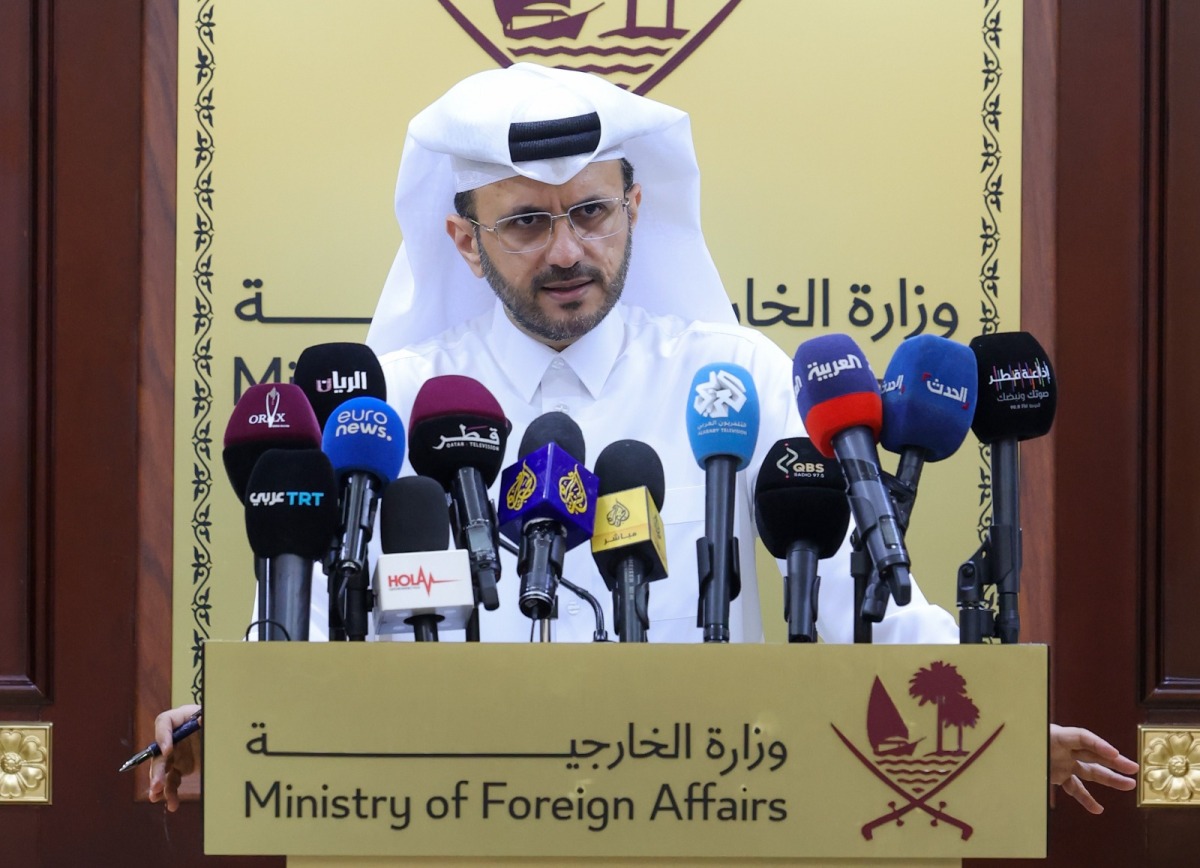
Doha: The State of Qatar has said that Iran must take "a clear decision" to stop attacks on the countries of the region, rejecting suggestions that investigations or joint teams are needed to address the issue. Speaking at the Ministry of Foreign Affairs' weekly media briefing, Advisor to the Prime Minister and Official Spokesperson of the Ministry of Foreign Affairs Dr. Majed bin Mohammed Al Ansari said that the matter is "very simple", and what is required is "to stop the attacks on countries that have not targeted Iran".
He stressed that the State of Qatar, along with the rest of the countries of the region, has distanced itself from this war and escalation since day one.
His remarks came in response to statements by Iranian Foreign Minister Abbas Araqchi.
Al Ansari added that the targeting of the State of Qatar is still ongoing, as it was subjected Sunday, to an attack by five drones. He emphasized that the State of Qatar will continue to defend itself and reserves the right to respond to these attacks.
He indicated that Iranian attacks during the past period targeted civilian and vital facilities in the State of Qatar, including residential areas and facilities in Ras Laffan, Mesaieed, and Hamad International Airport, in addition to threats published through unofficial Iranian media to target specific residential areas within the country.
The Official Spokesperson of the Ministry of Foreign Affairs indicated that the evacuation that affected parts of Doha on Saturday came after an Iranian missile was launched at a residential complex, which was intercepted.
He explained that following this interception, all measures were taken to secure and protect citizens and residents of the State of Qatar, stressing that Iranian attacks on civilian facilities in the State of Qatar have not stopped. Dr. Al Ansari commended the efforts of Qatar's Armed Forces, noting that Qatari soldiers have demonstrated their high competence and ability to handle various challenges.
He said that the Armed Forces have achieved the highest levels of readiness and preparedness, in addition to establishing a deterrent that has contributed to protecting the country from real harm resulting from these attacks, indicating that the rate of interception of Iranian attacks has reached more than 90 percent.
Regarding diplomatic moves, the Advisor to the Prime Minister and Official Spokesperson of the Ministry of Foreign Affairs indicated that the consultations held with the Egyptian side on Sunday addressed general coordination between the State of Qatar and the Arab Republic of Egypt, in addition to broader Arab coordination in light of regional developments.
He indicated that communication between officials in the GCC countries is ongoing on an almost daily basis and at various levels, whether between Their Majesties and Highnesses the leaders or the foreign ministers, stressing that the Gulf countries are speaking with one voice to the world today in rejecting Iranian aggression and in calling for de-escalation.
He noted that this unified Gulf position is also evident in communication with international partners, including the United States and European countries, where efforts are underway to enhance regional security and ensure the stability of the region. Dr. Al Ansari stressed that Gulf diplomacy is active at this stage, seeking to reduce escalation and reach diplomatic solutions to the crisis.
He noted that these efforts do not mean accepting or tolerating Iranian attacks, but rather are accompanied by defensive coordination and clear messages to the international community regarding the seriousness of these attacks.
As part of the Qatari diplomacy to counter the rising tensions in the Middle East, Al Ansari highlighted Prime Minister and Minister of Foreign Affairs HE Sheikh Mohammed bin Abdulrahman bin Jassim Al-Thani's talks with the Foreign Minister of the Federal Republic of Germany HE Johann Wadephul.
The two officials discussed the latest military escalation in the region and its potential impact on regional security and stability.
During the meeting, HE Sheikh Mohammed renewed Qatar's condemnation of Iranian attacks on the country and warned against "irresponsible" targeting of vital infrastructure, particularly facilities related to water, food supplies and energy.
Al Ansari also noted Minister of State for Foreign Affairs HE Sultan bin Saad Al Muraikhi's engagement in two virtual ministerial meetings.
These included a joint meeting between Their Highnesses and Excellencies Foreign Ministers of the Gulf Cooperation Council (GCC) and the United Kingdom, as well as another joint meeting involving Their Highnesses and Excellencies Foreign Ministers of the GCC with the Kingdom of Morocco, the Arab Republic of Egypt and the Hashemite Kingdom of Jordan.
In response to developments in recent days, the foreign affairs spokesperson, added, Qatar issued several official statements. On Wednesday, the country welcomed the adoption of United Nations Security Council Resolution 2817, which condemns Iranian attacks on countries in the region.
A day later, Qatar condemned an Iranian strike on the Port of Salalah in Oman, describing it as a hostile act and a violation of international law.
The same day, Doha also condemned Israeli attacks in southern Lebanon, calling them a breach of international law and of United Nations Security Council
Resolution 1701. On Saturday, it also denounced an attack on the United Arab Emirates' consulate general in the Kurdistan Region of Iraq, saying the targeting violated the Vienna Convention on Diplomatic Relations.
Qatar also sent an eighth identical letter on Friday to Secretary-General of the United Nations HE Antonio Guterres and to the US permanent representative to the UN and president of the Security Council for March HE Michael Waltz, detailing Iran's attack on its territory.
Submitted by Permanent Representative of the State of Qatar to the United Nations HE Sheikha Alya Ahmed bin Saif Al-Thani, the letter said the incident constituted a "flagrant violation" of Qatar's sovereignty and territorial integrity and represented an "unacceptable" escalation that threatens regional security and stability.
Separately, Al Ansari highlighted the humanitarian assistance announced by the State of Qatar for people affected by the escalating conflict in Lebanon.
Through the Qatar Fund for Development, Doha said it would provide urgent support to those displaced by ongoing Israeli attacks in the country.
The emergency response, implemented in cooperation with Qatar Charity and the Qatar Red Crescent, aims to assist more than 40,500 displaced and affected families.
The aid includes the distribution of more than 12,000 food baskets along with other essential non-food items.
Al Ansari said the assistance reflects Qatar's continuing commitment to humanitarian relief and its support for people in need in both neighboring and partner countries, including Lebanon.