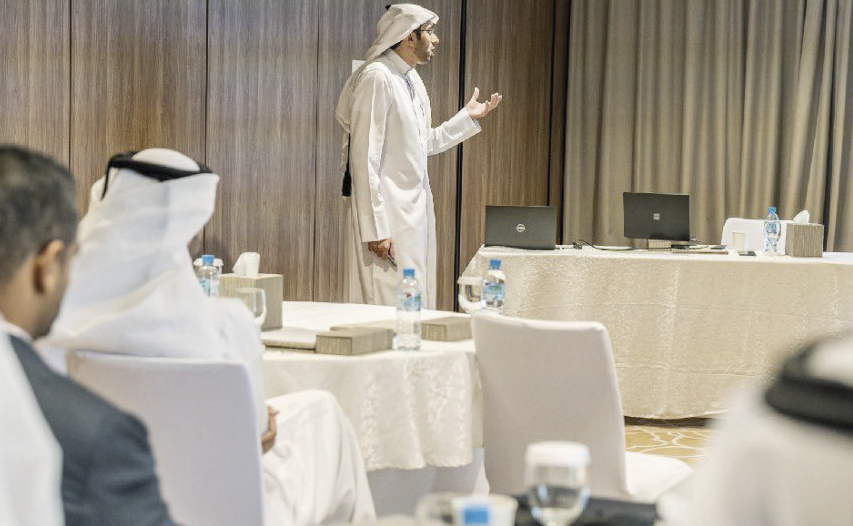
An MoJ official presents key data findings to attendees.
DOHA: The Legal and Judicial Studies Center at the Ministry of Justice (MoJ) witnessed its trainee enrolment surge by 16.4 percent year-over-year to reach 1,100 male and female participants in the first half of 2026, compared to 945 participants registered during the same period last year.
According to performance data released yesterday by the Ministry, the growth in human capital was matched by a 34.8 percent expansion in specialised programme offerings, with 62 training programmes and specialised courses delivered during the first six months of 2026, compared to the 46 programmes conducted in H1 2025.
The strong mid-year metrics reflect MoJ’s broader strategic push under Qatar National Vision (QNV) 2030 to build robust institutional capacity and modernise legal qualification across the state’s public and private sectors.
Driven by digital adaptation and expanded community engagement, the report underlines the ongoing strategy to modernise judicial capabilities and build institutional capacity across Qatar.
Dr. Abdullah Hamad Al-Khalidi, Director of the Legal and Judicial Studies Center at the Ministry of Justice, emphasised that the implementation of modern technology has been central to this momentum. “The Center has succeeded in leveraging digital transformation to expand the reach of its programmes and enhance their community impact, while continuing its mission in training, qualification, and spreading legal awareness,” Al-Khalidi stated.
In addition to core classroom and technical training, the Center saw higher output in legal academic publishing. The Legal and Judicial Journal published seven major research papers, representing a 40 percent growth in published academic studies over previous periods. The report also reveals an intentional pivot away from traditional, venue-bound outreach toward multi-channel digital distribution.
Rather than confining educational content to physical classrooms, the Center adapted to flexible remote formats, producing 28 specialised digital awareness materials. These included 15 informational videos, six infographics and posters, and seven technical reference pieces.
This digital strategy expanded the Center’s reach across nine distinct societal segments, serving target groups ranging from primary and secondary school students to public sector workforce members and families. Public engagement peaked through media partnerships, notably the digital show ‘Bi-Ikhtisar’ broadcast on Al-Sharq platforms, which generated over 12 million views and digital interactions in the first quarter of the year alone.
By taking advantage of broad-reach platforms, including digital channels, local youth clubs, and major cultural gatherings such as the Doha International Book Fair, the Center successfully scaled its public legal literacy efforts across the country.
Additionally, the Ministry is set to intensify its emphasis on developing innovative legal education initiatives that foster deeper public understanding and facilitate greater access to justice. This proactive approach is expected to further strengthen legal culture in Qatar, promote ethical standards, and support the nation’s goals under QNV 2030.