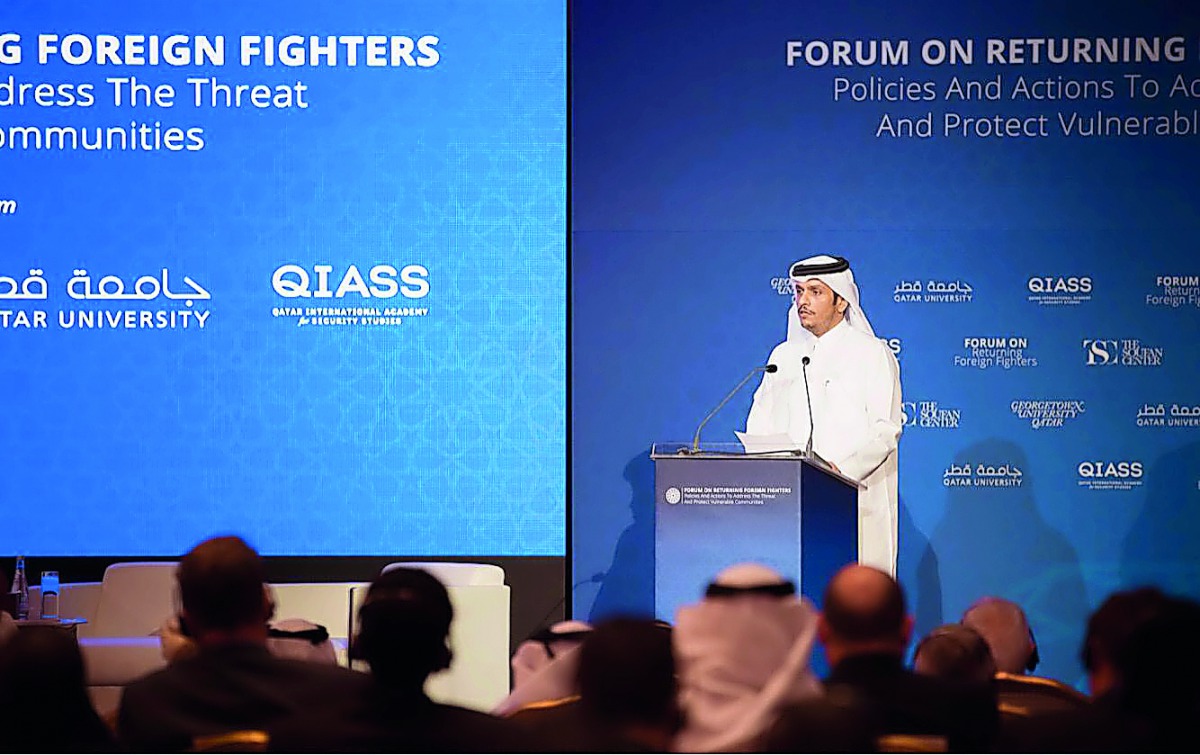
Deputy Prime Minister and Minister of Foreign Affairs H E Sheikh Mohamed bin Abdulrahman Al Thani addressing the opening of the Forum on ‘Returning Foreign Fighters’.
DOHA: Deputy Prime Minister and Minister of Foreign Affairs H E Sheikh Mohamed bin Abdulrahman Al Thani has affirmed that Qatar is an active partner in international collaboration against terrorism.
The Deputy Prime Minister pointed out that the issue of terrorism is a high priority for the State of Qatar, pointing to the continuous development of its national legislations and its related institutional entities against terrorism, and the implementation of United Nations resolutions in this regard as well as its active involvement in the international coalition against terrorism.
In a speech during the opening of the Forum on ‘Returning Foreign Fighters’, the Minister of Foreign Affairs said terrorism in all its forms and manifestations is one of the most serious threats to international peace and security, describing any terror act as a crime, regardless of the motives or identity of the perpetrators, including acts motivated by intolerance, extremism or otherwise.
He added that terrorism cannot be confronted and eliminated unless the international community united its efforts through a persevering and inclusive approach based on cooperation and participation among all States, international and regional organisations, civil society organisations and academic and research entities, in addition to the need for the international community to abide by international law and abandon the policy of double standards in the fight against terrorism.
The Minister of Foreign Affairs pointed out that the reports of the United Nations indicate that the common factors to foreign fighters, whether they are from the Middle East, Asia or Europe, are that most of them are young people who lack the ideology of right thinking.
They belong to oppressed communities or economically isolated, they lack livelihood opportunities and education, and they have weak job opportunities.
He stressed that terrorism cannot and should not be linked to any religion, nationality, civilisation or ethnic group, and it is important not to confuse terrorism with legitimate resistance, stressing the need to renounce recourse to State terrorism under the guise of combating it.
In his speech, he pointed out that the increasing use by terrorists and their supporters of communications technology to spread extremist ideology that leads to terrorism and recruiting others to commit and incite acts of terrorism require intensifying cooperation between States to prevent terrorists from exploiting technology, communications and resources in inciting support for terrorist acts.
The Deputy Prime Minister underlined that addressing the threat posed by foreign terrorist fighters requires comprehensively tackling the real causes of terrorism, particularly repressive and sectarian policies,
marginalisation and the absence of social justice suffered by large groups in some societies.
The Deputy Prime Minister stressed that the success of any national strategy to integrate returning terrorist elements from the battlefields required the eradication of the incubation environment of extremist ideology and building the State capacity to prevent and combat terrorism, with full respect for the State’s obligations towards the rule of law and human rights.
He added that there is no doubt that the process of rehabilitating the returning fighters and reintegrating them into society requires a comprehensive approach that corrects misconceptions about the violence, extremism and terrorism, and addresses the political, social and other causes.
The two-day Forum will discuss many topics and policies in dealing with foreign fighters as well a the international community’s cooperation in tackling this phenomenon, and the importance of this issue to the entire world at the present time, in addition to exchanging views and ideas among the participants and proposing solutions.