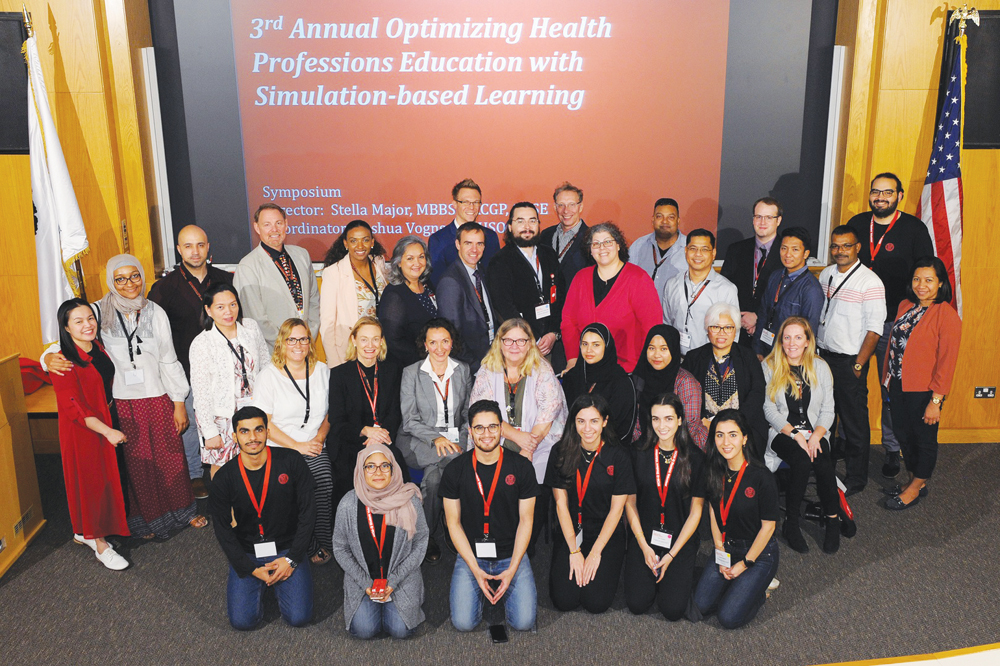
Experts on simulation-based education with healthcare practitioners pose during the WCM-Q symposium.
Experts in simulation-based medical education (SBE) convened at Weill Cornell Medicine-Qatar (WCM-Q) to share their knowledge at the college’s third annual SBE symposium.
Medical professionals from several healthcare institutions in Qatar participated in the event, with speakers from WCM-Q, Hamad Medical Corporation, Sidra Medicine, Qatar University’s Colleges of Medicine and Pharmacy, Sidra Medicine, University of Calgary in Qatar and College of the North Atlantic – Qatar.
Together, these expert facilitators form the multi-institutional Qatar Simulation Consortium, which was established to enhance the teaching of simulation-based medicine through the promotion of evidence-based best practices.
Simulation-based education utilizes a wide range of hi- and low-tech learning aids and artificially created scenarios to allow medical students to learn and perfect and variety of key practical skills in a safe environment.
The theme of this year’s symposium was ‘Institutional Culture and Academic Journeys’, with a strong focus on helping attendees cultivate a culture of positivity towards simulation-based education in their home institutions.
This was based on feedback from the previous two symposia, in which participants noted they faced barriers to the implementation of SBE, such as limited resources, time, skilled staffing, as well as technical skills such as debriefing and scenario writing, among others.
To assist them in prioritizing their needs, and in planning to promote a culture of change, the Simulation Culture Organizational Readiness Survey (SCORS) was selected as the appropriate survey tool to be used in the workshop. In total, 86 physicians, nurses and allied health practitioners completed the SCORS survey, with the resulting data then analyzed in groups of 12-14 with support from a trained facilitator.
This allowed the participants to identify the challenges they faced and list priorities for change, such as importance of transparency, open communication (both top-down and bottom-up), documenting commitment for change, considering sustainability, and planning to ensure appropriate manpower, space and budget.
The event benefited from the participation as a speaker of one of the world’s leading experts in simulation-based medical education, Professor Debra Nestel, Professor of Simulation Education in Healthcare, Monash University, and Professor of Surgical Education, Department of Surgery, University of Melbourne, Australia.
Speaking at the event, Prof. Nestel highlighted the importance of faculty development for the implementation of SBE and also discussed the critical need for a framework for procedural skills training. She also emphasized the importance of ensuring that, in order to optimize the learning of clinical skills, teaching strategies must incorporate steps that include elements to engender the development of both cognitive and psychomotor skills.