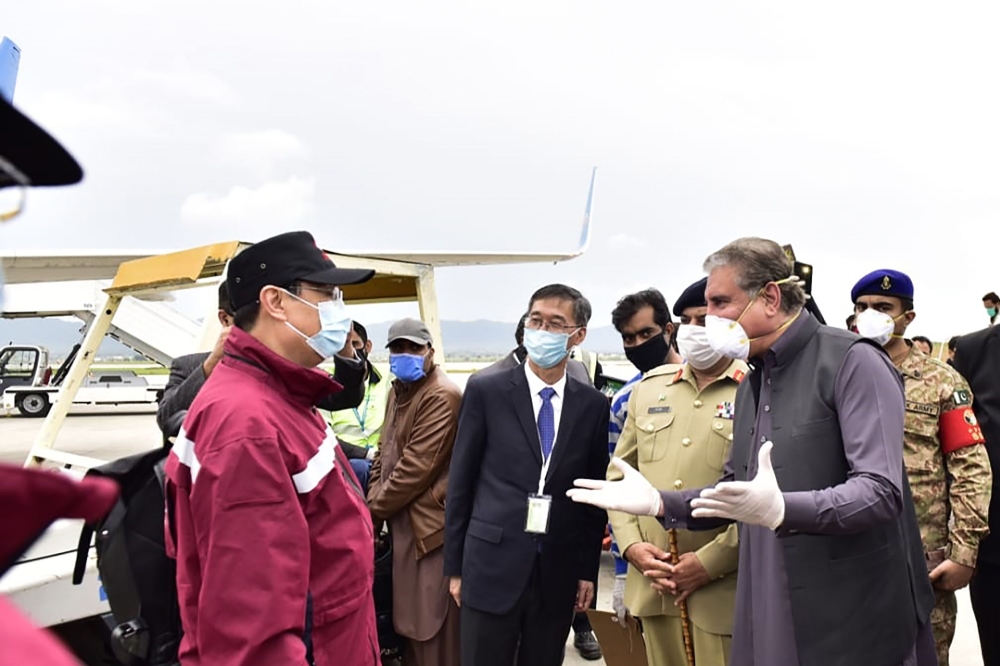
In this handout photograph taken and released by the Pakistan's Press Information Department (PID) on March 28, 2020, Pakistan's Foreign Minister Shah Mehmood Qureshi (R) greets Chinese doctors upon their arrival at the Islamabad International airport in
Islamabad - China has sent a plane loaded with medical personnel and supplies to aid Pakistan in the fight against the spread of the coronavirus in one of the world's most populous nations, the Pakistani foreign ministry said Saturday.
Across the Middle East, the outbreak has raised concerns that health systems strapped by multiple wars, refugee crises and unstable economies won't be able to handle a growing numbers in cases.
Iran is battling the worst outbreak in the region. Iranian state TV raised Saturday that the virus death toll by another 139 people, pushing the total fatalities to 2,517 amid 35,408 confirmed cases.
China has sought to portray itself as a global leader in the fight against the outbreak, which began a few months ago in its Wuhan province. The plane carrying aid to Pakistan was expected to arrive later Saturday.
Pakistan is a key link in China's ambitious multi-billion-dollar One Road Project linking south and central Asia with China. China is also a key military supplier for nuclear-armed Pakistan, having supplied the country with missiles capable of carrying atomic weapons.
Pakistan, with a population of 220 million, currently has 1,321 confirmed cases of the virus, including 10 deaths from the illness it causes, COVID-19. Most of the infected people there were travelers returning from neighboring Iran.
Most people infected by the virus only experience mild symptoms, such as fever and cough, and recover within a few weeks. But the virus can cause severe illness and death, particularly in older patients or those with underlying health problems.
Pakistan has closed its borders with both Iran and Afghanistan, but has come under widespread criticism for its initial lax response to the virus.
Even as the pandemic spread to the country, Pakistani authorities allowed tens of thousands of Islamic clerics from around the world to congregate for three days outside the eastern city of Lahore. Some 200 of the clerics are now quarantined at the site of the gathering, a sprawling compound belonging to an Islamic missionaries group, Tableeghi Jamaat.
Many of the visiting clerics at the conference returned to their home countries, some of them carrying the coronavirus. The first two reported cases in the Gaza Strip attended the three-day gathering in Pakistan, and are now under quarantine in Gaza. Other linked cases have emerged elsewhere in the Middle East and Central Asia.
Pakistan's Prime Minister Imran Khan has refused to impose a countrywide lockdown saying it would devastate the country's poor, but ordered non-essential businesses closed, including restaurants, money changers and wedding halls.
As of Saturday, the government still had not ordered mosques closed nationwide, instead relying on recommendations to worshippers not to gather for weekly Friday prayers.
The southern Sindh province has imposed a wider lockdown, but without closing mosques. In the eastern Punjab province, only groceries and pharmacies are open.