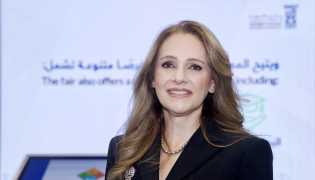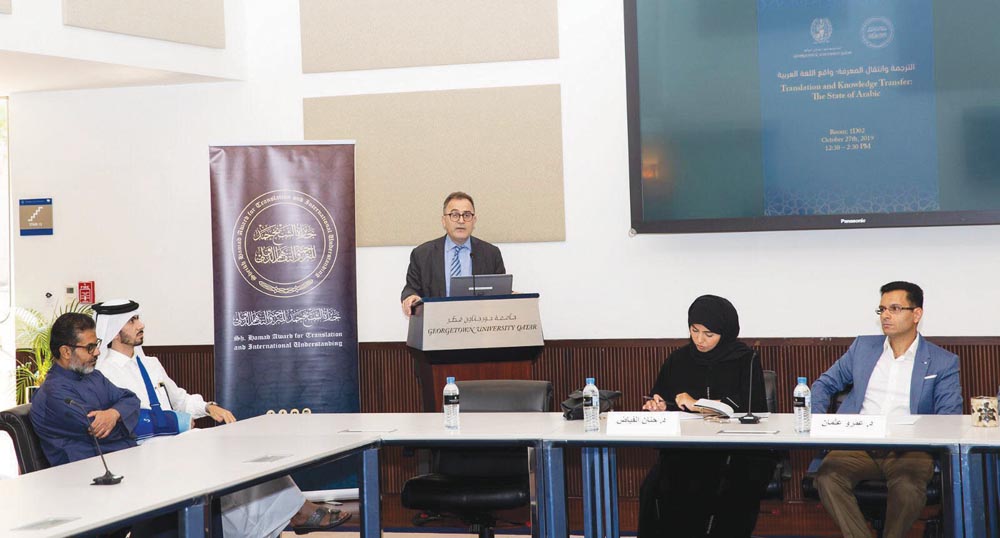
Participants during the Translation and Knowledge Transfer symposium.
Georgetown University in Qatar (GU-Q) yesterday organised a symposium entitled “Translation and Knowledge Transfer: The Reality of the Arabic Language” in cooperation with the Sheikh Hamad Award for Translation and International Understanding.
The event attracted participation of selected academics in the field of translation. Dr. Ahmed Dallal, Dean of Georgetown University in Qatar, stressed the importance of translation as a means of bridging the gaps between cultures and considering translation as one of the most accurate indicators of the renaissance and progress of nations.
“However, this along the need of nations to preserve their identities and special characters,” he said, noting that despite the leading role of nations and languages throughout history, the Arabic language remained for centuries among those languages which have long been a wellspring of science and knowledge.
He pointed out that Georgetown University in Qatar is interested in qualifying its students and developing their linguistic abilities even if translation is not their profession.
The pivotal role played by the Sheikh Hamad Award for Translation and International Understanding is to honour distinguished and competent translators, encourage serious intellectual creativity and celebrate cultural diversity.
The seminar was moderated by Dr. Mahmoud Al Asheeri, Director of the Arabic Language and Culture Program at Georgetown University in Qatar.
During the seminar, Dr. Hanan Al Fayyad, Media Adviser to the Sheikh Hamad Award for Translation and International Understanding, spoke about the role of translation as a means of breaking up conflicts and eliminating ignorance of other actors in the world.
She also talked about the details of the annual award, the judging criteria, the selection of winning works according to the accuracy and style of the translation as well as the value of the translated work.
Dr. Imtenan Al Smadi from Qatar University also spoke about the institutional support for translation as well as importance of intellectual activity, and reviewed the role of cultural and political institutions throughout history in supporting translation. “Translation contributed to linking the Arab world with the cultures of others and pushes the prosperity movement to continue.”
For his part, Dr. Mubarak Hanoun, Professor of Linguistics at Qatar University presented a paper entitled “The Linguistic Terminologies and Stakes of Scientific Communication: First Introductions”, in which he explained that the delivery of scientific knowledge requires the integrity of the terminology.
The interpreter, Dr. Alaa Al Jabali, Director of the Language Center at the Doha Institute for Graduate Studies, addressed the field of simultaneous interpretation and its importance in communication at various levels, including cognitive and political interactions.
Al Jabali also reviewed the series of mental processes experienced by the interpreter and the total decisions that he has to make during the translation process. He highlighted challenges facing interpreters, including working conditions and tools, time factor and cultural context, pointing to some differences between the work of a translator and the work of an interpreter.
Dr. Amro Osman, Associate Professor at Qatar University, addressed the problem of translating long and complex sentences that abound in intellectual works.