

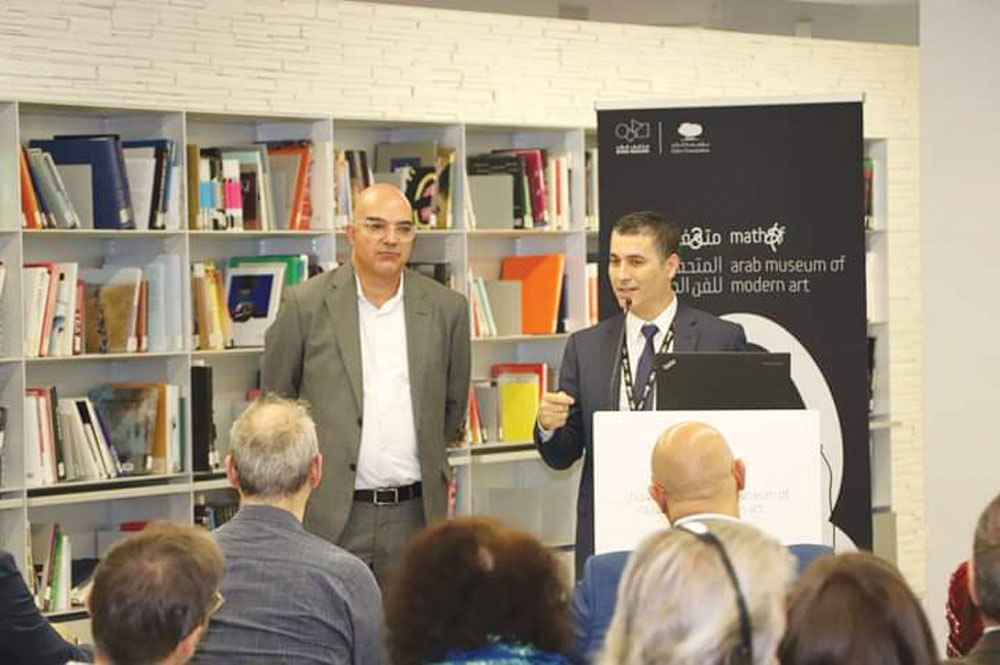
Abdellah Karroum (right), Director of Mathaf and Dr. Ismail Nashif, Professor of Sociology and Anthropology at the Doha Institute for Graduate Studies, during the opening of the three-day conference titled “Art Schools: Histories and Trajectories” at Math
Mathaf: Arab Museum of Modern Art and the Doha Institute for Graduate Studies (DI) yesterday wrapped up a three-day conference titled “Art Schools: Histories and Trajectories”.
The conference focused on fine arts institutions as well as the marginal avant-garde groups that emerged in response to the multiple developments in art theories and innovative artistic practices around the globe.
The first day of the conference took place at Mathaf Library in Education City – Qatar Foundation and continued for two days at the Doha Institute Amphitheatre.
The first day of the conference opened with Ebrahim Alkazi, an autodidact and creator of Para-Academic Spaces in 1950s Bombay and Ranjit Hoskote, a poet, cultural theorist and curator based in India as keynote speakers. The session was moderated by Brian Edwards, Dean of Tulane University, New Orleans.
Sessions on an opening day included “Changing Art Schools: A comparative institutional perspective” and “Building Institutions: Experiences, Critiques and Lessons.”
Commenting on the event, Abdellah Karroum – director of Mathaf, stated: “We are pleased to host the 2nd annual conference in collaboration with our colleagues at Doha Institute for Graduate Studies. This edition examines the varying historical and institutional formations of art schools, and the emergence of movements around new and disruptive ideas. These experiences have shaped the fine arts field in their respective regions and continue to be important case studies for the modern questions we face today. This year’s conference is also an opportunity to discuss the circulation of knowledge and ways of connecting the faculty research and museum practice.”
For his part, Dr. Ismail Nashif, professor of sociology and anthropology at the Doha Institute for Graduate Studies, said: “The radical transformations in Arab societies in the last decade necessitate that we think about artistic expressions and how to deal with art in its broadest sense – particularly its role in these transformations. Hence, we need to shed light on artistic schools and the pioneering and marginal groups that formed their antithesis in the modernist era. We also need to ask ourselves: how can art be taught today after the transformations that have swept Arab societies? Is the structural relationship between the Center and the Marginal, Institutional and Avant-garde still generating capacity at present in our societies? What about artistic community productions?”
The second day of the conference opened with a keynote lecture titled “Art Institutions in Modern Iran: Reflecting or Resisting Avant-gardism” followed by sessions on “Ways of Teaching: Schools, Movements, Styles” and “Center/Periphery: Deconstructing Binaries in Art Schools and Movements.”
The final day opened with a keynote lecture titled “Organic Connectors: Art Dynamics, New “Intellectuals” and Schools of Thought in Morocco” and concluded with a session on “Interdisciplinary Art Teaching and Practices.”
Developed as part of an ongoing dialogue between Mathaf and DI, the conference aimed to open avenues of discussion to a wide range of professionals, practitioners, and thinkers.







