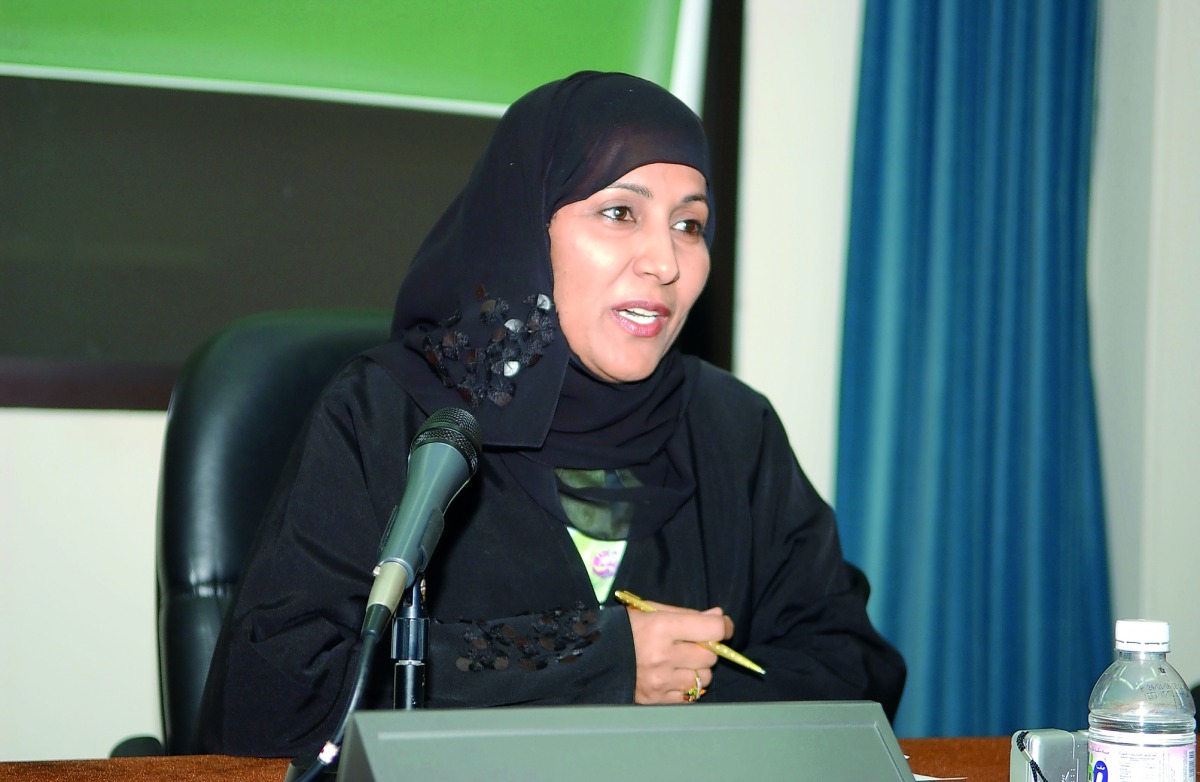
Dr Aisha Al Manai, Vice-Chair of the Doha International Center for Interfaith Dialogue.
Doha: Dialogue is the only and most optimal solution for all issues of mankind although there are many other challenges due to the absence of democracy and freedom of opinion and belief, said the Vice-Chair of Doha International Center for Interfaith Dialogue (DICID) in an interview recently.
Dr Aisha Al Manai, who is the Vice-Chair of the Doha International Center for Interfaith Dialogue (DICID), is also a researcher, an academic, and a woman addressing inter-faith dialogue.
During her interview, she emphasised that there is no doubt that dialogue is of utmost importance at all times and in all places until the final hour. “I have always believed, and still do believe, that dialogue is the only and most optimal solution for all issues of mankind. It is true that Allah, The Almighty, has the distinguished man with reason, logic, and thinking, but did not save him from error in thought and opinion”.
Therefore, mankind is in the direst need of discussion and dialogue which is one of our most distinctive characteristics she stressed.
She said dialogue serves the benefit of all people everywhere as a conflict of interests and purposes, and the absence of dialogue in many cases inevitably leads to conflict; which is detrimental to everything and destroys relations between individuals and countries.
Al Manai placed a strong emphasis on the necessity of dialogue for people in general. To her, the absence of democracy and freedom of opinion and belief, in addition to intransigence, are among the most important challenges to dialogue. Furthermore, the so-called male-centred communities create an additional challenge for a woman because she is not engaged in the dialogue due to mistrust in women’s capabilities.
She continued saying that challenges include intolerance of sect and doctrine, narrow-mindedness, and misunderstanding of the concept of dialogue among Muslims and non-Muslims. Also, the refusal of acknowledging the right of difference in opinion, but rather seeing differences as dispute and hostility.
Also, presently, the media contributes significantly and clearly in thwarting the effort of dialogue. It has become a great instrument of affliction and igniting clashes and conflicts. From among the obstacles of dialogue, a mention may also be made of mistrust and doubt between the participants in dialogue and the attempt to vindicate oneself at the expense facts, peace, and security.
In regard to the current political crisis in the Gulf, Dr Al Manai believes that the crisis is an indication of the absence of mechanisms of dialogue between the brothers and due to a political or economic benefit the blockading countries. She pointed out that Qatar was accused of terror and put under a political, economic and even social blockade. All this bears the same violence and terror which they claim to fight. “This is a fact in which there is no doubt. All parties of the crisis to be subject to dialogue, the crisis would have found no place and brotherhood and love would have been maintained between the brothers”.
Regarding the role of women in the dialogue so, to me, woman’s role in the dialogue, and participation in decision making is of the most important and the greatest aspects of the civilisational behaviour of any nation.
The woman is a guardian and educator. If she believes in something and is convinced of it, it is instilled in the minds and hearts of her children. They have a wide range of acceptance, openness to others, and broadmindedness to accept dialogue.
One of the most important challenges for women in the field of dialogue, according to Dr Aisha Al Mania is the so-called male-centred communities which hinder women from being engaged in the dialogue due to mistrust in their capabilities.
“In my view, the mission of engaging women in dialogue, and instilling the importance of dialogue should come from the supreme authorities in any country. It depends on what is called democracy in our contemporary concept which different countries have adopted in their constitutions and laws.
The faculties of Shariah differ in their curricula from country to country although the basic topics are the same. Adopting dialogue is subject to all curricula to the teacher and his thinking and ability to accept the other. That is why the teacher is of great importance and significance in the faculties of Shariah, because he is the educator and tutor, and it is he who runs the curriculum in many cases according to what he likes. So, there is a necessity to put criteria and goals that serve religion and its purposes in its call for tolerance, peace, justice, and freedom, but without ruining its principles over which there is no difference.
Answering question on the role of DICID, Dr Al Manai said the Center is still is serving, the state’s civilisational trend and Qatar’s National Vision 2030 in its different tracks especially in the area of social development.
“Throughout my experience in interfaith dialogue, I see that the Center, with its full staff and teamwork, presents the correct vision of Islam’s relationship with other religions”.
Moreover, I have found that the Center has been a representative of soft diplomacy in all its activities inside and outside the country through its objectives, vision, belief in combating extremism and terror with all its forms and kinds.