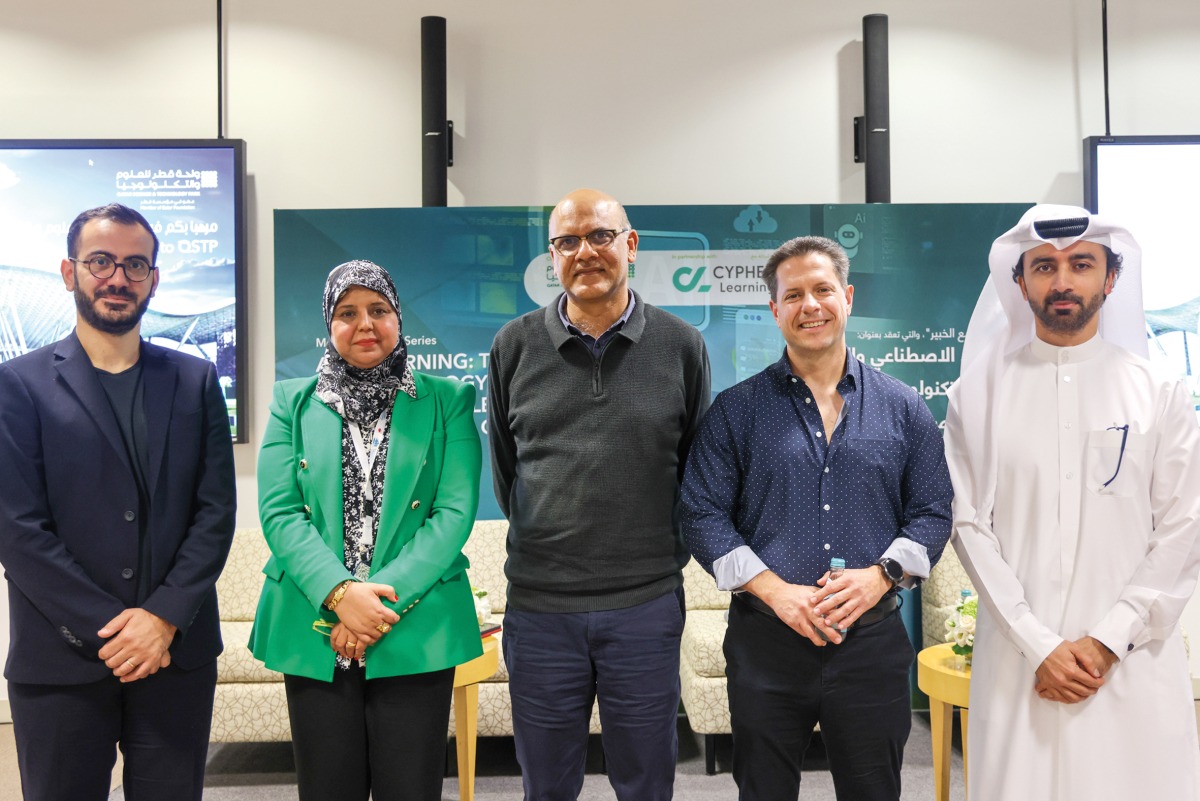
From left to right: Johnny Karam, Dr. Mayamin Altae, Dr Sanjay Chawla, Iyad Jabri, and Essa Al Jamali during the event organised by QSTP, recently.
Doha, Qatar: The role of artificial intelligence (AI) in academic and professional learning was in the spotlight at the latest edition of ‘Meet the Expert’ series organised by Qatar Science & Technology Park (QSTP), a member of Qatar Foundation.
Led by CYPHER Learning, a QSTP member company, the panel discussion gathered experts from academia and industry to examine AI’s potential in enhancing learning outcomes for individuals within education and work environments. The session helped develop a broad understanding of the implications of AI for education by evaluating the benefits and concerns around this technological advancement.
Speaking at the session, Iyad Jabri, Chief Technical Officer and General Manager, CYPHER Learning, highlighted that the company is working in strategic partnership with Qatar’s Ministry of Education and Higher Education to advance AI in learning across public schools in Qatar. Its platform (Q-education) has been deployed at local schools since early 2022 and has yielded notable benefits for educators and learners.
“One of the fundamental advantages of AI is mirrored in its value to personalize learning – whereby educators can customize the learning journey of each student based on their individual needs using insights from AI-centric platforms,” Jabri underlined.
“We are currently in the process of releasing solutions that will help teachers by automating tasks, allowing them to save effort and time and essentially be more productive. Our focus is also on empowering students through this technology to be in greater control of their learning journey and advance at their own pace.”
Sharing her perspectives, Dr Mayamin Altae, Assistant Professor in Educational Technology & TESOL, Assessment and Accreditation Coordinator, Qatar University (QU), mentioned that, for teachers, such technology provided greater access to relevant data and insights which could be used to efficiently assess each student’s progress and modify lesson and assessment plans accordingly. Speaking about the ways in which QU is supporting students to embrace new technologies, Dr Altae said that technology has become the fifth basic skill that students are being taught after reading, writing, listening and speaking.
Also part of the panel was Dr Sanjay Chawla, Senior Research Director, Hamad Bin Khalifa University (HBKU), who spoke about the area of generative AI – an AI technology that generates new types of content based on a variety of user prompts. He drew attention to the issue of language complexity when interacting with AI-based models, noting that sometimes the generated content may lack relevance.
Dr Sanjay highlighted that efforts are underway in the region, including within HBKU, to build Arabic Language Learning Models that incorporate different dialects to allow users in the region to generate digital content in Arabic. Johnny Karam, Regional Education Solutions Specialist, Microsoft, stressed the importance of continuous innovation in developing AI-powered tools to ensure wider impact. Giving the example of Microsoft’s Copilot, which increases workplace productivity through generating emails, presentations, meeting minutes, among other tasks, Karam pointed to AI’s potential for bringing about solutions that benefit individuals and organisations across business and learning environments. He also highlighted Microsoft’s role in bringing generative AI to the masses as part of its commitment to empowering startups and businesses with the latest technologies.
Essa Al Jamali, Relationship Manager, QSTP, commented, “Adopting novel technologies necessitates an understanding of its implications – ethically and socially. With AI’s growing influence on various aspects of human life, it is paramount to discuss and evaluate how this technology advancement can be deployed in education and learning spaces to improve learners’ capabilities and complement creativity and innovation. Through such sessions, QSTP is excited to foster dialogue around important topics which will hopefully encourage more scientific research and collaborations.”