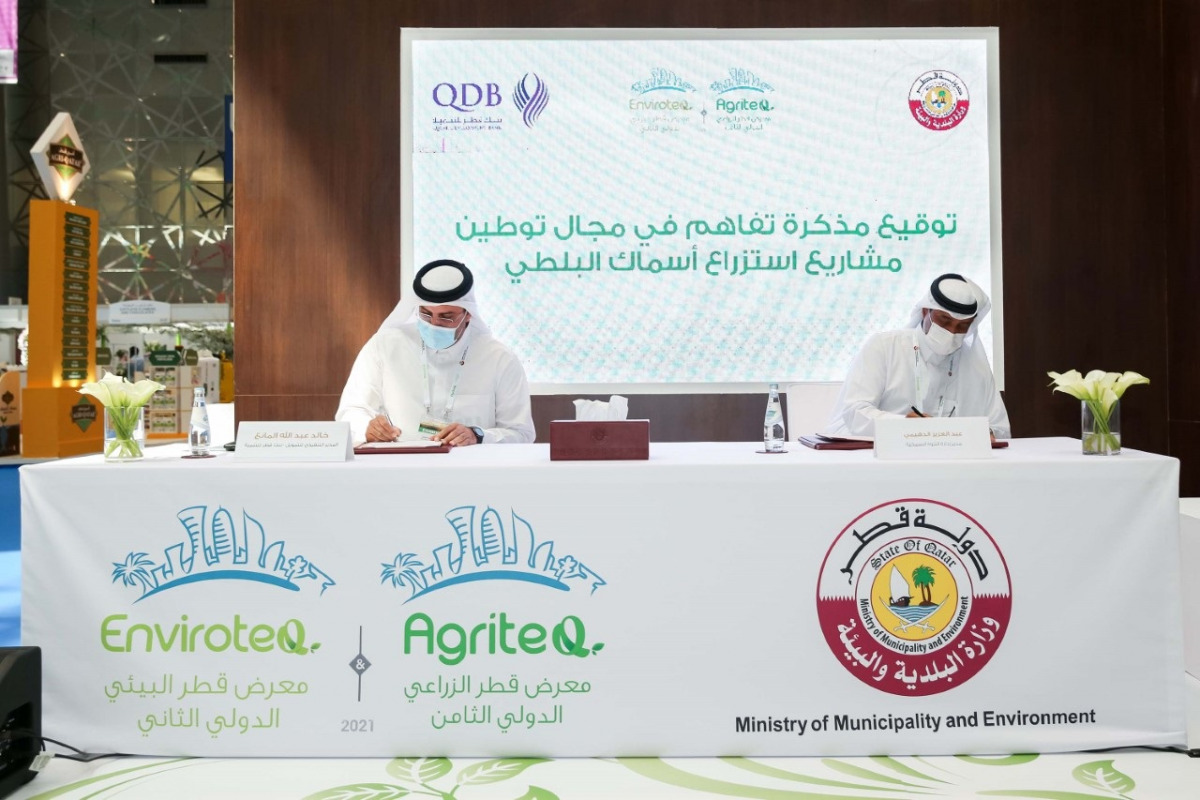
The Ministry of Municipality and Environment signed a memorandum of understanding with Qatar Development Bank (QDB) to launch an initiative to encourage the production of Tilapia
The Ministry of Municipality and Environment (MME) has signed a number of contracts and agreements with some concerned authorities in the country to enhance food security and achieve self-sufficiency in strategic commodities.
The signing took place on the sidelines of the ongoing 8th Qatar International Agricultural Exhibition and the 2nd Qatar International Environmental Exhibition at the Doha Exhibition and Conference Center.
The Ministry signed a memorandum of understanding with Qatar Development Bank (QDB) to launch an initiative to encourage the production of tilapia, by giving farmers an opportunity to establish productive projects within farms registered in the country, and with concessional financing from Qatar Development Bank.
The initiative includes establishing two projects for the production of tilapia fish with a production capacity of about 310 tonnes per project per year, with a total production of about 610 tonnes per year, which contributes to achieving about 70 percent of the country’s self-sufficiency of this type of fish, as these two projects are subject to full technical support from the specialists at the Ministry of Municipality and Environment.
The two projects will give farmers an opportunity to improve their production by taking advantage of the integrated farming system between plants and fish together, relying on fish residues to feed the plants to obtain healthy vegetables that are free of chemicals.
In a statement on this occasion, Director of the Fish Resources Department of the MME Abdulaziz Al Duhaimi affirmed the Ministry’s keenness to adopt projects that support the programs of the National Strategy for the Development of the Fisheries and Aquaculture Sector, and enhance the food security of these products.
For his part, Executive Director of Business Finance at QDB Khalid bin Abdullah Al Mana said that this initiative is the result of joint efforts between the Ministry of Municipality and Environment and the QDB to rely on national energies in the production of this strategic food commodity to achieve self-sufficiency and reduce dependence on imports, pointing out that the QDB seeks, in accordance with its ambitious strategy, to achieve a high rate of self-sufficiency in various productive sectors.
The MME, represented by the agricultural sector, also signed an agreement on contracts for 9 projects for breeding and fattening local sheep and goats, with nine private companies in five complexes: Al Wakra, Abu Nakhla, Al Kharib, Al Khor, and Simaisma, at the rate of two projects in each complex, where each project is on an area of 50,000 sqm.
The initiative to establish sheep breeding and fattening projects aims to achieve the highest possible rates of production according to the highest international standards and to use the best scientific methods in raising local sheep and goats, as well as the ability to collect male sheep from producing farms in the country and fatten them with a focus on the distinct types of them.
The projects will use the best environmental technology and methods to achieve the maximum possible efficiency in the use of resources, while ensuring environmental sustainability. Each project includes establishing the pens necessary for breeding, the pens needed for fattening, a slaughterhouse, a unit for fermentation of manure, in addition to stores for the production requirements of fodders and others.
Director of the Animal Resources Department of the MME Abdulaziz Al Ziyara explained that the MME continues to work towards achieving its goals and implementing its plans for increasing local production of red meat, stressing that offering these projects to the private sector will contribute to achieving food security and increasing the self-sufficiency of this material. The Ministry of Municipality and Environment, represented by the agricultural sector, signed an agreement to implement contracts for three agricultural projects to produce green fodder using treated wastewater, with three private companies to produce about 10 thousand tonnes per year, at a production rate of up to 20 tonnes per year per hectare each.
Plots of land for these projects have been allocated in three areas: Al-Karaana, with a total area of about 1.5 million sqm and Bu Glaila, with an area of about two million square metres, and Aba Al Hiran, with an area of about three million square metres. Projects to produce green fodder using treated wastewater are one of the important and vital projects that support food security due to the increased demand for it.
Assistant Director of the Agricultural Affairs Department of the MME Adel Al Keldi Al Yafei said that projects to produce green fodder using treated wastewater aim to cover the needs of the local market, noting their role in preserving groundwater by reducing dependence on groundwater and moving to use treated wastewater. The local market’s annual consumption of green fodder is about 215 thousand tonnes, while the total production is 115 thousand tonnes annually, with a self-sufficiency rate of 54 percent.
These strategic projects are expected to cover about 10 percent of the domestic consumption gap, as the green fodder production in the State of Qatar will reach about 125,300 tonnes per year.
Meanwhile, the Ministry of Municipality and Environment and the Qatar Livestock Society (Anaam) signed a memorandum of understanding to launch an initiative to rehabilitate and afforest the mobile farms in the country, with the aim of contributing to preserving the environment and intensifying the vegetation cover with wild tree species from the Qatari environment.
Under the initiative, the Qatar Livestock Society plays an awareness and advisory role to educate livestock breeders on the importance of developing nurseries through afforestation and planting wild plants, and the Ministry of Municipality and Environment, on its part, will provide appropriate wild trees and seedlings and provide technical and advisory support on methods of cultivation and plant care.
Assistant Deputy Minister for Agriculture and Fisheries Sheikh Dr. Faleh bin Nasser Al-Thani stated that the initiative, which was launched in cooperation with the Anaam, aims to support the Ministry’s efforts in promoting environmental sustainability by increasing the green area and developing nurseries.
Assistant Undersecretary for Environmental Affairs, Eng. Hassan Jumaa Al Muhannadi said that launching this initiative contributes to preserving the environment, mitigating global warming and the effects of pollution, combating desertification and limiting grazing degradation by promoting an increase in vegetation cover and an increase in biodiversity that protects wildlife.