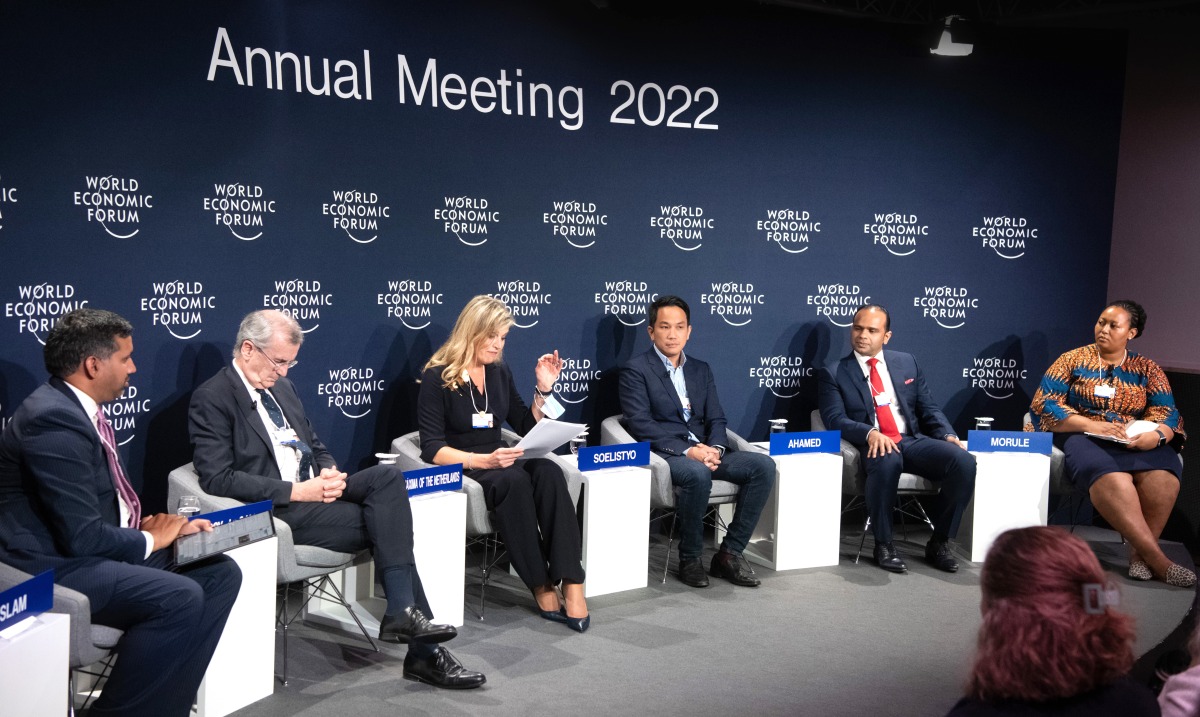
Adeeb Ahamed, Managing Director at Lulu Financial Group with other experts and officials during a session on ‘Financial Inclusion: Addressing the Largest Gaps’ at the World Economic Forum Annual Meeting 2022 in Davos-Klosters, Switzerland, yesterday.
Doha: Financial inclusion remains the first step towards personal and business wellbeing and is a pre-requisite to meet several goals under the United Nations Sustainable Development Goals. Despite this, over half the world is yet to gain equitable access to finance and this remains one of the biggest challenges facing the world today.
The World Economic Forum (WEF), which is driving forward the agenda of stakeholder capitalism, has consistently focused on financial inclusion and the role it plays in helping communities thrive.
This all-important topic was a subject of discussion on the second day of the ongoing WEF at Davos, with several global stakeholders convening to discuss the issue.
H M Queen Máxima of the Netherlands opened the session raising a question on the need for public and private stakeholders to fully understand the purpose of financial inclusion and evaluate how it can result in better financial health of an individual.
Karabo Morule of Capital Art, South Africa, brought up the subject of financial literacy as a key element of driving better use of access to finance. Her call for financial literacy finds relevance in various research studies which show a significant correlation between financial inclusion and financial education. In fact, developing countries today report a financial literacy level of as low as 30 percent compared to the average of 60 percent in developed economies.
Against this background, Morule spoke of how financial literacy would encourage people to invest in insurance, especially among the underprivileged and marginal groups.
Her thoughts on connecting the underprivileged with prudent products was echoed by Adeeb Ahamed, whose company, LuLu Financial Holdings, is involved in the cross-border remittances and micro-loans segment. With over 1.1 billion people worldwide locked out of formal financial channels due to lack of a verifiable identity, Adeeb took the examples of India’s Aadhar scheme and UAE’s Wage Protection Scheme to drive home the need for better traceability of consumer spending. According to him, this is important to complement awareness about products suited to the needs of the under-served. Adeeb also suggested that while digitisation has its inherent benefits, financial institutions should remember the emotional aspect at the grassroots level and accordingly bring in a personalised touch to their services to ensure last-mile consumers are onboarded efficiently.
Gelsomina Vigliotti of the European Investment Bank, which works with several developing economies on grassroots level projects, further mentioned that access to finance should come with adequate skill training and development so that the money is utilised properly. Merely gaining financial access doesn’t guarantee growth but having a strong business case to deploy it makes the difference, she added.