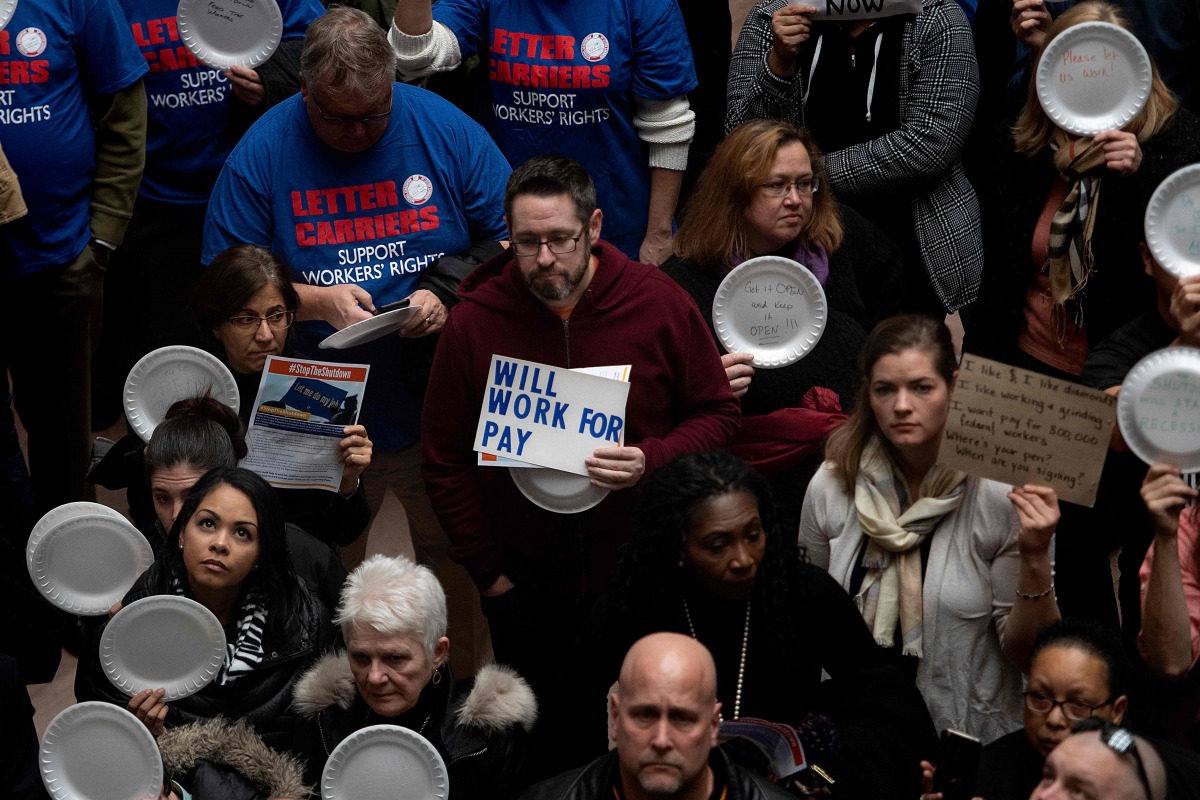
A federal worker stands with a placard reading "Will Work For Pay" as other federal employees stage a rally to call for a vote on the shutdown on Capitol Hill in Washington, DC, on January 23, 2019. AFP / Jim Watson
President Donald Trump would agree to temporarily reopen the government if Congress provides a 'large down payment' for a border wall, his spokeswoman said, as senators discussed a new compromise effort after blocking two rival proposals to end the 34-day partial shutdown.
Senate Majority Leader Mitch McConnell and Minority Leader Chuck Schumer met privately in McConnell’s office Thursday to discuss a path forward. GOP Senator Lindsey Graham said he hoped a deal could be reached after he spoke with the president about a bipartisan proposal to fund the shuttered federal agencies for three weeks.
'As was made clear to Senator Lindsey Graham, the three-week CR would only work if there is a large down payment on the wall,” White House spokeswoman Sarah Huckabee Sanders said, referring to a stopgap spending bill.
Graham said such a measure may have to contain some additional provisions to satisfy both sides.
"If we can get in a room, we can fix this, and it won’t take three weeks,” said Graham of South Carolina.
Minutes earlier, the Senate rejected two proposals -- one by Trump and one by Democrats -- intended to reopen the government. They were the first votes the Senate has taken on funding the government since the Dec. 22 start of the shutdown, now the longest in modern U.S. history.
'We will not Cave!' Trump tweeted a few hours before the votes.
The Democratic proposal attracted two more votes than the Trump-backed Republican plan, but both fell well short of the 60 needed to advance.
After meeting with McConnell, Schumer exited, smiling. 'We’re talking, we’re talking,' he said.
At the same time, a bipartisan group of 16 senators -- eight from each party -- took to the chamber’s floor to say they want to reopen the government for three weeks to allow time for work on a bipartisan border security deal.
'I think we can do this together,' said Republican Senator Lisa Murkowski of Alaska, a leader of the effort. 'But we can’t do it with the government shut down.”
Six Republicans had voted to advance the Democratic bill: Lamar Alexander of Tennessee, Susan Collins of Maine, Cory Gardner of Colorado, Johnny Isakson of Georgia, Lisa Murkowski of Alaska and Mitt Romney of Utah. Three senators, two Republicans and a Democrat, were absent.
Just last month, the Republican-controlled Senate had backed the Democratic measure by voice vote before Trump suddenly opposed it, triggering the closure.
The president late Wednesday acquiesced to House Speaker Nancy Pelosi’s cancellation of his planned Jan. 29 State of the Union address in her chamber until the government reopens. The Treasury Department, Department of Homeland Security and Environmental Protection Agency are closed as Trump fights for his 2016 campaign promise to build a wall at the border with Mexico.
In advance of the votes, McConnell called Trump’s plan a "pragmatic compromise that could end this impasse right away' by getting the president’s signature. He said the Democrats’ temporary measure creates the possibility of a new crisis in several weeks when funding expires.
Schumer said Trump’s proposal was a 'harshly partisan' plan that would give the president all he wants before reopening the government. The Democratic proposal would reopen federal agencies and allow time for negotiations over border security, he said.
The pain inflicted by the shutdown is "getting deeper and deeper every day,” with 800,000 federal employees set to miss another paycheck on Friday, Schumer said.
Trump’s proposal faced strong objections from Democrats who oppose the wall and the plan’s changes in immigration law including new limits on asylum claims by Central American minors.
The Trump bill would ban people under age 18 from El Salvador, Guatemala or Honduras from receiving U.S. asylum unless they apply at a processing center in Central America. That means they couldn’t apply in the U.S. if they fled their home countries due to gang violence, as many have done.
In an effort to gain Democratic votes, the Trump proposal would provide a three-year protection from deportation for young undocumented people enrolled in the Deferred Action for Childhood Arrivals program, or DACA. Similar protection would be given to people from countries like El Salvador and Haiti who live and work in the U.S legally because of civil turmoil or natural disasters in those countries. Trump has sought to end both programs.
However, the DACA extension would leave out hundreds of thousands of undocumented immigrants brought to the U.S. as children. It would protect only those already enrolled in the program, and not other young immigrants who might be eligible.
The White House had said Trump would veto the House-passed short-term measure. Overcoming a veto would require 20 Senate Republicans to vote with all 47 members of the Democratic caucus to reach a two-thirds vote for an override. Thursday’s Senate vote showed support well below what would be needed.
In the House, 237 lawmakers voted for the bill, far short of the 290 needed to override a veto in that chamber.
Attention now turns back to the House, where Democrats say they are preparing to offer a proposal to boost border security -- but not build a wall -- by spending an amount close to the $5.7 billion he wants for the wall.