

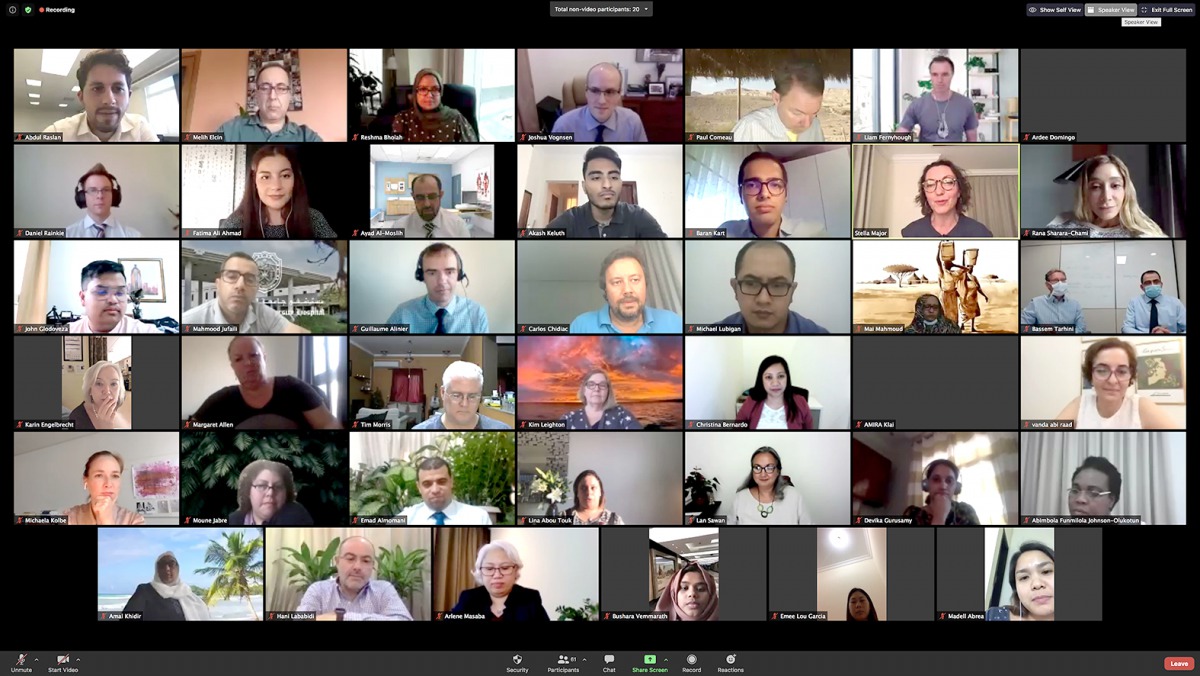
Educators and medical students discussing simulation-based learning during an online symposium coordinated by Weill Cornell Medicine-Qatar (WCM-Q).
Doha: Experts in medical education from across the Middle East and Europe convened for an online symposium hosted by Weill Cornell Medicine-Qatar (WCM-Q) to discuss the latest trends in simulation-based learning, including the impact of the COVID-19 pandemic.
The 4th annual symposium on Optimising Health Professions Education with Simulation-Based Learning: Psychological Safety in Times of COVID-19 was held fully online for the first time.
In another first for the symposium, course director Dr. Stella Major, Associate Professor of Family Medicine in Clinical Medicine and Director of the Clinical Skills & Simulation Lab (CSSL), extended its community of practice to include participants based in countries beyond Qatar, these being Lebanon, Oman, Turkey and KSA. Invited scholars and educators shared their stories reflecting on how simulation-based education and practice had helped the profession prepare for and respond to the emergent clinical demands of the pandemic.
The invited scholars discussed lessons learnt during the pandemic and reflected on the importance of remaining hopeful and resilient, acknowledging that the end-date of the pandemic is difficult to predict and thus the importance for educators and healthcare providers feeling cared for, safe and united, especially in times of physical isolation and prolonged uncertainty.
“We did not want to cancel our annual community symposium and worked very hard to learn how to achieve an interactive, educationally safe and inclusive event using online meetings. We were hugely supported by the excellent audio-visual team at WCM-Q who prepared us well so that we were able to connect with our community remotely,” Dr. Major said.
“Discussing ways to maintain and restore psychological safety during simulation-based-education, and in particular during difficult conversations in debriefing, become even more relevant as we practise with masks and face shields, and in online forums, where interpersonal communication becomes even more challenging,” she added.
The symposium featured a presentation by guest speaker Professor Michaela Kolbe, Director of the Simulation Center at University Hospital Zurich, Switzerland, who is an authority in the field of psychological safety in simulation-based education. Prof. Kolbe said that psychological safety was crucial in simulation-based learning in order to allow learners to speak openly about any difficulties they might be having with an exercise.
“In medicine, and indeed in other industries, we are strongly socialized to want to be seen to be succeeding and discouraged from being open about mistakes. That’s a dilemma because to really benefit from simulation-based training, both learners and educators need to feel safe in order to open up and discuss sub-optimal performance. This type of psychological safety is an extremely powerful tool for enabling fruitful learning experiences,” she said.
A key part of the event symposium was an interactive workshop that used video materials created by the WCM-Q Clinical Skills & Simulation Lab to demonstrate how to promote and restore psychological safety during the debriefings that follow most simulation-based learning experiences.
Medical students from Qatar, Lebanon and Turkey also attended the symposium and reflected on their experience as learners during the pandemic lockdown period.







