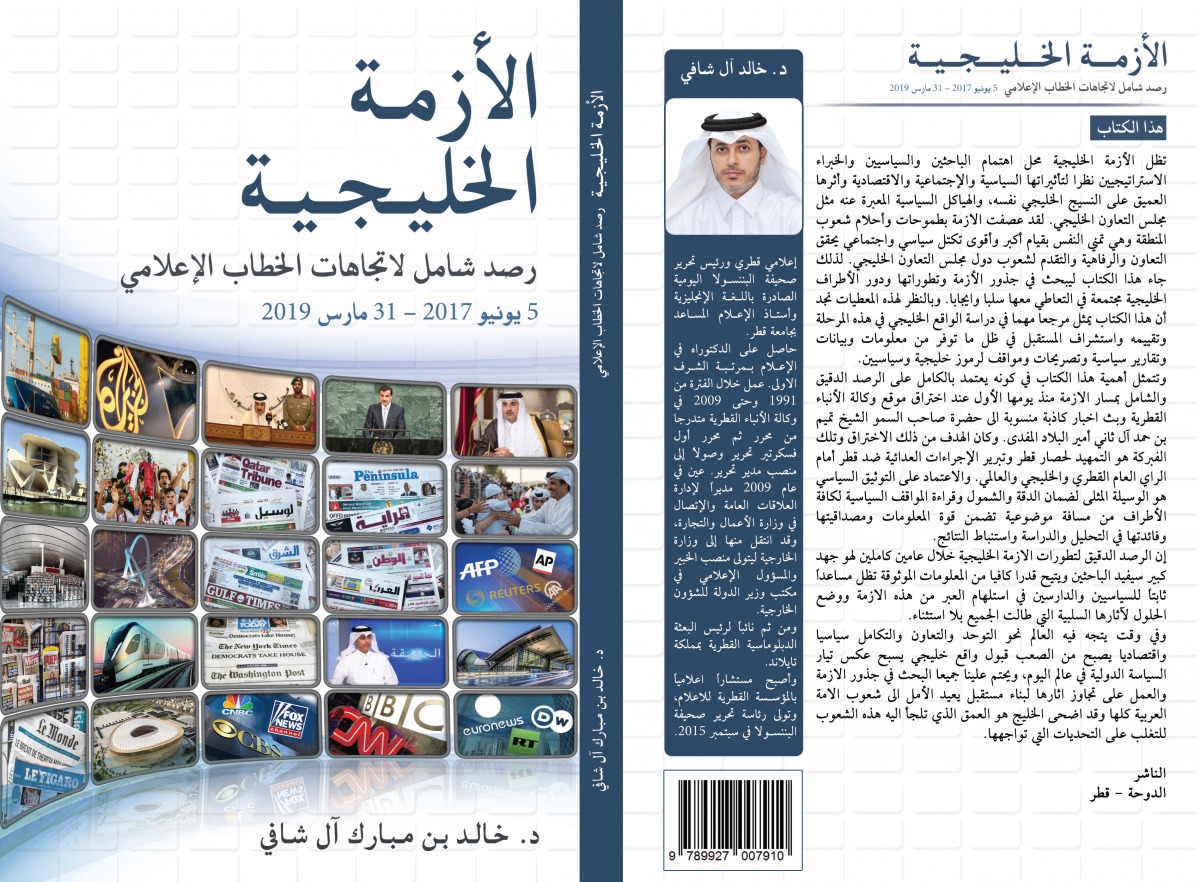
Doha: Dr. Khalid bin Mubarak Al Shafi, Editor-in-Chief of The Peninsula Newspaper, who is also Assistant Professor of Mass Communications at the Qatar University, recently published a new book titled ‘The Gulf Crisis: A Comprehensive Monitoring of Media Trends’.
The book includes seven chapters which span over 390 pages and discusses the issues of the unjust siege imposed on Qatar. The author has relied on more than 30 international media references including print, video, audio and digital media as well as modern applications and community journalism.
The book is a combination of monitoring, documentation, analysis, commentary and careful research on local, regional and international media trends and discourses and their impact on the public opinion. It presents the country’s position on the Gulf crisis and how it was addressed by decision makers, opinion leaders and how the Qatari media have defended its homeland in the face of campaigns aimed at distorting the political and social fabric of the Gulf at this sensitive situation in the region.
The book monitored the developments of the events from June 5, 2017 to March 31, 2019, presenting valuable materials for researchers, observers and experts wishing to conduct further studies on the current Gulf crisis.
The researchers will find a study of Qatar’s positive and honest positions in confronting the siege countries without insulting and abusing national figures or trying to influence the unity of the Gulf, an outstanding and mature position which will be acknowledged by generations and positively counted for the people of Qatar and H H the Amir.
This is a sensitive crisis that will remain in the memory of the generations for the unjust siege imposed on the State of Qatar.
The author has divided the book into seven chapters, beginning with studying the media policy of Qatar under the siege. In this section, the author has mentioned that the speeches of Amir H H Sheikh Tamim bin Hamad Al Thani, during the siege, played the role of general guidance for the public and the media in Qatar.
The social media was also praised for its commitment to the general position of the state, staying away from using false and fabricated news, deception and abuse of national figures.
The second chapter examines the political dimensions of the Gulf crisis, its motives and measures used by the blockading countries.
This chapter is an in-depth study of what happened during the crisis and how the world dealt with it, including political and media reactions and the positions of international organisations and activists.
The third chapter discusses the effects of the siege on the social fabric of the Gulf, based on the accurate reports that covered the social damage resulting from the siege, which included citizens, residents and citizens of the siege countries. This also includes complaints filed in international courts, human rights organisations and United Nations organisations.
In the fourth chapter, the author has highlighted the international positions which showed support to the State of Qatar, and which are worth documentation and study, because it reflects the most prominent evidence of the validity of Qatar’s positions and the justness of its cause.
The Qatari position has played the most prominent role in winning international public opinion alongside Qatar.
The strategic economic plan of Qatar is addressed in chapter five and it discusses how Qatar managed to deal with the potential economic effects of the blockade from the first moments of the crisis, which strengthened the ability of the state to withstand the siege.
In chapter six, the author has discussed the role of Qatari media, in its various institutions, documenting its trends, achievements and how it challenged the allegation of the blockading quartet, on the basis of objectivity, credibility and loyalty to the country.
Chapter seven reviews the World Cup Qatar 2022 and its relationship to the crisis and why siege countries attacked Qatar’s hosting of the World Cup and the reactions of the International Federation and international media institutions to the positions of the siege countries against the World Cup and the victories achieved by Qatar in this aspect. The book summed up with a set of conclusions which are useful for the Gulf media without exception.
The media of the siege countries have been fighting in this battle for two years and have been involved in a lot of serious mistakes, most notably the state of confusion, subordination and the repetition of lies and accusations. The results of this book are the culmination of the author’s effort to monitor the phenomenon and study the resulting facts, trends and developments.