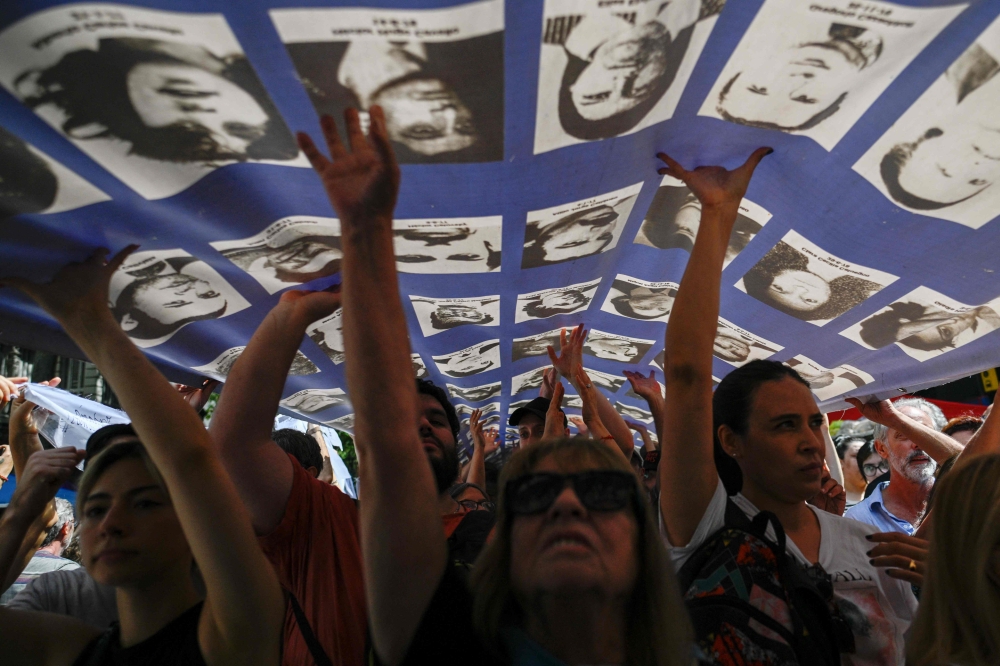
Hundreds hold a large banner with portraits of people who disappeared during the military dictatorship (1976-1983) while heading to Plaza de Mayo Square to commemorate the 48th anniversary of the coup in Buenos Aires on March 24, 2023. (Photo by Luis ROBAYO / AFP)
Buenos Aires, Argentina: As Argentina on Sunday marked the most traumatic date in its modern history - the 1976 military coup that ushered in a brutal dictatorship - President Javier Milei posted a startling video that demanded justice. Not for those who suffered in the "dirty war” under the junta, but for those victims of leftist guerrillas before the putsch.
Milei posted the video as thousands filled the streets of Buenos Aires to commemorate the 48th anniversary of the coup and the seven years that followed when as many as 30,000 people were killed or were forcibly disappeared in a systematic campaign that still haunts the country.
The video by the president, a far-right economist who took office in December, referred to "the other dead” before the coup, part of a contentious effort by the government to change Argentina’s memory of its recent history.
Opponents see the cause as equating guerrilla violence with state terror, justifying the junta's repression of anyone deemed subversive.
"FOR A COMPLETE MEMORY SO THAT THERE IS TRUTH AND JUSTICE,” Milei wrote on X Sunday with the video, which featured a cast of obscure figures - a woman who lost her father and sister to guerrilla violence, a repentant leftist militant and a former intelligence official - all discussing the dictatorship's repression in the context of a wider war.
"Those responsible for these crimes cannot go unpunished,” posted Vice President Victoria Villarruel. Her caption: "It wasn’t 30,000.”
Before becoming Argentina’s polished and powerful vice president, Villarruel was best known as a fringe activist who paid prison visits to military junta leader Jorge Rafael Videla, challenged human rights groups’ estimate of 30,000 disappeared people, and founded a nongovernmental organization championing victims of leftist militants.
Her uncle, Ernesto Guillermo Villarruel, was accused of committing crimes against humanity in a clandestine detention center.
Her extreme views, once dismissed by Argentines united in pain over their country’s memory, are now being discussed in mainstream circles, cracking a consensus that has held through Argentina’s 41 years of democracy.
"This is the first time I’ve seen a government defying the narrative we’ve had for decades,” said 46-year-old Matias Reggiardo, one of 500 Argentines born in captivity and stolen as an infant from his dissident parents before they were killed by the military. "It’s terrifying to find people in Milei’s government cast doubt on our stories.”
There is also alarm that changing how the country understands its dictatorship could put the rallying cry of democratic Argentina - "Nunca Mas,” or "Never Again” - at risk.
"Our society is being confronted with the question of its future - whether the era of human rights under which we lived for 40 years is coming to an end or not,” said Gaston Chillier, a human rights lawyer.
"It’s a global trend,” he added, referring to far-movements that gained momentum with former U.S. President Donald Trump and Jair Bolsonaro of Brazil, a defender of his country’s military dictatorship.
For years, human rights groups have lauded Argentina as a beacon of progress in settling accounts. Unlike Brazil and Chile that buried their past, Argentina has investigated crimes and imprisoned generals.
The leftist governments of Nestor Kirchner and his wife, Cristina Fernández de Kirchner, in the early 2000s advanced Argentina’s historical reckoning.
The Kirchners revoked pardons granted to junta members and converted the country’s most notorious clandestine detention site, the Naval Mechanics School, into a UNESCO-recognized Museum of Memory.
"In the world they have settled the discussion regarding what happened in Argentina during the last civil-military dictatorship," Cristina Kirchner posted Sunday on X, formerly Twitter, addressing "those who still refuse to reflect.”