

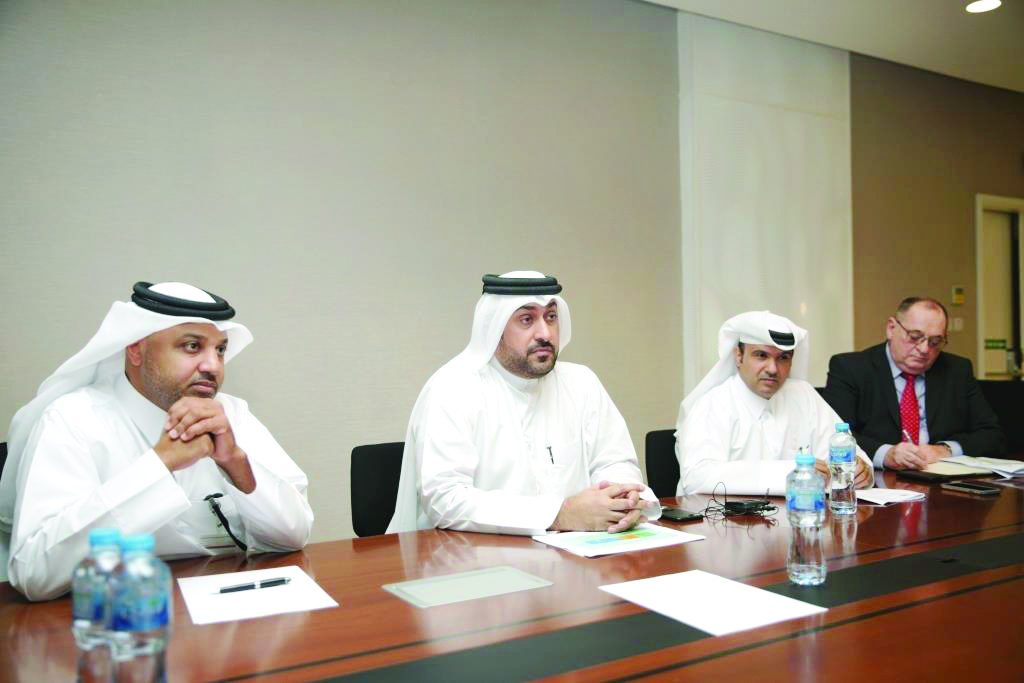
From Second Right: Khalid Saif Al Khayareen, Drainage Networks Projects Department Manager, Khalid Al Obaidli, Assistant of Drainage Networks Operations & Maintenance Department and Abdulla Saad Al Saad, Public Relations & communications Department Manage
The Public Works Authority (Ashghal) has reached about halfway in its ambitious project to grow a man-made-forest with 95,000 trees in an area of 12 square kilometres around its huge sewage treatment plant in Umm Salal Ali, north of Doha.
The QR3.6bn Doha North Sewage Treatment Works (STW) project also includes two artificial lakes close to the man-made forest, which will have 16 different varieties of flora.
So far 40,000 trees have been planted and the remaining are expected to be completed by the second quarter of next year, said a senior Ashghal official during a media trip to the facility yesterday.
A first-of-its-kind in Qatar, the forest is likely to be opened to the public once trees are fully grown and necessary services like roads and walkways are developed to serve the visitors. “We started planting trees in October last year. We will plant more trees now since the planting season has started. We have hired a private company. Plants that are suitable to the desert climate have been imported," the official told The Peninsula on the sidelines of the trip.
“The forest aims at reducing the carbon emissions by releasing more oxygen to the air to minimise the impact of the treatment plant. Special technology is being used to control the odour,” he added.
Different types of trees, some of them brought from different parts of the world, which are appropriate to the desert environment, will be planted; reeds and shrubs will be cultivated and an artificial lake will be established.
Once the planting process within the landscaped area is completed, the desert area surrounding Doha North STW will be transformed into a man-made forest.
Trees have been carefully selected as they do not consume water in large quantities, and a variety of flowering trees were planted to line the entrance roads to the STW.
After the construction of the permanent roads leading to the Treatment Works and the vegetation reach the required size, the possibility to open the landscaped area to the public to enjoy the greenery and watch the types of trees will be studied.
Whenever it is opened, the visitors can watch the artificial lake that was created as part of the beautification and landscaping works around the station, where high quality treated water is pumped into it.
The Doha North Sewage Treatment Works is a strategic project in Qatar. It was completed in December last year, and was in full operation after it had all inspection and testing needed by all concerned entities and authorities in July 2016.The plant receives raw sewage from Doha North main pumping station (PS 70) for treatment. The plant produces high quality treated effluent for non-potable use, such as irrigation of public parks and landscaped areas, reducing the reliance on drinking water supply.
The plant catchment extends to Umm Slal area, 25 km north of Doha and includes Al Kheesa, Al Khariatiyat, Al Duhail and the Pearl and Lusail developments to the east.
Phase one of the works is designed for a peak capacity to treat wastewater of up to 244,000 cubic metres per day and will serve a projected population of over 900,000 (in the year 2020).
This modern facility features advanced biological treatment processes as well as ultra-filtration membrane, which separates large particles and small granules from the water, and then it uses ultra-violet technologies to produce high quality reclaimed water for re-use, such as treated effluent for non-potable use.
The facility is equipped with a thermal drying plant that processes the wastewater sludge, generated during the treatment process, to pellets for safe disposal, all in accordance with international standards. The facility is also the first to have the comprehensive odour control system to minimise the impact on the surrounding environment.
The final completion of all landscaping and beautification works in the area surrounding the STW will be completed by the second quarter of 2017.
Plant produces high quality organic fertiliser
The new sewage treatment plant which is part of the Doha North Sewage Treatment Works in Umm Salal Ali produces high quality organic fertiliser from sludge with the capacity of 60 cubic meters per day. “We plan to launch the product in local market in 10kg bags but it needs approval from the Ministry of Municipality and Environment," an Ashghal official briefed media persons during a tour to the facility yesterday. A normal bag carries two cubic meters weighing around 40kg.
“We have large stocks of the fertiliser with huge storage facility. Now the fertiliser is being used inside the facility for growing the trees in the man-made-forest It is not being used for fruit trees and vegetables only for greenery”, he added.
The organic fertiliser is a kind of soil conditioner, said an engineer of the plant. A soil conditioner is a substance produced from organic matter that helps to improve the soil's properties, adding slow-releasing nutrients. It has been naturally composted to destroy any weed seeds.







