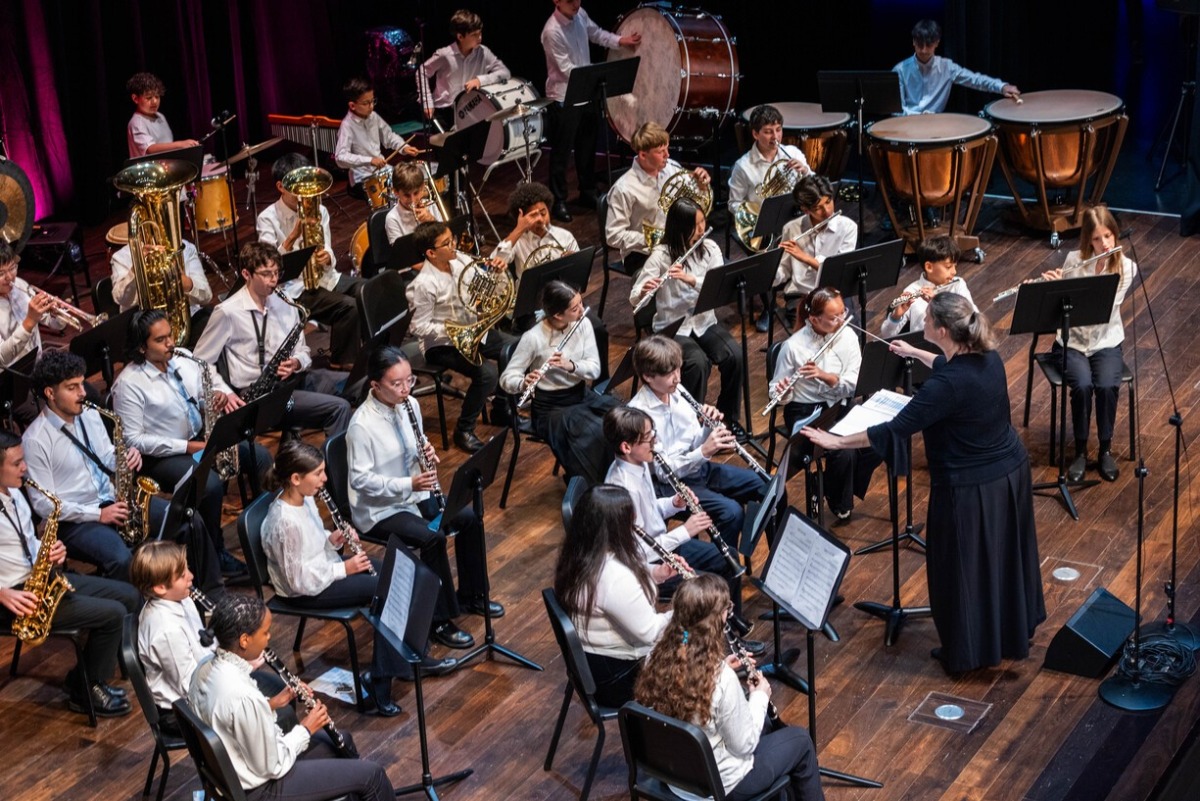
Qatar Foundation’s Qatar Music Academy members performing.
Doha, Qatar: One of the world’s most prestigious seals of approval for musical education has been awarded to Qatar Foundation’s Qatar Music Academy – making it the first institution in the Gulf region to gain this recognition.
MusiQuE (Music Quality Enhancement) accreditation is an independent accreditation body exclusively dedicated to setting global standards for music education and Qatar Music Academy (QMA), part of Qatar Foundation’s (QF) Pre-University Education, now finds itself among elite company that includes institutions dating from the centuries ago.
Based in Katara Cultural Village and established in 2011, QMA provides comprehensive Arab and Western classical music education programmes that nurture talented young musicians to be the next generation of world-class musicians, while also researching and helping to safeguard the musical heritage of Qatar and the region. The MusiQuE accreditation will now help to strengthen its international profile and network.
“This milestone affirms Qatar’s capacity to build specialised cultural institutions rooted in local identity, strengthened by academic rigor, and recognised by international standards,” said Head of Western Music, QMA, Dr. Ozgur Mert Esen.
“Since its establishment, QMA has become one of the most distinctive music education institutions in the region. Its importance lies not only in the students it has served or the graduates it has prepared, but in the educational system it has built.
“QMA is a unique institution because it serves a uniquely diverse community. Its students come from different cultural backgrounds and educational systems, and have different musical experiences, learning needs, and artistic ambitions. This diversity has required the academy to move beyond conventional approaches to music instruction and develop responsive pathways for beginners, developing musicians, serious pre-college students, advanced performers, and learners pursuing music as part of their wider personal and cultural formation.
“This has made QMA not only a provider of music education, but an expert institution in developing, adapting, producing, and applying educational models that are distinctive, progressive, and effective.”
Gaining recognition from MusiQuE, Dr. Esen explained, is the culmination of “a seven-year journey” to demonstrate how QMA’s education model, developed for Qatar, met international standards. The accreditation, he said, shows how this model is “not only locally meaningful, but internationally credible”.
“One of the most historically significant dimensions of this achievement is the international recognition of QMA’s dual musical identity,” he said. “QMA brings together Arab and Western music traditions within one education framework. This is not a decorative feature; it is one of our defining strengths.
“The academy has developed professional educational models in both traditions, allowing students to study, perform, progress, and be assessed within structured programmes that respect the integrity of each musical language.
The recognition, says Dr. Esen, makes QMA “a regional reference point for pre-college music education”, and “places Qatar at the forefront of an emerging regional conversation about the future of professional music education, cultural heritage, and artistic excellence.”
The accreditation, according to Head of Arab Music at QMA, Taoufik Mirkhan is a particular milestone for the academy’s Arab Music Department.
“For students, it provides international recognition of their academic achievements and opens broader opportunities for pursuing further education and professional careers on a global scale, while maintaining their connection to their Arab musical identity,” he said.