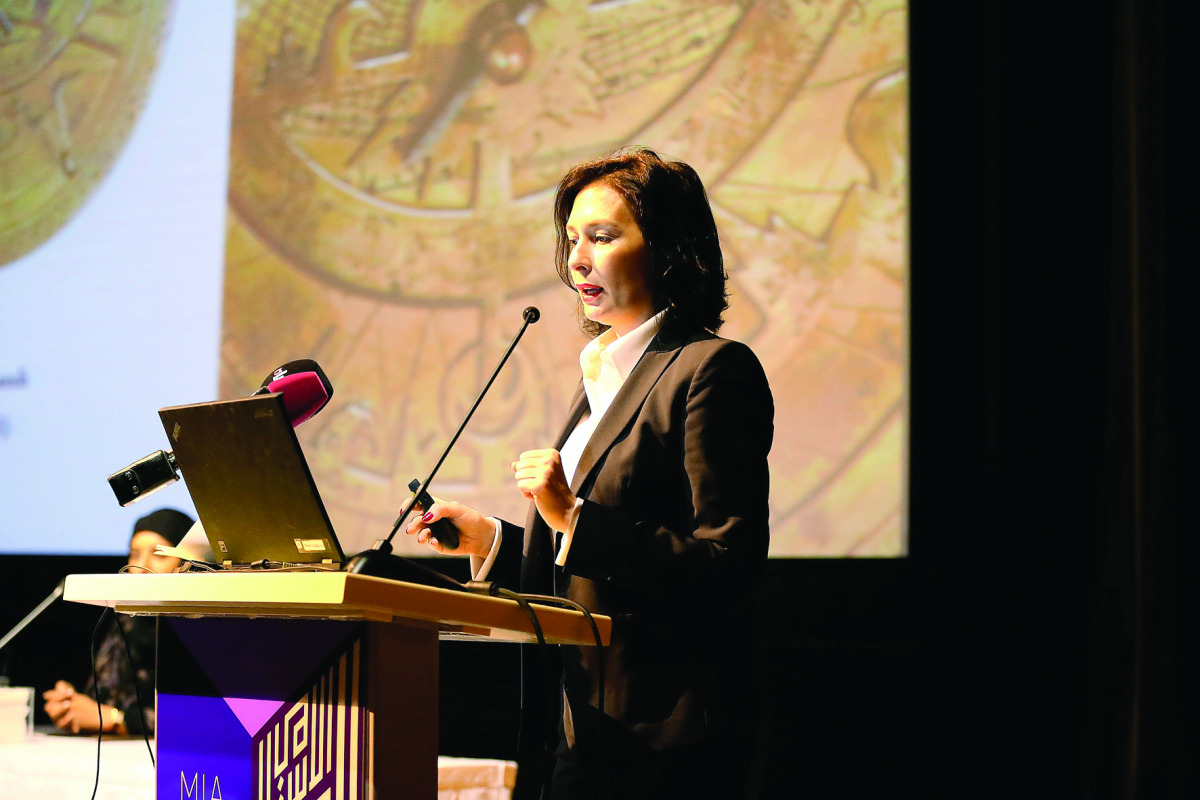
Dr Jelena Trkulja, Director of Education at Qatar Museums, speaking at the first-ever Teachers Council event on Sunday at the Museum of Islamic Art Auditorium.
Museums are a valuable education hub which contain artefacts that can provide numerous learning opportunities across various subjects in the school curriculum, according to an expert. “Museum collections can be great resources for almost all subjects of the school curriculum including art and a variety of other subjects like science, mathematics, languages and religious studies, among others,” said Dr Jelena Trkulja, Director of Education at Qatar Museums (QM).
Trkulja was speaking on “Learning in Museums” before 200 teachers at the first-ever Teachers Council event organised by QM on Sunday at the Museum of Islamic Art (MIA) Auditorium. The event was a step to engage educators more closely with QM for them to take advantage of the organisation’s rich lineup of programmes and resources for schools.
“The Science in Art gallery on the second floor of MIA is a treasure trove for teaching mathematics, astronomy and geography and MIA has one of the best collections of astrolabes in the whole world,” she said while citing the MIA’s Astrolabe collection as an example of a learning resource.
The Astrolabe is a scientific tool used in the Islamic world for many centuries. By measuring the position of the sun and the stars, the travellers could determine the position of their ship or a caravan and thus find their way home. It was also used to determine the direction towards Makkah and the time of prayer, she explained.
“Object-based teaching and learning changes the dynamics of everyday classroom because it brings the children in contact with the authentic artworks and artefacts and this builds a bridge between theoretical learning and real life,” she pointed out.
An ancient jar that can be used in teaching medicine and pharmacy, a textile that covered the door of the Kaaba and an 18th century lithograph of the Kaaba to bring to life the tradition of the Haj, and the gallery of manuscripts with some of the most important books dating back to the dawn of Islamic era to teach the development of Arabic script were among other MIA collections Trkulja mentioned.
“Our other collections are equally rich source of learning. Once our other museums open including the National Museum of Qatar, the Sports Museum, and the Orientalist Museum; opportunities for learning will exponentially increase,” she said.
QM provides student-centred experiential learning which utilises all senses which proves very effective to students remembering better, she stressed.
“There are lots of hands-on activities in which children are invited to build and create things, reconstruct and deconstruct objects and so on. A lot of things we do are very interactive and practical,” she said, adding there is also emphasis on teacher training. “Because professional development through teacher training programmes is something QM is committed to, we’re going to be organising a number of such programmes during this academic year such as a week-long general art history course, single sessions on how to develop lesson plans by using our collection, study sheets and lesson plans to teach modern art and week-long courses in Islamic art, lectures on art in science, art in mathematics, art in cultural studies, art in literacy.”