

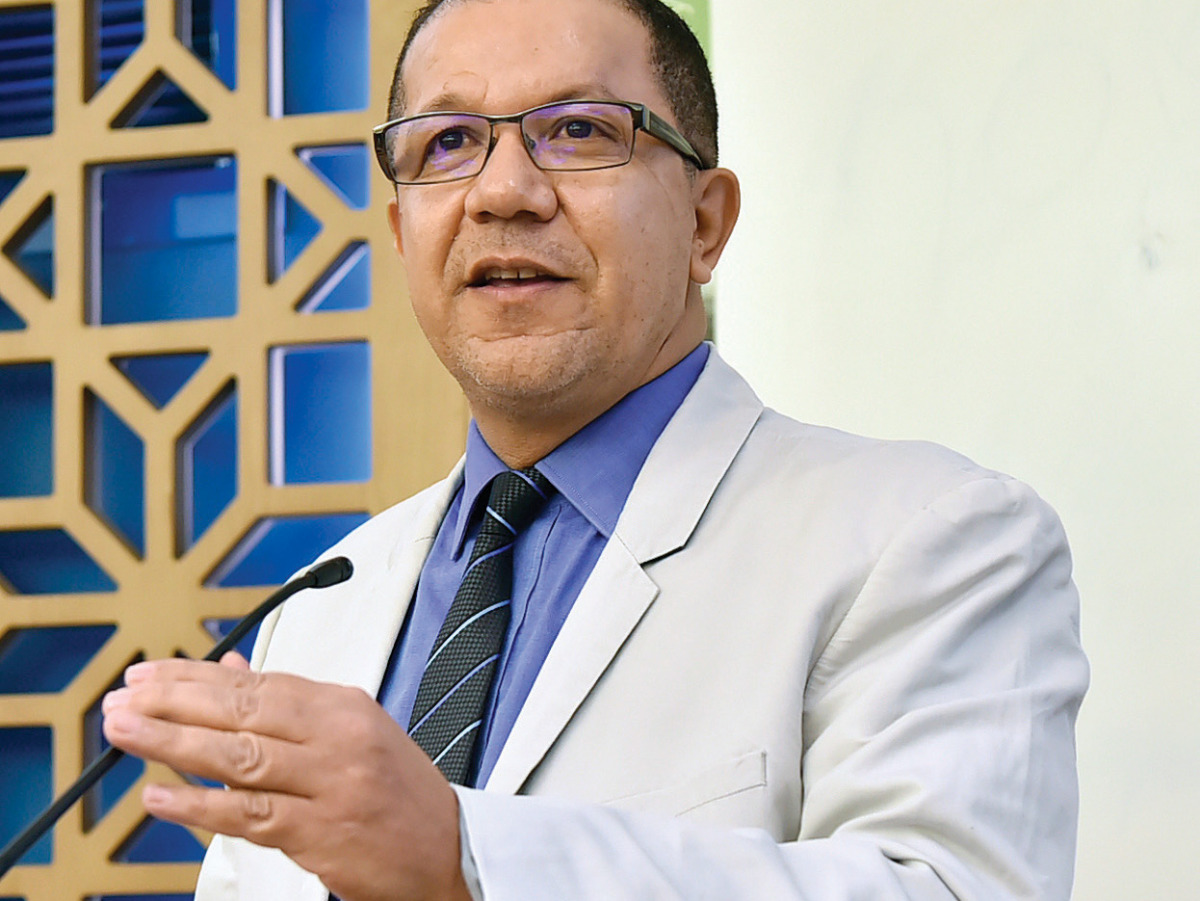
Dr. Kamal Hamidou, Head of the Department of Mass Communication, Qatar University
Doha: The Department of Mass Communication of Qatar University (QU) recently published media research papers by the Department’s professors on the influence and importance of the media on societies worldwide.
Dr. Kamal Hamidou, Head of the Department of Mass Communication at QU, said the research topics are important, as they “respond to the demand for understanding the changes that the media have imposed on the social and cultural systems all over the world.”
Dr. Hamidou added, “With the emergence of societies of the modern era with its rebellious intellectual, social and cultural characteristics that made it distinct from the societies of the previous era. With urbanization and the concomitant predominance of reason and individualism, and the decay of traditional social relations, the world realised the importance of media and communication research.”
Since the beginning of the twentieth century, Dr. Hamidou noted, media and communication research continues to discover and formulate the scientific foundations on which the efficiency of the communication and media process is based, especially in influence, persuasion, and communication.
He added that as this research reached its peak following WW II, “It is witnessing other developments that are accelerating in their content and trends, due to the overwhelming technological dimension, which is imposing media and communication media at the expense of others. Moreover, it is now imposing an updated formulation of the contents, uses, and influence.”
On the increasing importance of such research, Dr. Hamidou said, “It stems from the fact that the media and communication work has become a central link in all societies, whose roles intersect with political and economic action, cultural action, social action, and scientific action.”
Dr. Hamidou said the Department is keen to address research topics that touch on current issues, the last of which was the interest of some of them in preparing research on media dealing with the COVID-19 pandemic.
He added that many of the Department’s professors are interested in issues that stand as a priority to Qatar, including issues of media and identity, media and cultural and social change, new media, whether from the perspective of their effects or the perspective of uses and gratifications employed by the so-called digital generation.
The Department of Mass communication is proud that many of its professors have obtained research grants from the Qatar National Research Fund or other bodies for research proposals that addressed some of the central concerns mentioned, he said.
Among the most prominent researches is a study by Dr. Muhammad Al Amin Al Mousa, Associate Professor at the Department, who highlighted “Determinants of news satellite coverage of the COVID-19 pandemic in the digital era”.
The study was completed during the first months of the pandemic. He focused on how the media deals with global crises in a digital age in which knowledge flows at an unprecedented rate in the world.
Dr. Al Sadiq Rabeh, a Professor at the Department, published a paper titled “Rationalizing the Ethical Practices of Youth in Digital Spaces”. His study investigated the problem of ethical practices presented by digital spaces and their relationship with youth. Its vision is that the key concepts and issues in these interactive spaces lie in identity, privacy, credibility, and participation. It aims to clarify the methods and mechanisms that youth adopt in redefining these concepts and issues and formulating their contents through practice.
In a group book entitled “Press outside the Internet and Corruption”, Prof. Dr. Basyouni Hamada wrote about journalism’s problem and its relationship to the phenomenon of reducing corruption in societies. The book’s cases extend from Cuba to Algeria, India, Saudi Arabia, sub-Saharan Africa, the GCC Countries, the Arab world, and Japan. In another academic study, Dr. Muhammad Al Fateh Hamdi, Assistant Professor at the Department, published a paper that focused on ways to rationalise ethical practices of youth in digital spaces.






