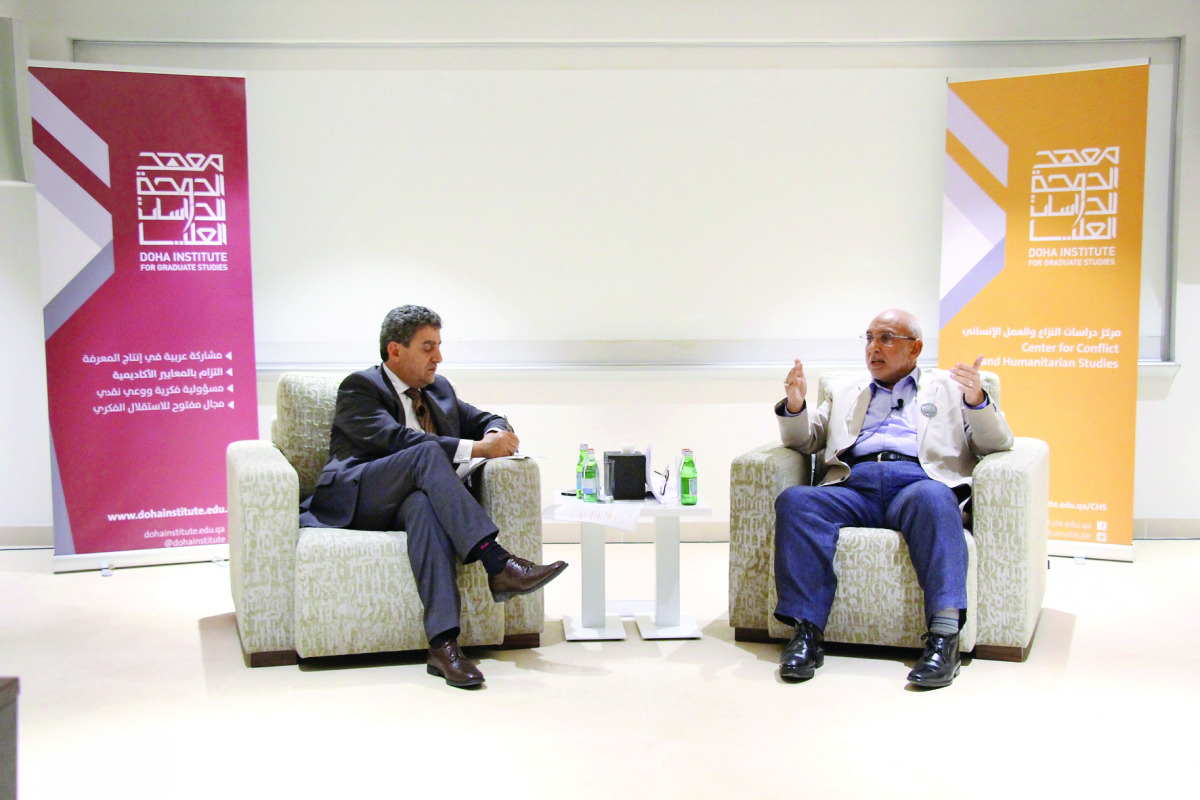
Dr Sultan Barakat, Director of Centre for Conflict and Humanitarian Studies (CHS) at the Doha Institute for Graduate Studies and Dr Hany El Banna, Founder of Islamic Relief and Founder and President of the Humanitarian Forum, during an interaction in Doha
DOHA: Capacity building and civil society engagement have to be part of relief process in order for efforts to be successful, said world renowned humanitarian relief and development expert Dr Hany El Banna.
“At some point we have to move away from aid to development, as people will eventually start to rebuild communities and societies. A very large part of our work deals with successfully coordinating efforts with other organisations, decision-makers, and financiers. Capacity building and engaging civil society have to be a part of the relief process in order for efforts to be successful,” said El Banna.
He highlighted that relief and aid organisations must develop relationships with one another to help beyond the immediate response to individuals as he spoke on “Humanitarian Work in the Muslim World: Lessons Learned and Future Directions.”
El Banna was speaking recently at a public lecture organised by Centre for Conflict and Humanitarian Studies (CHS) at the Doha Institute for Graduate Studies. The event attracted DI students as well as community members interested in humanitarian work and its impact on societies suffering armed conflicts.
With over 30 years experience in delivering Islamic humanitarian aid to people in need in more than 70 countries, El Banna is the Founder of Islamic Relief and Founder and President of the Humanitarian Forum. He is also the Chairman of the Muslim Charities Forum and Zakat House, Board Member of the Centre for Interfaith Action on Global Poverty (CIFA), and an Associate Fellow at the CHS-DI.
During his lecture, El Banna emphasised on the importance of prioritising the people in need of help.
“My boss is the humanitarian group, the refugee, it is not necessarily the donor or the executive. Money is important to our cause, but the priority has always been the person in need. Islamic humanitarian efforts uses faith to inspire our responsibility to help all human beings who are suffering or poor, regardless of their particular background.”
He explained that responding to humanitarian crises involves more than just delivering items to those around us, it also requires research, set standards and political will.
“Presently there are massive amounts of resources in Arab World, but there is a general lack of research in the field of humanitarianism in the Arab countries. This must be improved upon, as the value of research is necessary for governments and organisations to take proper and valuable action to help.”
The next guest for the CHS public lecture series will be Stephen O’Brien, Under-Secretary-General for Humanitarian Affairs on November 2 at 7pm.