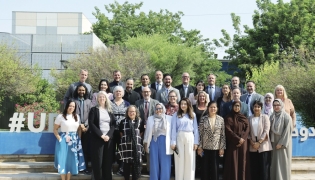
By Sidi Mohamed
DOHA: Prime Minister and Interior Minister H E Sheikh Abdullah bin Nasser bin Khalifa Al Thani yesterday called on all departments and institutions in the public and private sectors to cooperate with the Ministry of Development Planning and Statistics in its quest to complete putting in place a modern national statistical system.
The departments and institutions can provide the necessary data needed to make the right development decisions, taking into account the fundamental principles of official statistics issued by the United Nations and relevant national legislations, particularly maintaining the confidentiality of individual and institutional data, the PM said.
He was addressing the World Statistics Day Forum organised by the Ministry of Development Planning and Statistics (MDPS) under the slogan “Better Data” here yesterday.
He said: “The World Statistics Day Forum follows the request of the United Nations General Assembly which adopted October 20, 2015 as World Statistics Day.
“The wise leadership of the state has adopted Qatar National Vision 2030 since 2008 as base and guidance for all development plans in the state”.
The World Statistics Day coincides in Qatar with a declaration of the outcome of the General Simplified Census Of Population, Housing and Establishments for 2015.
Minister of Development Planning and Statistics H E Dr Saleh Mohammed Salem Al Nabet, said on the occasion that marking the World Statistics Day underscores the importance of official statistics’ role in backing sustainable development.
“One of the ministry’s priorities is to provide data and indicators necessary for decision and policy-makers in the ministries, government departments, business community, civil society organisations and other academics, researchers and interested people in general.”
Al Nabet underlined that statistical data on population and housing contribute to monitoring of demographic, economic, social and environmental phenomena. He said the ministry looks for new sources of data such as administrative records and data derived from modern means of communication and networking.
UNSD Assistant Director Ivo Havinga praised Qatar’s efforts to develop the statistics system.
Later, Al Nabet told a press conference that he expected low population growth rates in Qatar in the coming years as the state gears up to achieve the goal of knowledge-based economy.
He said the annual population growth rate at 7.2 percent during 2010-2015 was significant, “but we can understand it when we look at the strong economic growth rates in the state”. The percentage is large but acceptable, given Qatar’s massive economic growth.
“I think the population growth will not be as high in the coming years compared to the past years,” he said, pointing out that growth was lower between 2010 and 2015 than in the previous five years, and this is expected to be the case for the coming years.”
To a question from The Peninsula, he said what marked the general simplified census of 2015 was accuracy, comprehensiveness and low cost. The number of statisticians and field workers was 300 this time which represents 10 percent of field staff deployed for the 2010 census when their number was 3,000,” he added.
According to results announced yesterday, the total population was over 2.4 million compared to a little over 1.6 million in 2010. Doha Municipality ranked first with 95,6460 residents, representing 39.8 percent of total population, followed by Al Rayan Municipality with 25.2 percent of the total.
The Peninsula