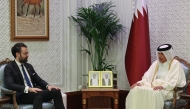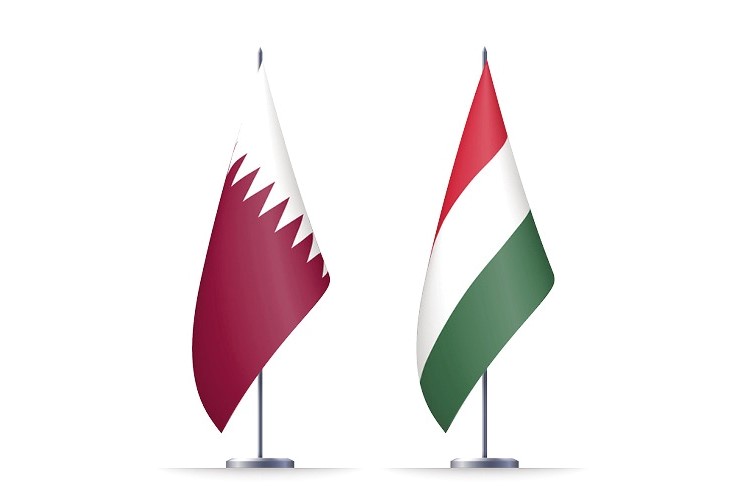
Doha, Qatar: Within the framework of Qatari policy values, which are based on building bridges and the strongest ties and relations with various countries and peoples of the world, HH the Amir Sheikh Tamim bin Hamad Al Thani arrived in the Hungarian capital, Budapest, on an official visit to Hungary at the invitation of President of Hungary HE Katalin Novak.
During the visit, HH the Amir will meet with President Novak, Hungarian Prime Minister Viktor Orban and a number of senior Hungarian officials to discuss strengthening cooperation relations between the two countries in various fields, in addition to the most important regional and international issues of common concern.
It is expected that HH the Amir's visit to Hungary and the talks that will take place during it will contribute to supporting and strengthening relations between the two countries in various fields, especially in the economic, trade and investment sectors, as well as in the field of energy.
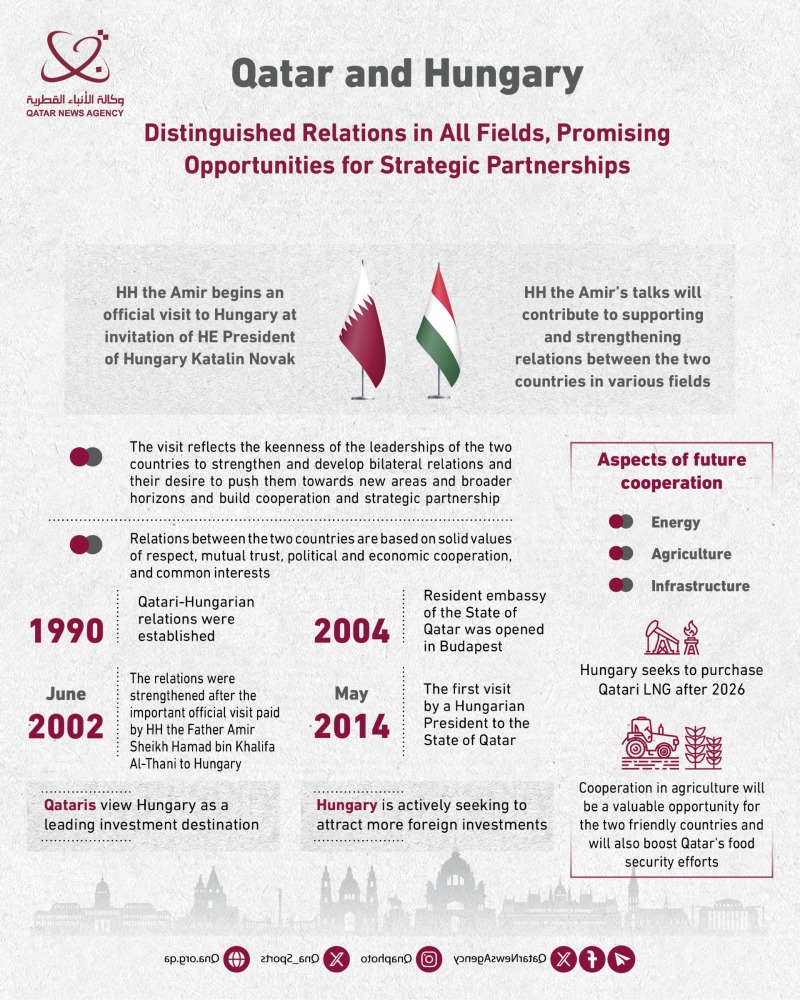
HH the Amir's visit to Budapest reflects the keenness of the leaderships of the two countries to strengthen and develop bilateral relations and their desire to push them towards new areas and broader horizons and build cooperation and strategic partnership that serves the two countries and their common interests and aspirations.
Mutual trust and common interests
Relations between the two countries are based on solid values of respect, mutual trust, political and economic cooperation, and common interests. The two countries have a common and firm belief in the importance of maintaining international peace and stability, settling disputes through dialogue and peaceful means, and playing an active and influential role in this context at the regional and international levels.
The relations between Qatar and Hungary are close and distinguished at all levels. They witnessed remarkable development over the years due to the mutual official visits between the two countries.
The bilateral relations are organized by a set of agreements and MOU signed between the two countries, which cover cooperation in the political, commercial, industrial, cultural, artistic and tourism fields, as well as sports and youth, air services, avoidance of double taxation and prevention of financial evasion, in addition to cooperation in the fields of energy, economy, business, education, higher education and scientific research.
Qatari-Hungarian relations were established in 1990, at the non-resident embassies level. In late 2004, a resident embassy of the State of Qatar was opened in Budapest, and mutual visits continued at various levels between the two countries. These relations were strengthened after the important official visit paid by HH the Father Amir Sheikh Hamad bin Khalifa Al Thani to Hungary on June 12, 2002, who was received by Hungarian President Ferenc Madl. During this visit, a number of bilateral agreements were signed.
Education and scientific research
In the first visit by a Hungarian President to the State of Qatar, HE President Janos Ader visited Qatar in May 2014, during which an official talks session was held at the Amiri Diwan between the State of Qatar and Hungary, chaired by HH the Amir and HE President Janos Ader. During the session, they reviewed bilateral cooperation relations between the two countries and ways of developing them in various fields, in addition to signing an agreement for cooperation in the field of education, higher education and scientific research between the governments of the two countries.
In recent years, Hungarian Prime Minister Viktor Orban paid a number of visits to Qatar, the most recent of which was last May. HH the Amir and Hungarian Prime Minister held an official talks session at the Amiri Diwan, which dealt with developing cooperation, especially in the areas of economy and investment, in addition to exchanging views on the most important developments of common interest regionally and internationally.
In a previous interview with the Qatar News Agency, PM Orban affirmed his country's keenness on building strategic partnership with the State of Qatar in different fields, in light of the growing cooperation relations between the two countries. He said that the Qatari-Hungarian relations are steadily growing, adding that the two countries are keen on strengthening these relations in different fields to serve the two people's interests. He also pointed out that the two countries have set several strategic aspects of cooperation that are of high priority to both of them, including energy, agriculture and infrastructure, especially with relation to air transport, in addition to cooperation in the security and military fields.
Energy, agriculture, and infrastructure
Cooperation in the field of energy is of utmost importance to Hungary, which seeks to purchase Qatari LNG after 2026, he said, adding that cooperation in agriculture will be a valuable opportunity for the two friendly countries and will also boost Qatar's food security efforts. The cooperation between Qatar and Hungary in the field of infrastructure is currently focusing on the air transport sector, he said, pointing out that the two countries are currently discussing the possibility of attracting Qatari investments to this sector, especially airports.
The mutual visits at all levels, as well as the agreements signed between Qatar and Hungary, have helped bring the business community and investors in Qatar and Hungary closer together. Last July, Budapest hosted the third session of the Qatari-Hungarian Joint Economic Committee, which was held under the chairmanship of HE Minister of Commerce and Industry Sheikh Mohammed Bin Hamad Bin Qassim Al-Thani and the Minister of Foreign Affairs and Trade of Hungary HE Peter Szijjarto.
During the session, various aspects of cooperation in priority sectors were discussed, in addition to ways to strengthen bilateral cooperation in fields such as trade, investment, construction, infrastructure, agriculture, shipping, civil aviation, health, education and information technology. The two sides agreed to consolidate cooperation between the two countries to increase trade exchange between them, and facilitate the flow of goods, services, and investments.
Political consultations
Last March, a round of political consultations was held in Budapest between the Qatari and Hungarian foreign ministries. The Qatari side was headed by Secretary-General of the Ministry of Foreign Affairs HE Dr Ahmed bin Hassan Al Hammadi, while the Hungarian side was headed by Secretary of State for Bilateral Relations of the Ministry of Foreign Affairs and Trade HE Tamas Menczer. During the political consultations, they reviewed bilateral cooperation relations between the two countries and ways to support and enhance them.
Investment destinations
The prospects for cooperation between the two countries appear promising, especially with the mutual interest in developing economic and trade relations and exploring broader horizons for intra-trade. Qataris view Hungary as a leading investment destination, especially in sectors such as the automotive, chemical industries, medicines, infrastructure projects, agriculture, and others.
The investment climate in Hungary is also stimulating to joint Qatari-Hungarian projects, and there is great interest on the part of Budapest in facilitating business for Qatari investors. The Hungarian Chamber of Commerce and Industry also supports the existence of joint projects, and in return the Qatari market is full of many opportunities for cooperation between the two sides, especially in light of the incentives provided by the State to encourage investment, especially in industry, agriculture, tourism and other sectors.
The investment environment in Qatar is encouraging and the laws, legislations and procedures facilitate the launch and practice of business. Furthermore, there is a developed infrastructure at the highest level, and there are many opportunities in the free and industrial zones.
Hungary is located in Central Europe within the basin of the Carpathian Mountains. It is a landlocked country that does not have access to the sea. It is surrounded by seven countries, with an estimated population of 9.71 people and an area of 93,026 km. Forests cover about 20 percent of its lands, and its most important river is the Danube, which divides it into two halves. Hungary has the largest natural lake in Eastern Europe called Balaton, with an area of 596 km. It is considered one of the most important tourist resorts there, as Hungary is a tourist destination that is visited annually by about 30 million tourists.
The dissolution of the former Soviet Union and its system of socialist states in Eastern Europe constituted a radical turning point in the course of politics and economics pursued by successive Hungarian governments since then, as the market economy prevailed while trade and economy were liberalized, both internally and externally.
The Hungarian economy is currently based mainly on the services sector, which represents two-thirds of the GDP, followed by industry by 24 percent, the agricultural and construction sectors. The automotive industry and related industries occupy advanced positions within the industrial sector, as some German and Japanese companies make large investments in this field.
Immediately after the start of the transformation process, foreign investments, especially western ones, began to flow into Hungary, and their cumulative value has since reached more than 80 billion euros.
Hungary is actively seeking to attract more foreign investments, especially as it is rich in many natural resources, the most important of which are: bauxite, coal, iron ore, manganese, natural gas and oil. It exports machinery, equipment, agricultural products, food and livestock, and mainly imports fuel and mineral raw materials.