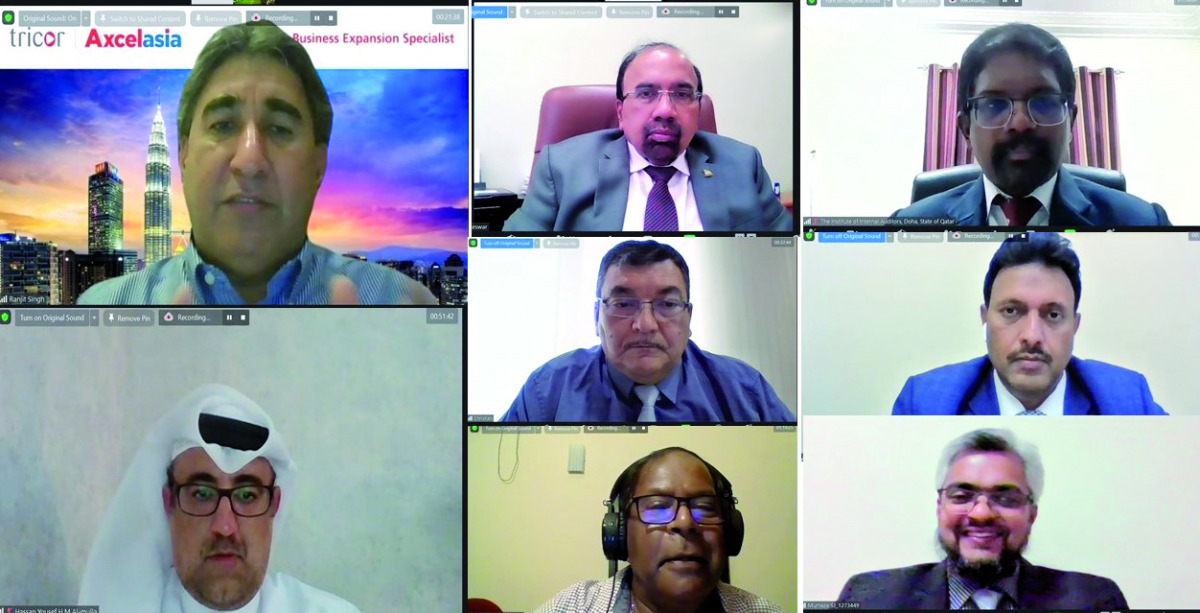
Ranjit Singh, board member of Global Institute of Internal Auditors (IIA) and Regional Managing Director of Tricor Axcelasia, Malayasia, with other participants during a webinar hosted by IIA Doha Chapter recently.
It is important for internal auditors to focus on identifying the strategic risks which may lead to a significant market and values decline in a company, Ranjit Singh, Board Member of Global Institute of Internal Auditors (IIA) and Regional Managing Director of Tricor Axcelasia, Malayasia, has said during a webinar hosted by IIA Doha Chapter recently.
Speaking on the topic “Why Focusing on Strategic Risks is Important for Internal Auditors?’, Singh said: “A business survey shows that 86 percent of companies’ failures leading to significant market and values decline were caused by strategic risks. However, the proportion of time auditors spent on strategic risk is only 6 percent. It is paradoxical. We can add value only if we audit where value is, such as strategies. Internal auditors must involve in activities that directly impact their ability to create value for the organisation”.
He went on to discuss several case studies of Airbnb, Disney, Netflix, Alibaba, Amazon, Didi, and Grab to identify strategic risks and their impact on companies.
“Internal Auditors’ ability to identify strategic risks, to lead a strategic level discussion with senior management, and to challenge on risk action plans with recommendations to improve controls are real game-changers,” Singh added.
The Board’s perspective on strategic risks falls into five sphere: Technology and innovation, Supply chain, Market–customers and stakeholders, People, and Regulatory compliances.
Singh elucidated these risks with approach questions. Whether a company’s level of technology is relevant, and what kind of innovation will sustain are pertinent. Overreliance on specific vendors and challenges faced by critical vendors are matters of concern related to the supply chain.
How the company track changes in customers preferences and stakeholders opinion are significant. Regarding people, strategic risk is whether there is upskilling for future-readiness. Another question is business flexibility to adapt to regulatory changes.
He also reiterated the skills required to audit strategic risks effectively, including business acumen, analytics, agility, proactiveness, personal relationships, and communication. “Strategic audit preferably is conducted with the oversight of a senior staff,” added Singh.
Sundaresan Rajeswar, Board Member at IIA Doha Chapter, who also coordinated the event, said: “Ranjit’s training covered critical aspects to identify strategic risks through case studies, skills required to audit internal controls relating to strategic risks, and auditing of strategies.
Apart from global case studies, Singh shared his personal experience and challenges faced in strategy auditing and how he provided value to organisations”.
“Ranjit is a very passionate internal auditor who grew in stature over the years, and the presentation was rich with contents,” said Christian Adonis, Past President of IIA Doha Chapter in his closing remarks. Ayisha Rafique and Muralikrishnan hosted the event, while Rajeswar handled Q&A Session.