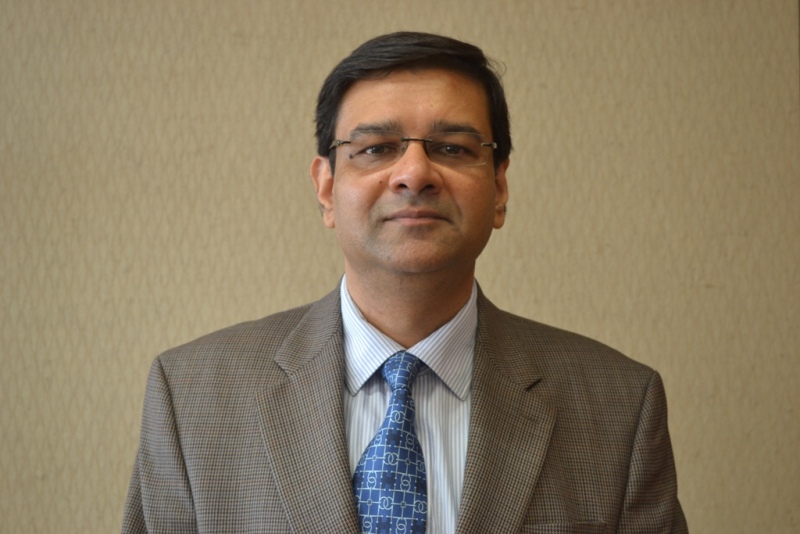
New Delhi: The Indian government on Saturday named insider Urjit Patel as the new governor of the Reserve Bank of India, to replace popular central banker Raghuram Rajan when his term ends in September.
"Dr Urjit R Patel new Governor of RBI," Frank Noronha, principal spokesperson for the Indian government posted on Twitter.
The promotion of Patel, currently the RBI's deputy governor, ends weeks of feverish speculation by the Indian media since Rajan caught investors off guard in June by announcing he was stepping down to return to academia.
Patel, 52, is one of four deputy governors and was re-appointed in January this year for a three-year term.
He runs the Indian central bank's monetary policy department, working closely with outgoing governor Rajan who steps down on September 4.
A press note seen by AFP said: "The Appointments Committee of Cabinet has approved the appointment of Dr. Urjit R. Patel as Governor, Reserve Bank of India (RBI) for a period of three years."
The chief of the RBI is typically chosen by the prime minister in consultation with the finance ministry, making Patel the first governor to be chosen by right wing Prime Minister Narendra Modi.
Prior to joining the RBI, Patel was an adviser with The Boston Consulting Group, spent a decade in the financial sector and was a president at Indian conglomerate Reliance Industries.
He has also worked as a consultant to the Ministry of Finance.
Like Rajan, Patel has the International Monetary Fund on his CV, having worked at the IMF in the 1990s on desks including the US, Myanmar and India.
He has an M. Phil in economics from Oxford University and a PhD in economics from Yale University in the US.
Patel was a key architect of a switch to using consumer prices instead of wholesale prices to measure inflation, believing them a better gauge of volatile price changes.
Many economists hail this as one of the most important reforms brought in by the RBI since India's economic liberalisation began in 1991.
- 'Message of continuity' -
While many investors were disappointed in Rajan's decision to step down, they are hoping that the new appointee will take a more dovish approach towards lowering interest rates.
"Broadly this is a message of continuity. That should help markets react positively to the news," Shubhada Rao, Chief Economist at Yes Bank in Mumbai told AFP.
"His sense of monetary policy would be keenly awaited. We will be looking out for his stance (at the next RBI rate-setting meeting) in October," she said.
India's economy expanded by 7.9 percent in the fourth quarter of 2015-16, the fastest of any large economy, while inflation has fallen from double-digit levels to around six percent on Rajan's watch.
But although interest rates are at their lowest level since 2011, there have been tensions with the ruling Bharatiya Janata Party which has been pushing for deeper cuts, saying these would boost growth further.
Rajan took the reins at the RBI in September 2013 at a time when India's economy was struggling with a ballooning current account deficit, a plummeting currency and decade-low economic growth.
Many economists have hailed his line on rate cuts for bringing down India's inflation.
AFP