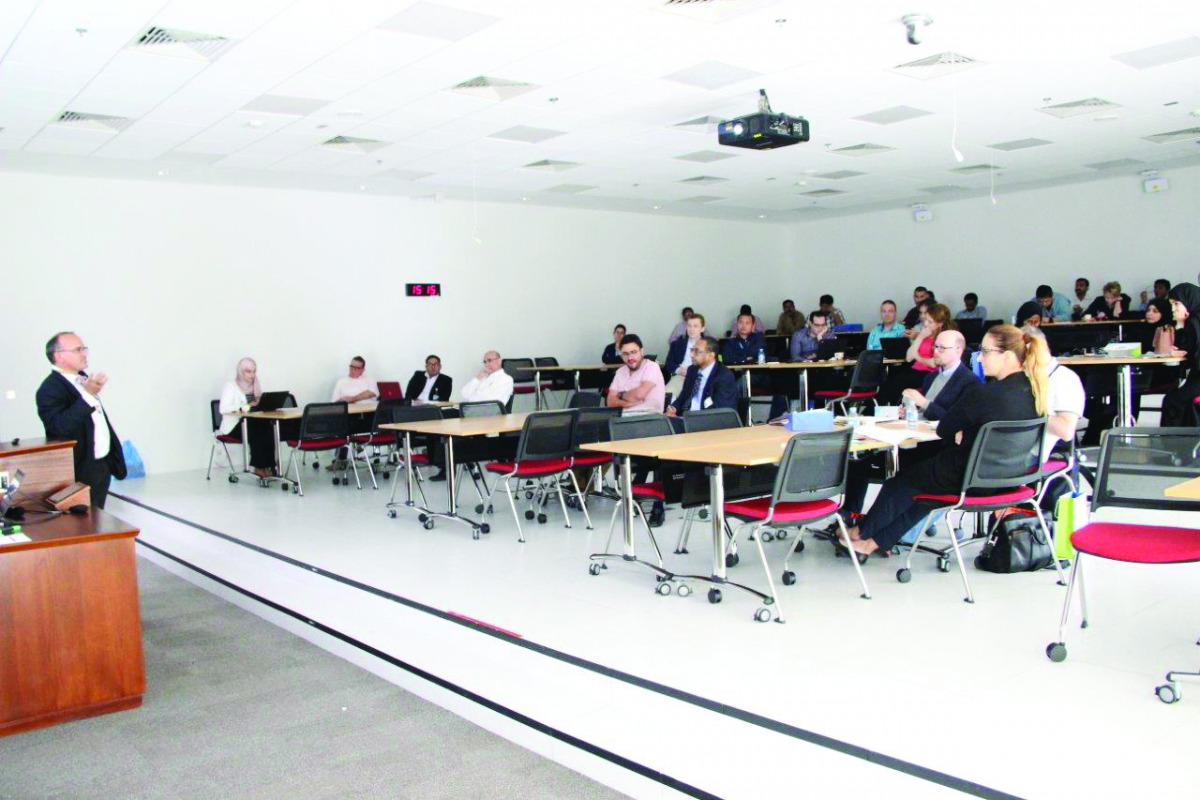
DOHA: Experts discussed the latest developments of ‘Cytometry’ — a technology that allows to analyse the condition of tumours — during a symposium organised by Qatar University College of Medicine (QU-CMED).
The symposium on ‘Flow Cytometry-Based Phenotyping – Evolving Applications in Health Care and Research,’ aimed at highlighting recent developments and applications of flow cytometry in clinical and research use.
It also aimed at bringing researchers and practitioners using the technology in Qatar to exchange knowledge, create opportunities for partnerships and advance understanding of its applications locally, according to Dr Farhan Cyprian, Assistant Professor of Immunology and Cell Biology at the college.
“By using florescent imaging, flow cytometry is a technology that allows us to analyse a single cell or particle in many dimensions — growth rate, metastasis, maturity, capacity for killing tumours and other characteristics.
“Although the technology has been available for about two decades, its applications have expanded exponentially in recent years which promises advances that could revolutionise personalised patient therapy,” said Dr Cyprian.
Clinicians and researchers from local healthcare institutions discussed and shared knowledge, ideas and expertise on the most recent updates in flow cytometry-based phenotyping.
Dr Jean Charles Grivel, Director, Sidra Phenotyping Core Lab; Dr Michal Kulinski, Manager, Interim Translational Research Institute (iTRI); Aleksandra Liberska, Supervisor, Flow Cytometry Lab, Weill Cornell Medical College in Qatar (WCMC-Q); and CMED faculty, students and staff took part. The event addressed topics such as ‘Transforming Growth Factor Based Immune Modulation’; ‘Application of Nanoparticles in Flow Cytometry’; ‘Flow Cytometry Crossmatch in Transplantation’; ‘Flow Cytometry — Detection of Platelet Function and Activation in Cardiovascular Diseases’; and ‘Thrombospondin-1 Dependent Induction of Regulatory Immune Response by Ocular Antigen Presenting Cells’.
Dr Egon Toft, Vice-President for Medical Education, QU, and Dean of CMED, said, “The College of Medicine is committed to bringing together practitioners, researchers and students through various platforms, including events like this one to exchange knowledge, advance collaborative synergies, enrich their experiences, and ultimately improve patient care.”
The Peninsula