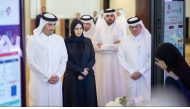
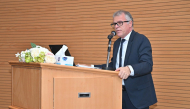
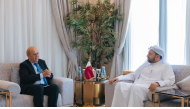
The Permanent Representative of the State of Qatar to the United Nations Educational, Scientific and Cultural Organization (UNESCO) Dr. Nasser bin Hamad Al Hanzab affirmed that the State of Qatar has established its relations with UNESCO on common foundations and values, pointing to the Qatari support and UNESCOs strategic plans and programs to promote values and concepts to achieve peace, stability and coexistence with different cultures on the basis of mutual respect between peoples.
HE Qatar's Permanent Representative to UNESCO said in an interview with Al-Raya newspaper published Wednesday that the world needs UNESCO today more than ever, noting the importance of the international community's support to activate the organization's role in promoting stability in the world through education and culture.
HE stressed that the State of Qatar has established its relations with UNESCO on common foundations and values, in terms of the directions and policies adopted by the State since its accession to this prestigious organization, and has worked with UNESCO to strengthen programs locally, regionally, and internationally in all sectors in UNESCO's areas of competence, namely: education, culture, science, communication and media.
HE Al Hanzab pointed out that the State of Qatar has worked to support development programs and plans in the education sector in particular, and in partnership with Qatar Foundation for Education, Science and Community Development (QF) and Education Above All Foundation (EAA), under the international leadership of HH Sheikha Moza bint Nasser, where HH was appointed in 2003 as UNESCO's Special Envoy for Basic and Higher Education, in recognition and appreciation of Her Highness' clear efforts in supporting the educational process and protecting the right to education at the international level.
HE underlined that the UNESCO Doha Office is one of the models for partnership and cooperation between Qatar and this international organization, to implement projects, programs, and initiatives in many countries, and extend to the sectors of education, culture, heritage and science, empower youth of both genders, and confront extremism and violence.
HE the Permanent Representative stated that UNESCO is working to achieve international peace and security and the goals of sustainable development, according to the charter of the organization that emerged from the London Conference of 19461947, which stipulated: "Since wars begin in the minds of men, it is in the minds of men that the defences of peace must be constructed." From this standpoint, the State of Qatar has worked to support development programs and plans in the education sector in particular, and in partnership with QF and EAA, he added.
Al Hanzab pointed out that one of the most prominent fruits of the cooperation between Qatar and UNESCO, and the partnership with EAA, clear to all international partners, is the State of Qatar's keenness on education, which is at the heart of UNESCO's work and its biggest fields, noting that this is evident through the support provided by Qatar to develop and modernize it locally in accordance with the highest international standards.
This keenness is manifested internationally through qualitative initiatives and projects, such as the World Innovation Summit for Education (WISE), Educate A Child (EAC), and EAA, which provided an opportunity for more than 10 million children to attend education in the most vulnerable and marginalized regions of the world, particularly conflict zones, HE stressed.
HE explained that the State of Qatar was one of the first supporting countries that cooperated with UNESCO to support education in Beirut through the initiative of the Qatar Fund For Development (QFFD) and EAA to rehabilitate destroyed schools and restart the educational process for male and female students who were deprived of their right to education, in response to a campaign, which was launched after the explosion of Beirut Port in August 2020.