

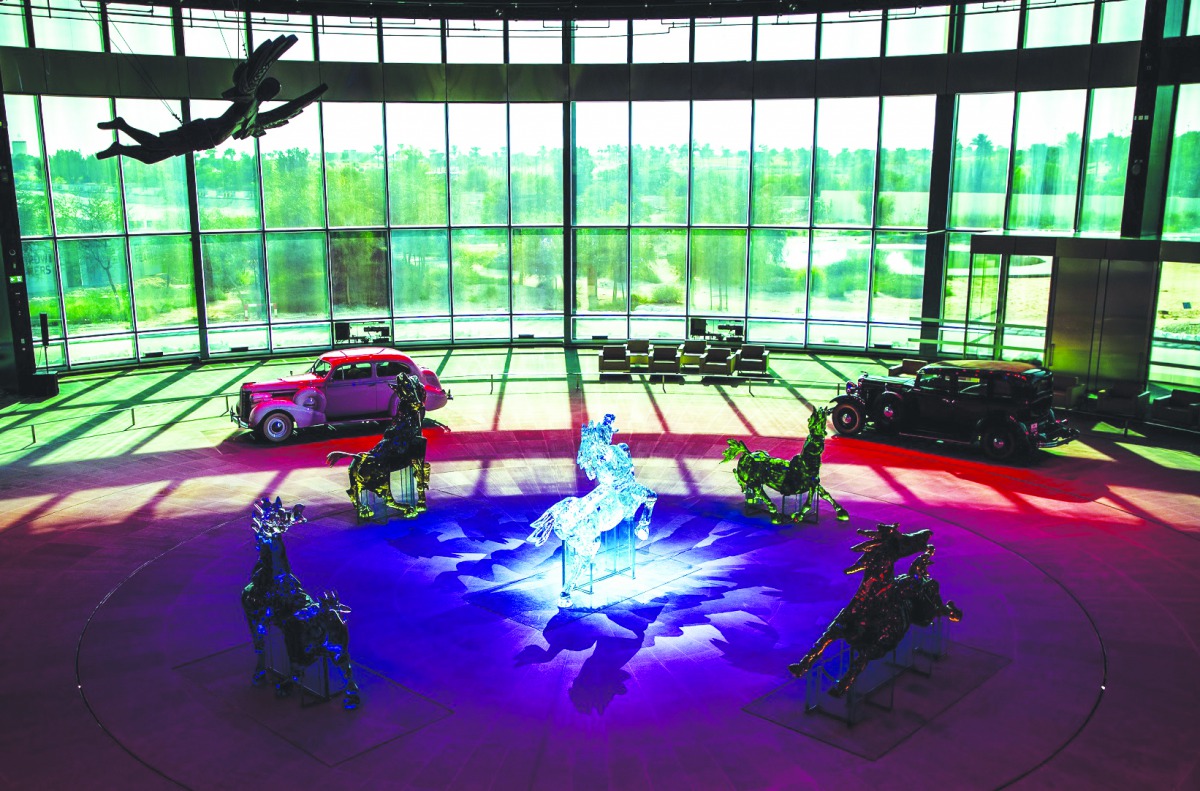
Fans and critics of Maqbool Fida Husain are likely to have differing interpretations of the Seeroo fi al Ardh, the artist’s final art installation which has now been unveiled at Qatar Foundation’s Education City.
Those familiar with his evolution as a painter, however, will immediately recognise the link between the kinetic experience that the art installation offers, and something that was very close to the artist’s heart: cinema.
The fact that Husain was born in 1913, the same year in which India’s first officially recognised full-length feature film was released, may be a coincidence. However, the artist’s love for cinema was anything but. His fascination with it is well-documented, and it influenced his art throughout his life.
“Like many people of his generation, Husain had a strong connection with cinema,” says Ranjit Hoskote, an Indian art critic, poet, writer, curator, and cultural theorist. “His tastes ranged from popular movies to what are more commonly known as art house productions.
“Even as he matured as a versatile artist, he followed the different genres that cinema offered: documentaries, short films, and feature films. Locally, he was conscious of the varying approaches of the Bengali and Hindi film directors who dominated the Indian cinema scene at the time, and of world cinema, particularly the work of the 1950s Italian neo-realists. And, the more he immersed himself in the industry, the more he could see himself in the director’s seat.”
Hoskote’s association with Husain began in the 1980s when he often bumped into the artist at the Pundole Art Gallery in Mumbai. Through the years they knew each other, he observed Husain’s evolving style and his fascination for films.
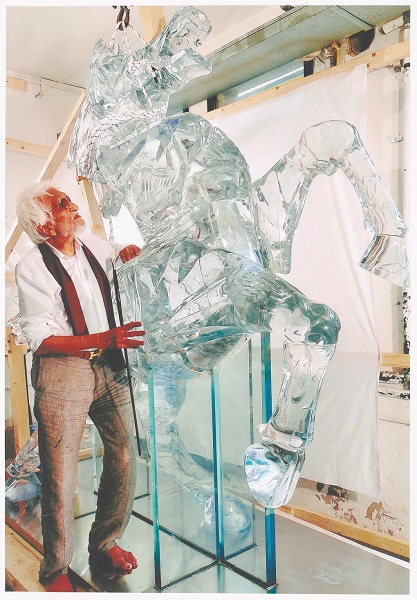
Little did Hoskote know that it would culminate in him being invited by Qatar Foundation to curate Husain’s Horses of the Sun exhibit at Mathaf: Arab Museum of Modern Art, at Education City, in the spring of 2019 – where one of Husain’s films was screened as a tribute to the artist’s contributions to world cinema.
The art critic speaks of one of Husain’s first jobs – as a billboard painter in Bollywood, the Mumbai-based heart of India’s film industry. The larger-than-life imagery that characterised these hoardings fascinated the young artist. It fed his imagination and influenced the style he would eventually use to portray his interpretation of history and civilization – bold, stark, and often theatrical.
“You can almost imagine the scene,” said Hoskote. “A young Husain seated on scaffolding, dangling 70-80 feet above the ground. He isn’t wearing a safety harness or a helmet, as was the norm. Yet his eyes reflect the sheer joy of being able to paint towering images of movie stars.
“In a way, cinema fuelled his love for monumentality, for machines and moving parts. You can see that in his paintings. His ideas grew grander and bolder with time. If you look closely at his art, you’ll notice that the themes convey a sense of dynamism, a feeling of contained energy and movement – many images presented as a shuffle of frames, much as you would find in a movie.”
Hoskote notes how, in the second half of his almost 100-year-long life, Husain’s persona acquired a sense of superstardom in India and abroad. Rather than being inhibited by it, he embraced it, easily interacting with the public and confidently branching out into producing his own films.
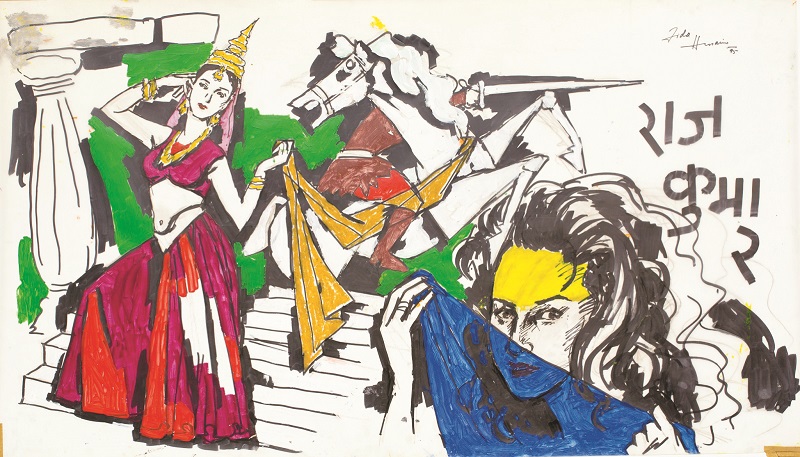
“The artist in Husain loved the drama that light, sound and music created,” says the artist’s former acquaintance. “He could see how it made a painting multisensory and appealing to the masses.
“That’s why he produced and directed at least a dozen films, from mini documentaries all the way to full-length feature films. One of his first films, Through the Eyes of a Painter, is an example of how he effectively uses the soundtrack to enrich visual imagery.
“The Seeroo fi al Ardh art installation juxtaposes both these roles: that of an artist, and of a superstar. On the one side, you see Husain the artist and filmmaker who adroitly uses light, music and movement to convey the spirit of Arab civilisation. On the other, you see Husain the superstar, demonstrating the sheer audacity of being able to conceive and execute an idea of such proportions.”






