

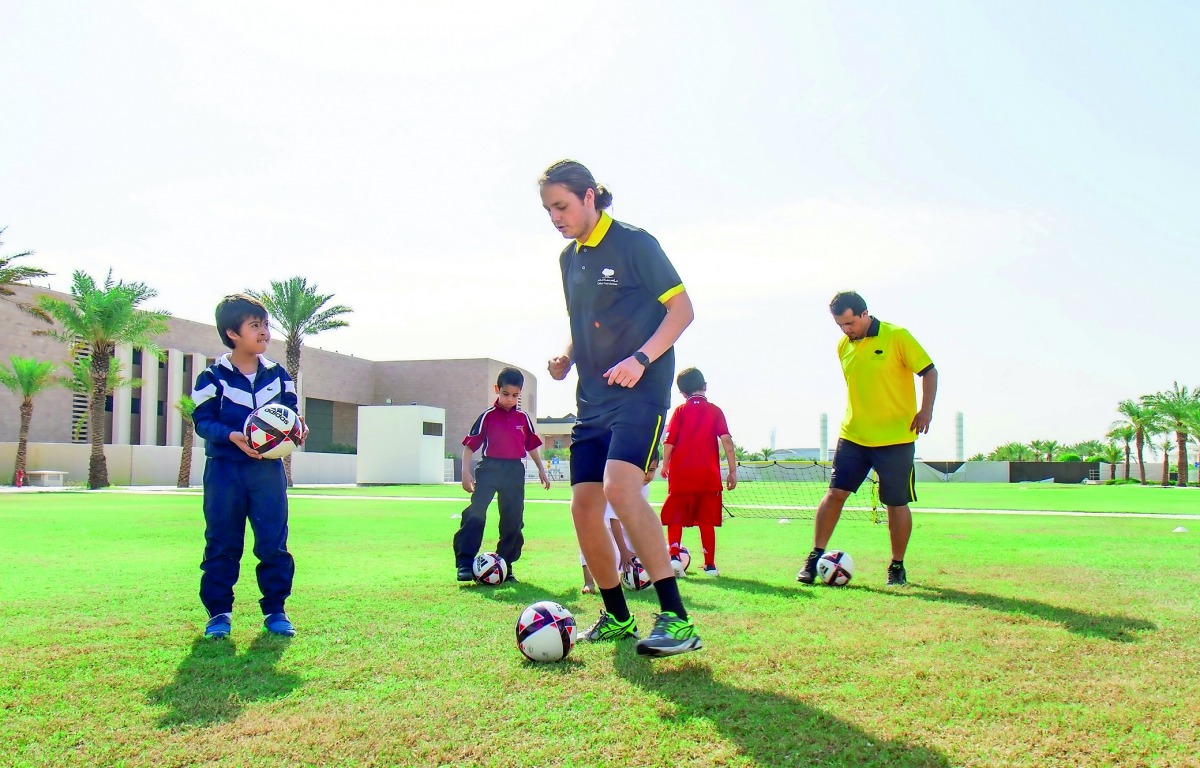
Children with autism at the football lessons held by QF. RIGHT: QF holds swimming lessons for students with autism.
Over the last decade, as Qatar has emerged as an international sporting hub, Qatar Foundation (QF) has played a key role in enabling everyone, of all capabilities, to reap the benefits of having access to world-class sport facilities and training opportunities.
QF has made huge strides to ensure sport in Qatar is inclusive. It has been spearheading the drive to provide access to sport for people with autism. The environment that QF is fostering is central to ensuring that, in Qatar, sport really is for all.
“Sport transcends differences. Whoever you are, playing sport provides benefits,” says Ryan Moignard, Special Needs Football Specialist & Coach, who teaches football to students with autism at QF.
“That is why Qatar Foundation is using sport as a tool to level the playing ground for people with different capabilities.”
In 2017, the World Innovation Summit for Health (WISH), a QF initiative, invited two Liverpool Football Club Foundation coaches – experienced in teaching students with varying disabilities, including autism, in the UK – to Qatar. Through a program called ‘Coach the Coach’, Moignard and Jamie Spellman mentored sport instructors at QF’s educational institutions on ways of teaching football to disabled footballers.
The program was so successful that Moignard and Spellman are now special needs football coaches at QF.
They are currently involved in developing a two-pronged strategy for QF’s autism-friendly football training program.
Prior to joining QF, they had both worked with Liverpool Football Club Foundation and, the Premier League/BT Disability Fund in the UK.
“Where autism is concerned, access and acceptance go hand in hand. QF’s aim is to not just provide access to sport, such as football, for people with autism,” said Spellman.
“We also aim to get the wider community to recognise that disabled people enjoy sport just as much as non-disabled people. So we not only train other coaches, we’ve opened our classes to participants with autism from outside the QF community as well,” he added.
Moignard believes that such QF initiatives bolster Qatar’s image as a sport-loving nation. “QF is helping Qatar emerge as a role model for inclusiveness in sport. It has set the standards and upped expectations for people in this country, and in the region,” he said.
QF recently launched autism specific sports classes for participants from both QF schools and the wider community.
Football classes are being held at Multaqa (Education City Student Center), while swimming classes take place at the QF Recreation Centre. And, almost three fourths of the students enrolled in each of these classes are from non-QF schools - proof that QF’s exemplar of inclusiveness is spreading across the country.
Kathleen Bates, Senior Special Needs Aquatic Specialist at QF, heads the swimming program at Recreation Centre, and emphasizes that swimming is a sport that can be enjoyed by people with differing needs.
“When it comes to swimming, there are no limits on who can – or should – learn how to swim.QF realises this and offers swimming classes for students with autism from both within and outside the QF community, for anyone above the age of 4 years,” said Bates.
QF’s commitment to enhancing access to sport is reflected in the daily routine of students at Renad Academy, part of QF’s Pre-University Education, and a specialised school for children with mild-to-moderate Autism Spectrum Disorder. Its students enjoy lessons in swimming, football, and horse-riding every week.
Lulwa S. J Al-Darwish, who is a teacher at Renad Academy, says sport is an integral part of the school’s curriculum, and that, through horse-riding, students not only learn a sport – they experience an activity that is a part of Qatari heritage.
She also emphasises that these activities are to ensure inclusion, not to provide therapy. “The benefits that a child with autism receives from a sport is no different than the benefits that a child without autism would get from the same sport,” she said.
QF’s initiatives to promote inclusiveness in sport mirror the efforts that have been taking place across the country, such as the swimming classes for students with varying challenges and needs, including autism, at the Aspire Zone.
Qatar is one of the few countries to have a National Autism Plan, which has encouraged collaboration in improving access for people with autism, across different facets of daily life.







