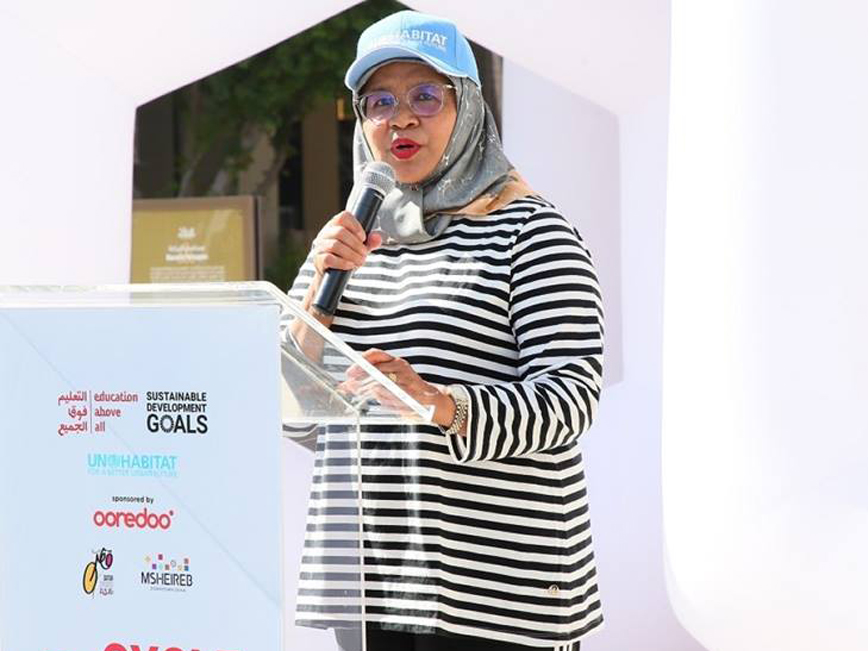
Executive Director of UN-Habitat Maimunah Mohd Sharif at an event.
Doha: The Executive Director of the United Nations Human Settlements Programme (UN-Habitat) Maimunah Mohd Sharif praised Qatar’s efforts in achieving the Sustainable Development Goals (SDGs), especially in implementing a new urban agenda in parallel with its recent hosting of the FIFA World Cup Qatar 2022.
In an exclusive interview with Qatar News Agency (QNA), the Executive Director of UN-Habitat said that she was briefed on the achievements and urban development projects, such as modern mass transit projects, open green spaces, and urban services that constitute significant progress toward achieving the indicators of goal eleven of the SDG.
She noted the achieved progress in the field of preventive and psychological care in various sectors, including the early detection of disease and the health coverage reaching the level of full inclusion by 100%, which is considered a remarkable progress.
She pointed out that Qatar is working toward 70% of food security during 2023 as Qatar National Vision 2030 adopted the promotion of the SDG. It is worth noting that Qatar was ranked first in the list of safest and most crime-free countries in the Arab region and the world in 2017, 2019 and 2020, which constitutes a major progress.
She believes that with the rapid urbanisation in Qatar, there is a room for cooperation where the UN-Habitat can support local authorities and stakeholders in their efforts to implement the SDGs and the New Urban Agenda, as well as promote sustainable and inclusive urban development. She said that UN-Habitat hopes to expand cooperation with the Ministry of Municipality to make progress in building Urban Observatories to support urban data and evidence-based policymaking.
Regarding the United Nations Human Settlements Programme view of the achieved SDGs in the Arab world, Mohd Sharif stressed that there are positive indicators and setbacks around the region, not only regarding goal eleven but the whole SDGs. Many countries are on the right track to achieving goal four (Quality Education), goal seven (Affordable and Clean Energy), and goal thirteen (Climate Action), while other countries showed moderate performance increases across many of the other SDGs.
She believes that several Arab countries have taken measures to empower local administrations, especially in implementing the New Urban Agenda.
Countries like Algeria, Tunisia, and Palestine have adopted measures to move towards decentralisation and build the capabilities of local authorities, while Egypt has developed a central coordination mechanism that focuses on bridging the gap between different regions.
In this regard, she indicated that a number of Arab countries monitor the implementation of the SDGs at the local level through Voluntary Local Reviews (VLRs).
The first VLRs in the Arab region was launched in Amman, Jordan, and more cities like Agadir, Morocco; Ramallah, Palestine; and Tunis, Tunisia are working on developing their VLRs. According to the 2022 SDG index, and the rates related to the Arab region, most countries in the region show a decline or stagnation in goal eleven (Sustainable Cities and Communities), which can be explained by the conflicts experienced by low-income countries in the region and populations affected by conflicts and natural disasters.
At the global level, the Executive Director of the UN-Habitat highlighted the need for further efforts to make significant progress in achieving the goals of 2030, with more than half of the world’s population living in cities, and by 2050, it is likely that seven in 10 people will live in urban areas, given that cities are the engines of economic growth and contribute to more than 80 percent of global GDP. However, cities are also responsible for more than 70 percent of global greenhouse gas emissions, she said.