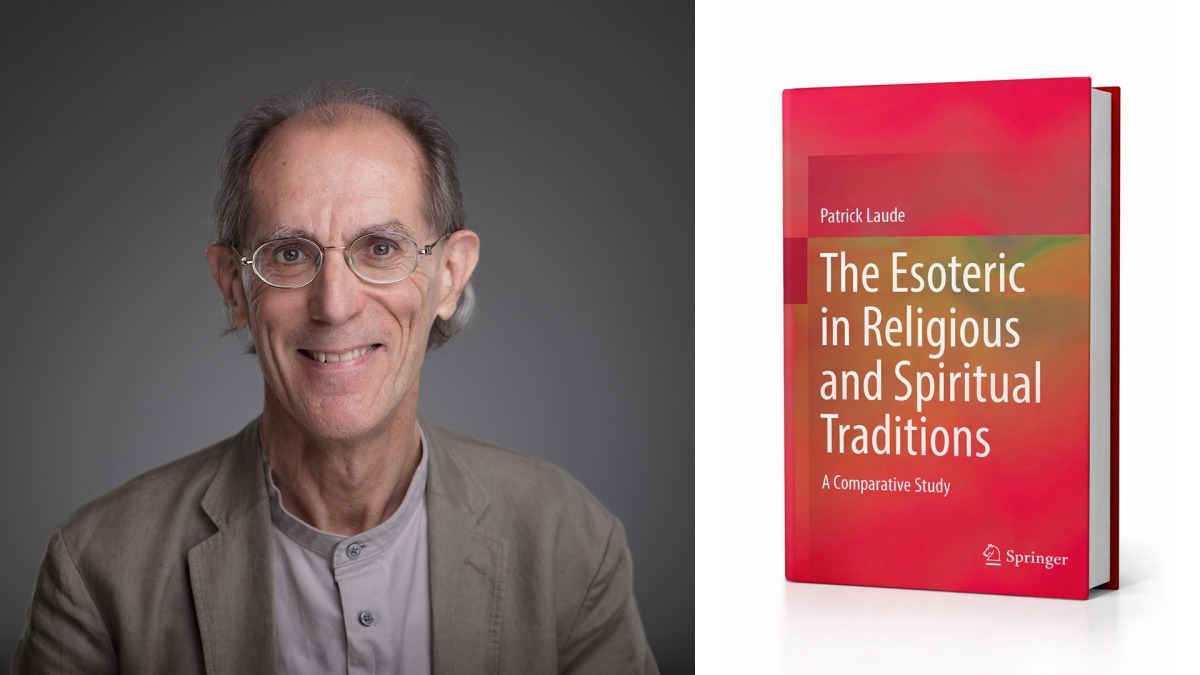
Doha, Qatar: As the holiday season approaches, a new resource is helping to shed light on why religion matters today, and it comes from Georgetown University in Qatar Professor of Theology and Religious Studies, Dr. Patrick Laude.
In his new book, The Esoteric in Religious and Spiritual Tradition - A Comparative Study (Springer 2025), Dr. Laude takes on what many would consider an age-old mystery—whether the “esoteric,” or inner dimensions of religion, can be meaningfully understood across traditions—and offers one of the most comprehensive answers to date.
In doing so, Dr. Laude argues that esoteric traditions help address contemporary tensions in how people experience faith today. “Religious consciousness is torn between competing narratives, from a return to the ‘fundamentals’ to calls for more informal practices of spirituality,” he observes. Identifying inner dimensions of religion offers ways of holding these opposites together.
Focusing mainly on Buddhism, Christianity, Hinduism, and Islam, Laude’s book proposes a coherent way to think about spiritual knowledge not as something marginal or obscure, but as a recurring and deeply human orientation within religious life. “There is a lot of confusion about what the term esoteric means,” he explains, adding: “It is often dismissed as obscure, fanciful, or elitist, and I set out to go beyond these stereotypes.”
Drawing on four decades of inspiring scholarship at the intersection of religions, Dr. Laude set out to test whether the concept could be defined rigorously and applied across traditions.
He constructed a comparative framework that identifies both great diversity and surprising coherence across religions. “My main argument is that the esoteric is identifiable as a fundamental direction of the human quest for religious meaning and spiritual realization,” Dr. Laude says.
His book reflects on six key unifying principles that may give some orientation during this age of confusion, including the ideas that humans can recover wholeness through direct access to the source of religious inspiration, that reality is one and that this unity is at the heart of the very nature of mankind, and that empirical existence and the Ultimate hold distinct, but not contradictory, truths.
In doing so, Dr. Laude proposes that esoteric traditions can help address contemporary tensions in how people experience faith today.
As the year closes and reflection deepens, Laude’s work invites readers to reconsider the inner dimensions of faith—not as hidden curiosities, but as enduring pathways toward meaning and wholeness.