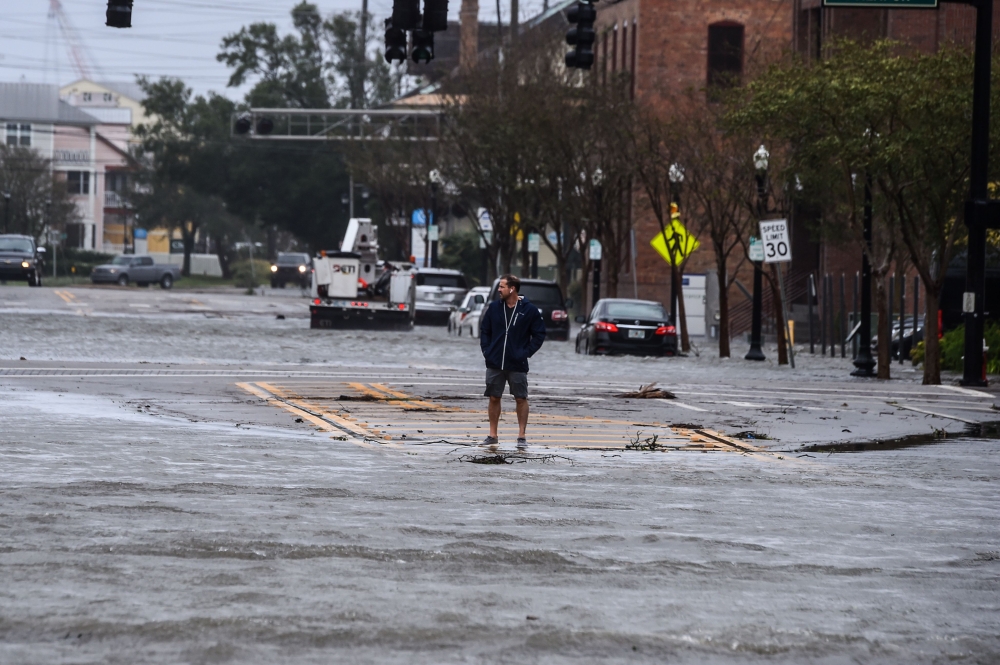
A man stands on a street flooded by Hurricane Sally in Pensacola, Florida, on September 16, 2020. Hurricane Sally barrelled into the US Gulf Coast early Wednesday, with forecasts of drenching rains that could provoke "historic" and potentially deadly flas
Hurricane Sally roared ashore in Alabama with high winds, dangerous storm surge and the threat of flooding rains that could inflict $8 billion in damages and losses from the Gulf Coast to Virginia.
Sally made landfall near Gulf Shores, Alabama, at 5:45 a.m. New York time Wednesday, according to the National Hurricane Center. It had winds of 100 miles (161 kilometers) per hour at 8 a.m., making it a Category 2 hurricane on the five-step Saffir-Simpson scale. Sally is the eighth storm to hit the U.S. this year.
"Historic and catastrophic flooding is unfolding,” Dan Brown, a National Hurricane Center forecaster, wrote in his outlook. "This rainfall will lead to widespread moderate to major river flooding.”
Natural disasters have fallen hard on the U.S. in 2020. Wildfires are raging across the West, killing dozens and destroying vast swaths of property and forests. Tropical storms and hurricanes have slammed into the East and Gulf Coasts, causing billions in damage, and a derecho ripped across the Midwest, leaving a path of destruction from Iowa to Indiana. The Atlantic has spun up 20 named tropical systems, the second most on record. The hurricane season doesn’t end until November 30.
In the hours before landfall, Sally’s top winds accelerated from a Category 1 to a Category 2 hurricane.
"The burst is really more academic interest than anything,” said Chuck Watson, a disaster modeler for Enki Research. "We have the ability to see smaller areas of high winds than we used to.”
The combination of storm surge along the coast and the inland flooding could end up causing $8 billion in losses and damages across the South as Sally drifts north from Alabama through Friday, Watson said. Parts of Florida have already received upward of 20 inches (51 centimeters) of rain.
Sally’s slow forward motion, about 3 mph, will mean it won’t drag high winds far inland, said Ryan Truchelut, president of commercial forecaster WeatherTiger LLC.
"You are trading the wind aspect of the damage for the inland rain threat,” Truchelut said.
Oil Disruption
That heavy rain will spread throughout the South, some of it soaking areas that are still trying to recover from past floods, including the deluge brought by Hurricane Florence in 2018. There are isolated areas that could get close to 3 feet of rain, the hurricane center said.
Across the Gulf, just over 23% of production platforms and 30% of rigs have been evacuated, according to the Bureau of Safety and Environmental Enforcement. Nearly 27% of oil production and more than 28% of gas has been shut in. Phillips 66 said it would shut its Alliance refinery in Louisiana ahead of the storm.
There could be some damage to cotton crops because there will be so much rain, but many growing areas are at higher elevations and that could protect them from severe damage, Truchelut said.
In addition to Sally, a few other storms are churning in the Atlantic. Hurricane Paulette is drifting out to sea after battering Bermuda. The other storms -- Teddy and Vicky -- won’t be an immediate threat to land. There is a 70% chance a fifth storm could form in the next five days.