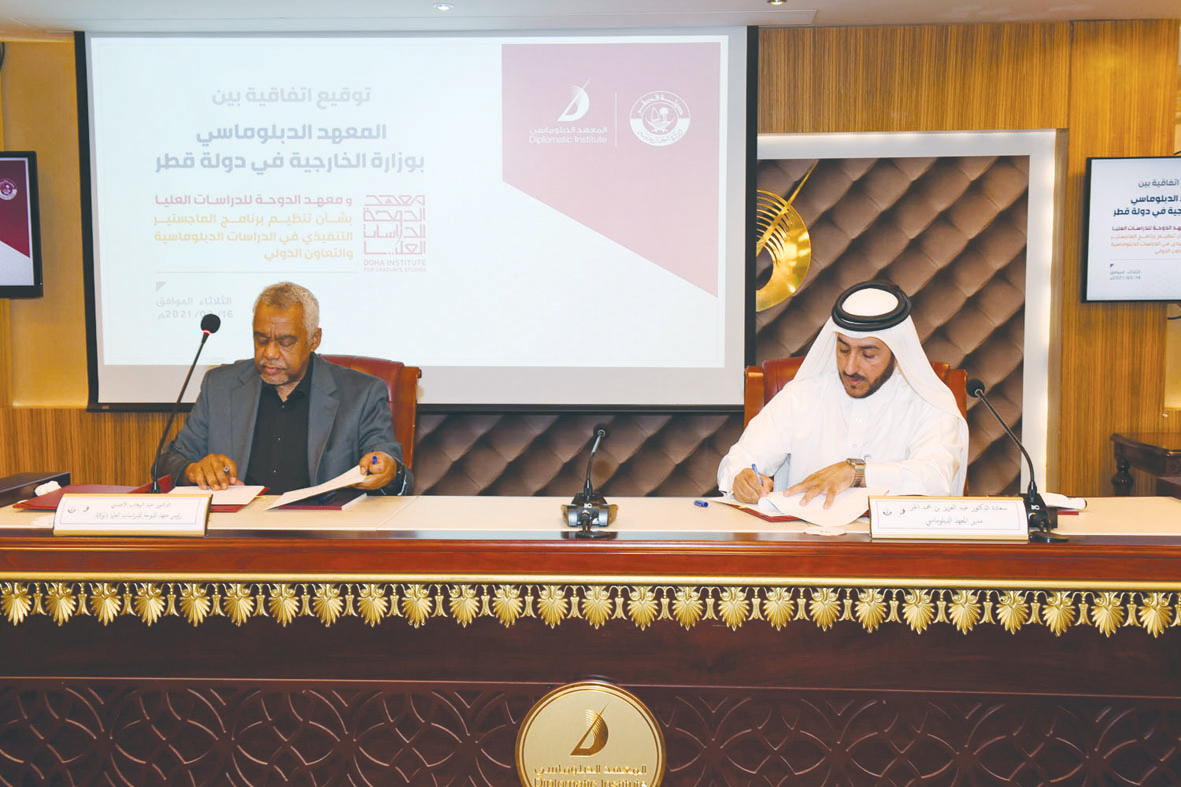
Director of the Diplomatic Institute of the Ministry of Foreign Affairs, Ambassador Dr. Abdulaziz bin Mohammed Al Horr (right), and Acting President Dr. Abdul Wahab Al Afandi from Doha Institute signing the agreement.
Doha: The Diplomatic Institute of the Ministry of Foreign Affairs (MoFA) and Doha Institute for Graduate Studies (DI) signed a cooperation agreement for the implementation of the Executive Master of Diplomatic Studies and International Cooperation Program, which was launched by the DI’s School of Public Administration and Development Economics (SPADE) in partnership with the Diplomatic Institute for the academic year 2020-2021.
The agreement was signed for the Ministry of Foreign Affairs by Director of the Diplomatic Institute Ambassador Dr. Abdulaziz bin Mohammed Al Horr and for the Doha Institute by Acting President Dr. Abdul Wahab Al Afandi.
Ambassador Al Horr said that the programme is in implementation of the vision and directives of the Deputy Prime Minister and Minister of Foreign Affairs H E Sheikh Mohammed bin Abdulrahman Al-Thani to develop human resources in the ministry to perform the diplomatic role outstandingly. Besides, to prepare reports, studies, and research specialized in foreign policy and international cooperation contributing to the decision-making process in foreign affairs, and to achieve the ministry’s vision of performance excellence in capable cadres decently representing Qatar in international forums, and perform its diplomatic duties efficiently, protect the interests of the State in line with developments in diplomatic work and follow-up global changes.
He affirmed that this programme achieves several goals that allow those in the diplomatic corps and international cooperation, official representations in regional and international organizations, official envoys, and those working in international mediation from Qatar to deal with international and diplomatic relations with its political, cultural and legal ramifications.
It will also enable them to have the tools of written diplomatic work (international law, treaties) and unwritten (international norms), serving Qatar’s national interest in its bilateral relations and multilateral relations. He stated that the programme combines the theoretical path (education) and the practical track (learning and application).
He explained that the theoretical path includes foreign policy, international law, and international cooperation, as they are the foundations that frame this programme.
In this regard, Al Horr emphasized that this understanding requires recognition of major trends in the theory of foreign policy and international relations, international law, international organizations, and others. He noted that the diplomat must familiarize with the foreign policy-making mechanisms, tools, and levels of diplomatic work, its various issues, and the new technologies emerging in this field to achieve this.
He pointed out that the practical track requires training the student in communication skills, conducting interviews, unpacking information, sifting, documenting, and analyzing it, and drafting reports that adhere to objectivity, provide evidence, and express opinion supported by a weighted argument to train in oral presentation skills and immediate response to the questions of others.
The Ambassador added that the programme would host, in each of its sessions, two experienced diplomats from America, Europe, the UN, the Arab world, or elsewhere, to hold workshops aimed at presenting reference cases in diplomatic work and international cooperation. Also, a field visit to the UN headquarters in Geneva.
He also pointed out that the program is open to nomination only by students’ employers to cover tuition fees, noting that the executive programs are not subject to the scholarship policy conditions at the Doha Institute. For his part, Acting President of the Doha Institute for Graduate Studies Dr. Abdul Wahab Al Afandi said that the programme is the first of its kind in Qatar and came due to coordination and cooperation between the Doha Institute and the Diplomatic Institute. He explained that the programme would provide learners with a global level of study and training, supervised by a team of institute professors, supported by elite professors and international experts, through international academic and professional partnerships.
With regards to admission, the applicant must have a Bachelor’s degree received from an accredited institution of higher education with a cumulative GPA of at least 3 out of 4 and an official IELTS or TOEFL report or other evidence of English proficiency, in addition to management experience not less than two years.
The applicant must also submit a personal statement written in Arabic (approximately 700 - 1000 words), explaining to which the degree of Executive Master of Diplomatic Studies and International Cooperation is compatible with his/her future academic and professional objectives.