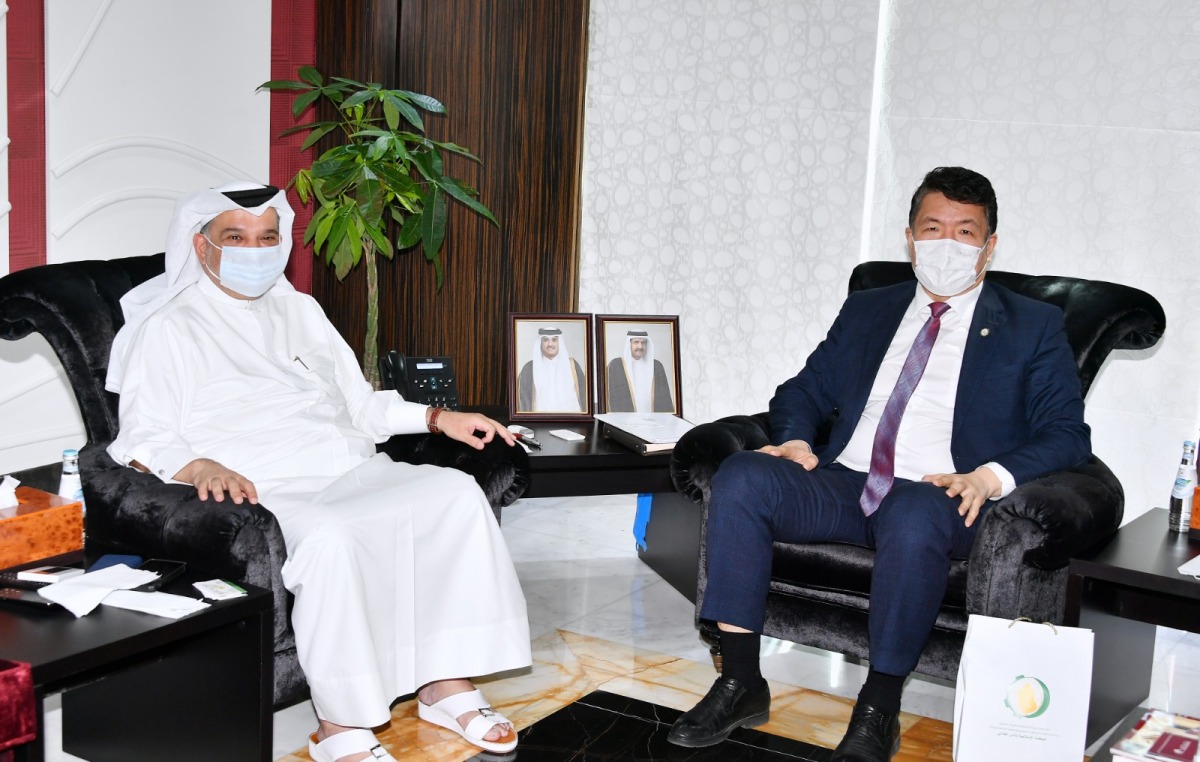
Qatar Chamber Board Member and Chair of its Food Security Committee Mohamed bin Ahmed Al Obaidly (left) with the Director-General of the Islamic Organization for Food Security (IFOS) Prof. Yerian A. Baidaulet, during their meeting in Doha, yesterday.
Doha: Qatar Chamber (QC) Board Member and Chair of its Food Security Committee Mohamed bin Ahmed Al Obaidly met yesterday with the Director-General of the Islamic Organization for Food Security (IFOS) Prof. Yerian A. Baidaulet.
Ambassador of Kazakhstan to Qatar H E Arman Issagaliyev and the General Counsel of IFOS Nursalim Suleimenov were also present during the event.
During the meeting, both sides discussed ways to enhance cooperation between both institutions, as well as cooperation in paving the ways for the Qatari private sector and its counterparts in the 36 Islamic member countries of the organization with the aim to promote mutual investments in agriculture and food sectors.
Al Obaidly underscored the importance of cementing cooperation among Islamic states in food security, stressing the need for these economies to be open to various global economies and build strong relationships in agriculture and food industries that allow the private sector to play an important role in enhancing food security in Islamic countries.
He also assured the importance of having a general accord governing the cooperation between the various parties in a way that boosts trade and investment exchange in the field of food security, noting the need to support agricultural investments and assist producers in marketing process.
Baidaulet praised the development of the food security sector in Qatar, pointing out that the organization seeks to foster cooperation relations with Qatar Chamber to encourage Qatari investors to invest in food industries in member states.
Elaborating the role of IFOS, he said that it aims to provide expertise and technical know-how to member states on various aspects of sustainable agriculture, rural development, food security, and biotechnology.
It also works to assess and monitor the state of food security in member states to be able to identify emergencies and provide social safety nets and humanitarian assistance through food security reserves.
He added that the organization seeks to coordinate, formulate, and implement common agricultural policies, such as exchange and transfer of appropriate technology and public food management systems.
“We address problems posed by desertification, deforestation, erosion, and salinity, as well as mobilize and manage financial and agricultural resources to enhance food security,” he added.