

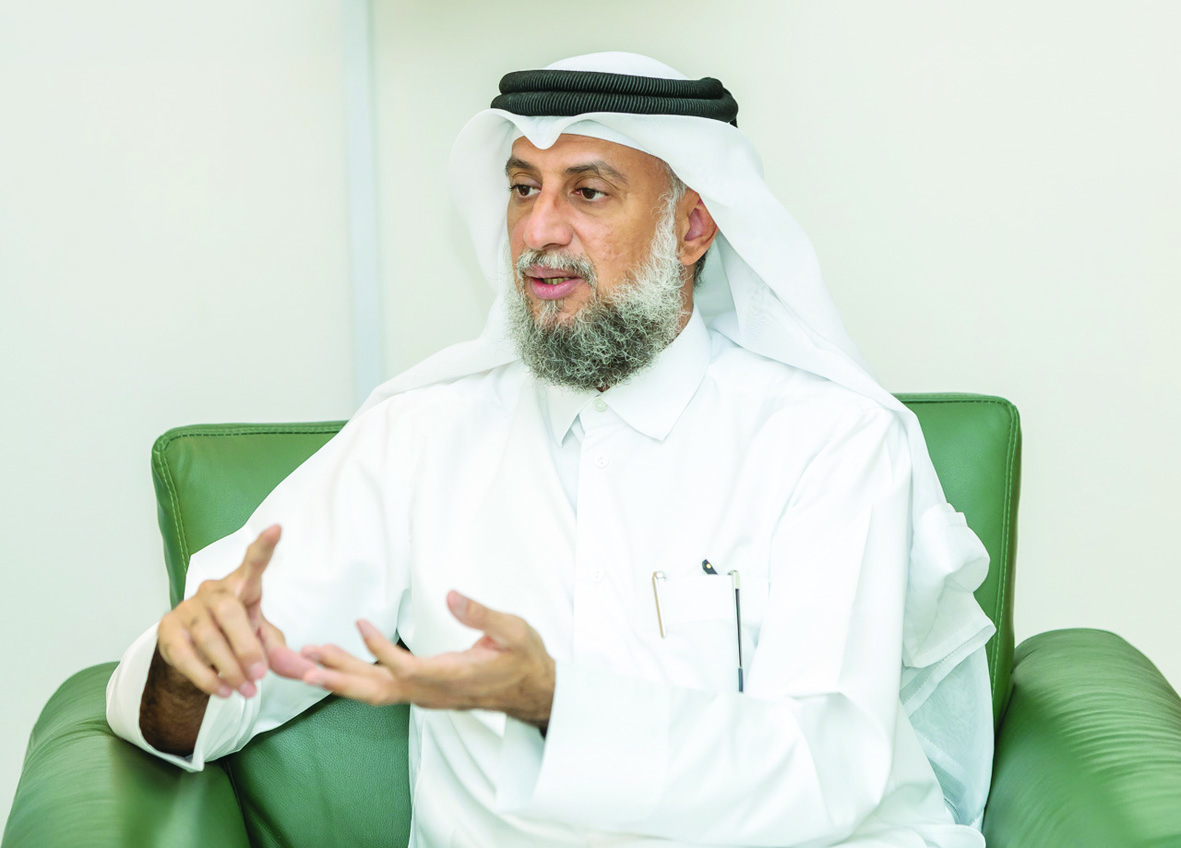
H E Dr Ahmed bin Mohammed Al Muraikhi, Special Adviser to the UN Secretary-General.
Doha: The relationship between the State of Qatar and United Nations organizations and agencies is firm, strong and distinguished said the Special Adviser to the Secretary-General of the United Nations H E Dr. Ahmed bin Mohammed Al Muraikhi.
The cooperation with the UN bodies was crowned with the opening of the representative offices of various UN agencies in Doha Al Muraikhi noted, pointing out that the most recent of which was the opening of the International Hub on Behavioral Insights to Counter Terrorism, which was preceded by the opening of many centers and offices of the UN agencies in various fields.
In an interview with Qatar News Agency (QNA), Dr. Al Muraikhi pointed out that Qatar’s hosting of representative offices of UN agencies, as well as the imminent opening of the United Nations House proves that the State of Qatar is moving forward in strengthening multilateral relations. It also clearly reflects the State of Qatar’s trend towards strengthening its regional and international position by affirming that it is a state sponsor of peace and that it places multilateral international cooperation among its priorities to enhance the efforts of achieving the UN development goals and efforts to combat terrorism.
In this context, he pointed to the cooperation between the UN and the Ministry of Foreign Affairs, Qatar University, and the Qatar National Commission for Education, Culture and Science to achieve a mechanism directed at school and university students of the younger generation with the aim of introducing them to the mechanisms of UN action and qualifying them to work within UN organizations by involving them in the international meetings held inside and outside the State of Qatar, visiting the centers of UN organizations and refugee camps and closely introducing them to the methods of international action and raising their awareness about those methods.
Al Muraikhi added that these efforts would inform youth and encourage them to work with UN organizations and various international organizations and motivate them for those aspirations, which will lead these organizations to understand the nature of the Qatari society. It will also achieve the national goals that guide the state in increasing international cooperation and building bridges of mutual understanding and gain.
In regards to Cooperation between the UN bodies and Qatari official institutions he also referred to the cooperation with the Ministry of Commerce, the Qatar Financial Centre, and the Qatar Chamber of Commerce to create a partnership between the Qatari private sector and UN organizations, as a series of introductory sessions will be held, targeting the Qatari private sector related to how to establish a constructive partnership between it and the UN organizations to reach a form of cooperation to create an effective presence of the Qatari private sector on the international arena.
Regarding the spread of the Coronavirus pandemic in the world, its impact on various aspects of life and its effects on humanitarian work in particular, the Special Adviser to the UN Secretary-General, stated that 2020 was a great challenge to the course of humanitarian work as the world faced the pandemic and its impact on achieving the UN development goals.
He further stressed that the impact of the pandemic has contributed to the increase in humanitarian needs worldwide, an increase of 40 percent over last year.
Dr. Al Muraikhi underlined that despite these challenges, UN was able to create an opportunity to promote unconventional work, with many creative visions, ideas and methods, and by adapting technology to achieve sustainable development goals.
He said that the Coronavirus pandemic has had a major impact on countries in general, let alone refugee camps, which suffer from difficult living conditions that have been made more difficult by the pandemic. Nevertheless, UN was able to overcome that impact and come up with unconventional methods that does not affect daily life in the refugees camps. It has managed them through the High Commissioner for Refugees and various UN organizations. The spread of the disease in the camps was limited due to adapting appropriate methods to cope with the pandemic situation, he added.
H E Al Muraikhi talked about the importance of engaging the private sector worldwide with United Nations agencies and building bridges of cooperation between them in order to resolve many issues and achieve the seventeen goals of sustainable development.
There is a great response by the private sector, represented by major international companies in various fields and the United Nations organisations and all concerned parties with the aim of cooperating in developing a vision on how to provide assistance and support to poor and needy countries, Al Muraikhi said.
Al Muraikhi talked about the initiative that was put forward at the World Humanitarian Summit in Istanbul, Turkey, and use of Islamic financing tools such as Zakat, charity, endowments, with the aim of achieving a shift that contributes to meeting humanitarian needs, by using these tools and trying to harmonize them with the tools of the UN will maximum the benefit. He described this initiative as very important as the largest proportion of the humanitarian needs are concentrated in the Islamic world, specifically in the Middle East. By looking at the estimates of zakat in the Islamic world, it turns out that they range from $300 to 600bn, which highlights the importance of finding a mechanism to fill the need gap through that initiative, and for Muslims to prove to the world the extent of their effectiveness and solidarity by harnessing these incomes according to an international mechanism to meet the humanitarian needs in the world, he said.
Additionally, he pointed out that there are United Nations organizations that are actually implementing these financing policies. The UN will launch during the coming period a dialogue between Sharia specialists and specialists in Islamic finance, and between experts and specialists of the United Nations, he said, noting that this is the first step in the process of achieving the initiative.
Al Muraikhi said that according to the UN Humanitarian Action Plan announced in early December, there are 56 affected countries, and 235 million affected people. With the increasing needs, USD 35 billion is needed to achieve the minimum of their needs, and it is necessary to create new and effective methods, take advantage of the mechanisms they have, and try to adapt them to meet those needs.
He explained that humanitarian work faces difficulties with regard to the safety of the transfer of funds from internal to external, indicating that the initiative will create safe, transparent and observed channels, which requires extensive study and opinions of specialists in all areas related to Islamic and international finance, adding that this issue will be raised during the World Islamic Economic Forum (WIEF) in Doha and will be discussed and taken into consideration.
He also explained that in conflict situations, humanitarian work faces a difficulty in the fact that it deals with multiple parties that are not connected with the state and not subject to international law, unlike in sports where parties are official governments or governmental organizations and bodies that are subject to international law and UN resolutions.
On the important role that sports play in immigrants’ camps, he stressed the success of using sports as a means of alleviating the spare time that the youth face everyday, by bringing them together and strengthening their bonds of cooperation.
During his interview with QNA, His Excellency stressed that the State of Qatar donated $500m to support the basic resources for United Nations organizations, and donated another $63m, which was announced during the Doha Forum activities.
H E Dr. Ahmed bin Mohammed Al Muraikhi pointed to the response of the United Nations organizations to the Qatari effective efforts in the international community, which proves the State of Qatar’s progress in achieving its national vision 2030, through its endeavors to achieve international security and peace and achieve multilateral international cooperation.
With regard to the issue of refugees and the efforts to provide safe areas for their return, the Special Adviser to the Secretary-General of the United Nations stressed that the return of refugees and the resolving of the asylum file represent a major challenge for all active states and international and humanitarian organizations.
He added that through these data, the UN and its agencies are making great efforts to convey that image to the countries concerned and to demand that they take a position on this matter by stopping fighting and war and allowing the return of refugees and providing safe areas for them. He cited the peace process in Afghanistan and the great efforts of the State of Qatar in the success of that process to bring peace to Afghanistan, affirming that these efforts have demonstrated the ability of countries to create influence and achieve peace. He noted the firm position of the State of Qatar, and its belief in the principle of dialogue and sitting at the dialogue table, stressing the impossibility of achieving any solutions without dialogue.
About the South-South Cooperation, Dr. Al Muraikhi explained that this issue is one of the files that he worked on as commissioned by the Secretary-General of the UN, pointing out that most of the countries of the South are countries in need of assistance. Accordingly “South-South” cooperation has been established for encouraging mutual cooperation between the countries of the South and achieving an exchange of experiences in addition to shedding light on the cooperation of Arab countries among them, he said. To achieve this, an office at the United Nations under the UNDP was founded and it is concerned with how to achieve cooperation between countries of the South.







