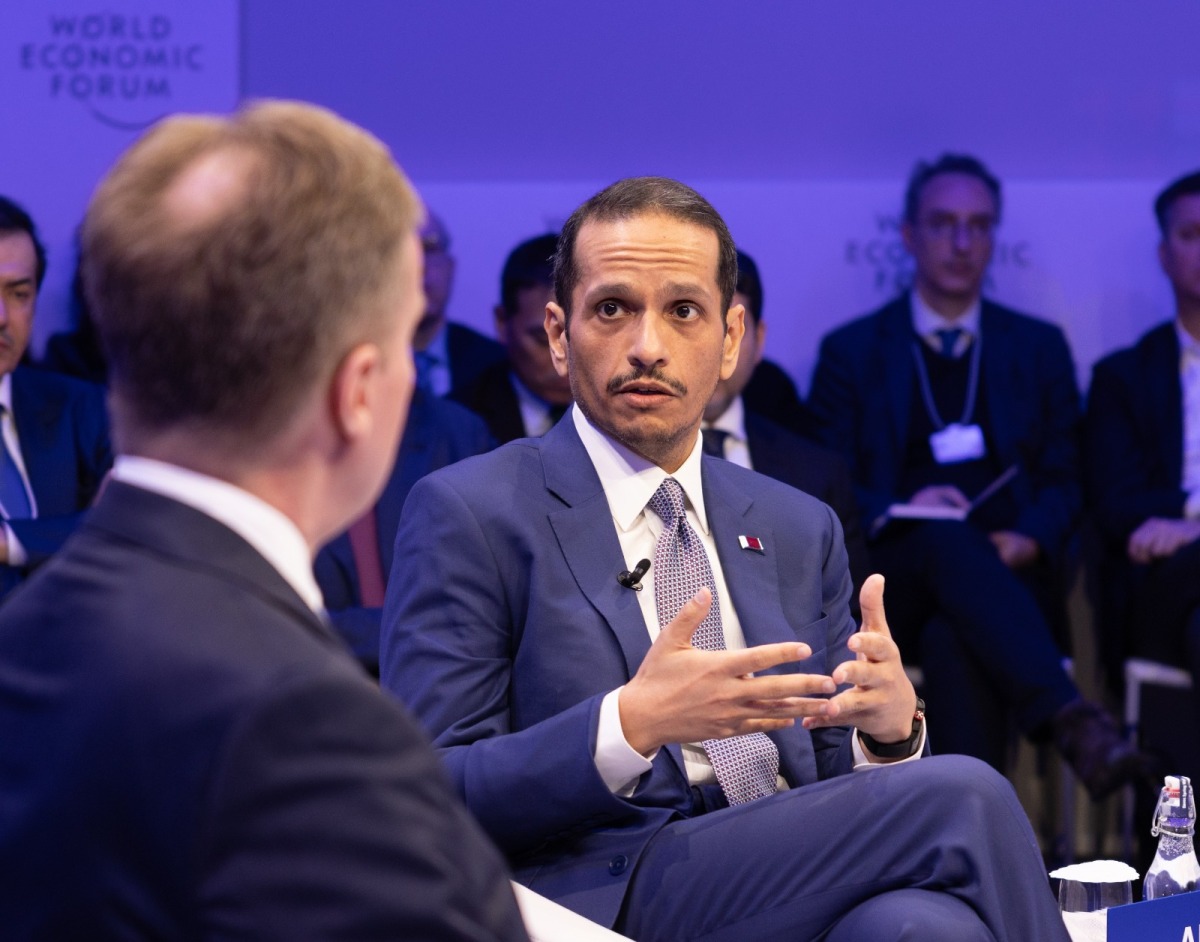
Davos: Prime Minister and Minister of Foreign Affairs HE Sheikh Mohammed bin Abdulrahman bin Jassim Al-Thani said Tuesday the Palestinian cause is a central issue for the Middle East and the world.
Speaking at a panel at the World Economic Forum in Davos on Tuesday, HE said that the international community's reaction to the war in the Gaza Strip was unfortunately disappointing for the people of the region and that there is a need to find an immediate solution and ways to end the war as soon as possible, and to release both hostages and Palestinian prisoners.

For the first time in modern history and in a situation like this, even the call for a ceasefire has become a controversial term, and the only effective way to reach a ceasefire is related to the exchange of hostages, which faces many challenges, His Excellency said.
His Excellency stressed the need to address the issue in the West Bank as well, adding that the media doesn't convey much of what is happening there. He pointed out that the situation in the West Bank is not better than what is happening in the Gaza Strip, as there may not be comprehensive bombing, but there are killings and violence by settlers, and the extremist government calling for ethnic cleansing of the Palestinian people, and unfortunately, there hasn't been a real reaction from the international community.
His Excellency underscored the need to address the rift of Palestinian factions as a prerequisite to implementing the principle of the two-state solution, warning that a two-state solution cannot be reached without the Israeli government and politicians showing a strong belief in peaceful coexistence and bringing the war to an end.
Highlighting the huge impacts of the repercussions of the war on the Gaza Strip on future generations, His Excellency said the death toll and horrific images from the war would bear grave short, medium and long-term impacts. With the children and families watching their relatives and parents being killed in bombings amid international indifference, future generations in the region, Europe and the whole world will only show anger and loathing, His Excellency said.

Commenting on the reconstruction in the Gaza Strip, His Excellency said the reconstruction conference, which was jointly hosted by Norway and Egypt following the 2014 Israeli war on Gaza, saw many countries pledging to provide large sums of money to reconstruct the Gaza Strip, but the matter did not go beyond that, because most of these countries do not believe that the situation would be sustainable.
From time to time, almost every year, limited-scale tensions have escalated in the Gaza Strip, leaving a lot of destruction, His Excellency added.
The devastation in Gaza left over 23,000 people killed, almost two-thirds of whom were women and children; Nearly there is no Gaza anymore, There is nothing there, the shelling targets the entire Gaza Strip, which necessitates a post-war reconstruction of the whole city, His Excellency added.
Regarding the escalation in the Red Sea and whether it could lead to an expansion of the war in the Gaza Strip regionally, HE Prime Minister and Minister of Foreign Affairs Sheikh Mohammed bin Abdulrahman bin Jassim Al-Thani stated that the current global situation is taking a challenging turn, adding that Qatar has previously warned against the expansion of war and its extension in the region, emphasizing that its impact will not be confined to Gaza alone but will extend beyond that.
His Excellency added that this escalation started in southern Lebanon, then in Syria and Iraq, and now in the Red Sea, noting that the escalation in the Red Sea is currently the most dangerous because its impact is not limited to the region but also affects global trade.

His Excellency explained that this has changed the view of global trade and shipping, and also changed the extent of the interconnectivity from east to west as when something happens in the Middle East, it affects everyone.
His Excellency expressed concern about the escalating situation in the Red Sea and the widening scope of the crisis, stating that Qatar always prefers diplomacy to military solutions and believes that the focus should not only be on these small conflicts but on the main conflict in the Gaza Strip because resolving this conflict will lead to the resolution of other issues.
He pointed out that during the six or seven days of the pause in Gaza for the release of hostages, all other fronts were simply closed at the same time, and this shows the impact of the central problem.
On another note, His Excellency stressed that the impact on freedom of navigation is a global issue that must be contained, but a military solution will not lead to its end, on the contrary, it will lead to increased escalation and exacerbate the situation further.
Regarding the impact of attacks in the Red Sea on Qatar's exports of liquefied natural gas, His Excellency said that liquefied natural gas, like any commercial shipments, will be affected.
He added that there are alternative trade routes, but these alternative routes are not more efficient; they are less efficient than the current routes.
HE Prime Minister and Minister of Foreign Affairs Sheikh Mohammed bin Abdulrahman bin Jassim Al-Thani also emphasized that the Islamic Republic of Iran and the Gulf Cooperation Council (GCC) countries are neighbors, and the rapprochement between them is a necessity, not a luxury.
His Excellency stated that there is a common understanding among GCC countries that it is crucial to focus on how to engage with Iran, create a better ground of common interests and understanding, and build on that to address the differences through dialogue and face-to-face problem-solving.
He pointed out that there is a great opportunity, and this momentum is still ongoing between the GCC countries, which was clear in various meetings.
He added that there would be immense possibilities that would be available if the GCC and Iran cooperated economically in addition to the impact on regional security if there is a serious and sincere dialogue about various issues in the region that can be contained through the cooperation of all those countries.
In response to a question about development plans in Qatar, HE Prime Minister and Minister of Foreign Affairs Sheikh Mohammed bin Abdulrahman bin Jassim Al-Thani stated that Qatar has invested in infrastructure and energy over the past two decades. He added that around USD 200 billion has been invested in infrastructure over the past ten years alone, pointing out that Qatar has successfully built national champions, possesses one of the top 10 sovereign wealth funds, has one of the world's best airlines, and a pioneering energy business model in the field of liquefied natural gas supply.
His Excellency pointed out that the government is exploring how to leverage the existing infrastructure and that its role is transitioning from development to empowerment, particularly empowering the private sector to take a leadership role. He added that in the coming year, the government will focus on reforming the policies and changing some regulations to remove barriers for companies, in addition to allocating billions to stimulate and empower the private sector to lead growth to create a qualified workforce for the country.
His Excellency added that there is excitement in various sectors, such as tourism, as during the 2022 FIFA World Cup, Qatar welcomed around 1.6 million people during the event, and this year the number reached 4 million, demonstrating the growth and potential in the country. The expansion of the North Field will represent 40 percent of the additional supplies of liquefied natural gas (LNG) in the world by 2029, he explained.
Regarding Qatar's foreign policy and its role in global peace and security, His Excellency highlighted mediation as a fundamental element of Qatar's foreign policy and constitution. He added that Qatar's mediation efforts are based on the belief that this is vital for a small country as it provides the flexibility to move forward faster and helps in establishing good relations with everyone, pointing out that Qatar considers the mediation efforts as a contribution towards global peace and security.
His Excellency emphasized that HH the Amir Sheikh Tamim bin Hamad Al-Thani has always been clear on this matter, stating that righteous deeds do not go unpunished, despite criticism and scrutiny, Qatar maintains relationships with various entities and engages in mediation to save lives, even if the efforts will lead to saving one life, it's worth it, and that's Qatar's principle.
He added that some politicians are trying to achieve some political victory here or there by playing into the role that Qatar plays, but ultimately, Qatar's actions during conflicts, both within and beyond the region, have demonstrated its commitment to peace, as seen in Ukraine, Venezuela, Chad, Djibouti and Eritrea, and recently in Gaza, where negotiations led to the release of 109 hostages and not military operations, which highlights the strength of diplomatic negotiations.