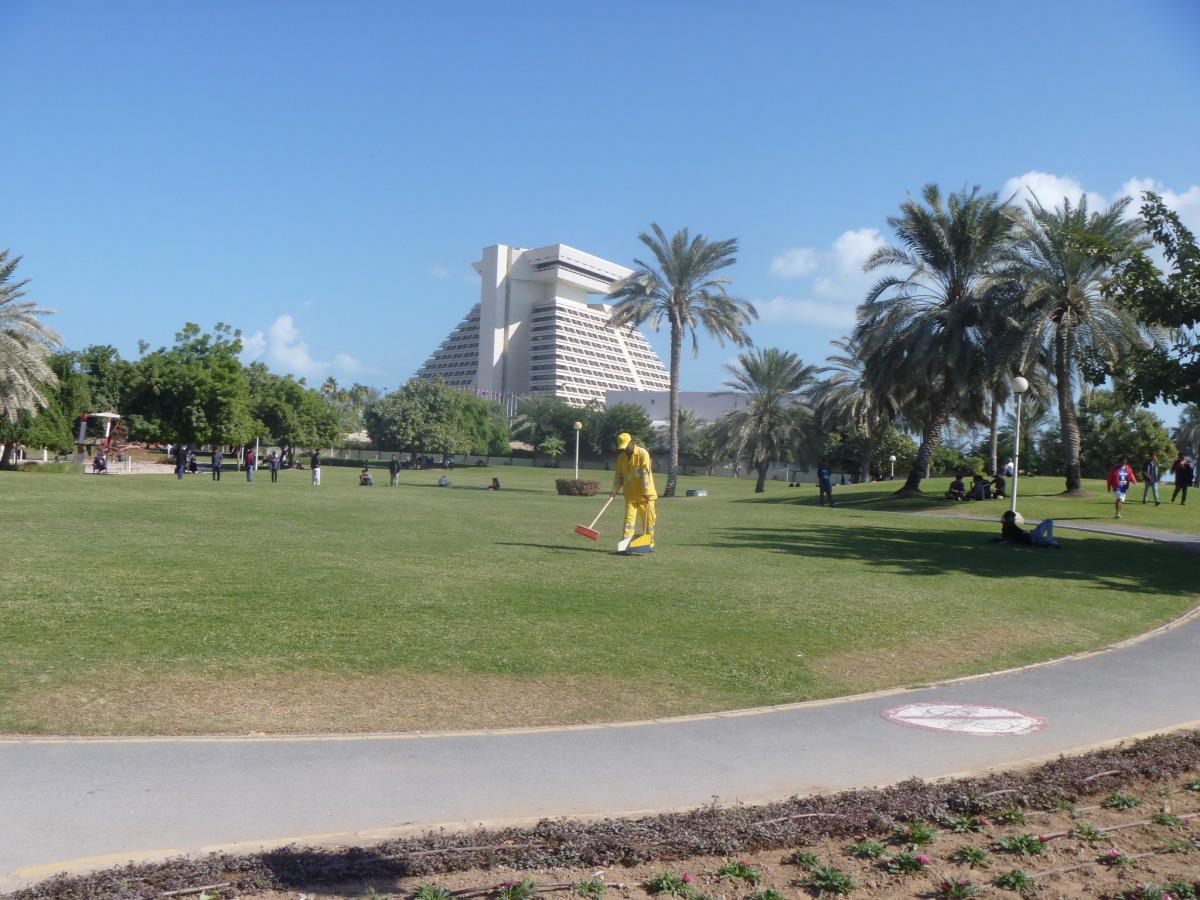
File picture used for representation.
Doha: The Ministry of Municipality and Environment, represented by the municipalities, will begin implementing the new public hygiene Law No. 18 of 2017 starting from February 1.
“The municipal inspectors and employees armed with judicial power from general monitoring sections will start catching violations, issuing warnings and punishing according to the new law,” said Safar Al Shafi, Director of General Cleanliness Department at the Ministry in a statement.
Under the preparation for the implementation of the new law, the Minister of Municipality and Environment H E Mohamed bin Abdullah Al Rumaihi issued ministerial decision No. 358 of 2017 to form a working team led by Safar Al Shafi, Director of General Cleanliness Department to prepare the legislative tools for the public hygiene law.
The team is comprised of members from the municipalities, environmental affairs section, legal affairs department of the Ministry.
The team was assigned to prepare draft executive regulations for public hygiene law in coordination with authorities concerned.
The team was also asked to prepare necessary draft ministerial decisions for the implementation of the law and coordinate and communicate with municipalities and authorities concerned for implementation of the new law.
The Ministry of Municipality and Environment held a workshop on “Judicial Power in the Field of Public Hygiene” from January 9 to 11.
The workshop was attended by heads of the monitoring and cleanliness departments from all municipalities. The programme aimed at educating participants about public hygiene law and to increase their skills and provide them with necessary legal knowledge in the field of general monitoring.
A number of topics were discussed during the workshop, including a draft of ministerial decisions to be issued by the Minister to implement new public hygiene law and the views of the municipalities concerned regarding the implementation of the relevant laws.
Other topics of discussions were the feasibility to invite private sector for collecting waste and recycling it and regulations for transporting waste, specifying its route and timings.
The forms for booking violations, issuing warning and undertaking were also revised to upgrade them according to the new law. The procedures for catching violations by the inspectors armed with judicial powers were revised. The inspectors were also educated about fine and reconciliation amount.
The Ministry has prepared a media campaign and a comprehensive awareness programme to educate people through print, electronic media and social networking sites in a bid to raise awareness among the public as they have an important role in maintaining public hygiene in the cities and to protect the environment.
The municipalities directed the inspectors of public hygiene to upgrade the forms being used for catching violation as per the new public hygiene law that will come into effect from February 1, 2018.
The inspectors were introduced to their roles and mechanism for catching violations as per the new law.
The inspectors were taken to field visits to work sites to teach them practically about types of violations and fine amount as per the new law.
Speaking on the implementation of new public hygiene law, the Director of General Cleanliness Department, Safar Al Shafi (pictured belows), said that the promulgation of Law No. 18 of 2017 on Public Hygiene and Cleaning has been enacted in a timely manner.
“There is an all-inclusive and unparalleled constructional and developmental renaissance in the country which requires amending the law including public hygiene and cleaning services and environmental health, ” Al Shafi said.
He added that the new law has much in common with the objectives of the previous law and is even considered a complementary enactment thereof.
“Accordingly, one may say that the new law is more comprehensive and largely fulfills the developments of the current and future eras as well as the behavioral changes usually taking place within the context of social mobility due to the demographic, economic and cultural variables and the different cultures adopted by the segments of the society in Qatar.”

“The Law also assists in eliminating the additional efforts of the Public Cleanliness Department due to the continuous cleaning of the wastes which are thrown away in a random, irresponsible and illegal manner,” Al Shafi added.
Al Shafi pointed that the new law is strict in addressing the violations which impede the provision of public hygiene services on a round-the-clock basis.
“This is manifested in applying its provisions which range between imprisonment, levying fines or both penalties as set out in Article No. 15 of the law. There are violations where conciliation is strictly prohibited,” said Al Shafi adding that with respect to the reasons for the variations of fines under the law, out that this is a natural matter in accordance with the seriousness of the violation.
He added that the new law is the result of handwork and the long study conducted by specialists at the Ministry of Municipality and Environment in a bid to achieve Qatar National Vision 2030 under the directive of H E Mohamad bin Abdullah Al Rumaihi, Minister of Municipality and Environment.
About the role of monitoring organizations in applying the law and the success thereof, Safar Al Shafi said that the new cleaning law has been especially promulgated to assist inspectors in their work adding that this law directly targets at realizing success with respect to the hygienic operations and achieving its objectives so that our residential areas shall reach the required level.
“Penalty starts from QR300 up to QR6,000 depending on the type of violation and damage, provided that the reasons for the violation shall be eliminated.”

Al Shafi said that as for penalties in case no conciliation has been figured out, they include 4 procedures depending on the type of violation and pursuant to Article No. 15 of the Law: A term of up to 1 year imprisonment and penalty fines which shall not exceed twenty five thousand (QR25,000) or one of these penalties: a term of up to six months imprisonment and penalty fine which shall not exceed ten thousand (QR10,000) or one of these penalties.
On how does the new law deal with violators, Safar Al Shafi said, the law is very clear with respect to addressing hygienic contraventions.