

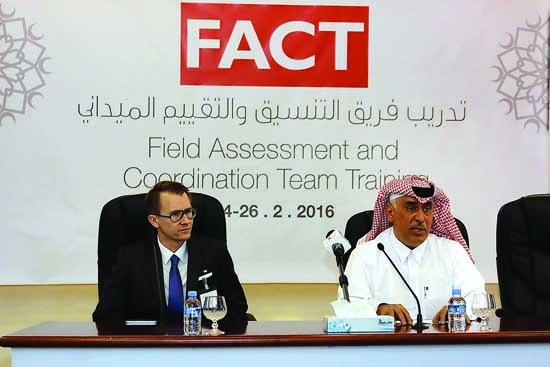
DOHA: For the first time in the Middle East and North Africa (Mena) region, Qatar Red Crescent Society (QRCS) is hosting the 23rd Field Assessment and Coordination Team Training (FACT), organised by the International Federation of the Red Cross and Red Crescent Societies (IFRC) and the British Red Cross.
The event started on Sunday and runs until February 24. It is attended by 34 humanitarians from 22 national societies from around the world and IFRC representatives.
Qatar is represented by three QRCS volunteers.
Supervised by IFRC trainers and experts, the FACT is a key part of relief training in the Red Cross and Red Crescent Movement to build an effective team from national societies ready for deployment within 24 hours following large, complex and slow-onset disasters anywhere in the world.
The opening ceremony was attended by Saleh bin Ali Al Mohannadi, Secretary-General, QRCS.
“Since I started working with QRCS, we have been offering disaster management courses in cooperation with IFRC, and I saw how important it is to have tools particularly in disaster information gathering and needs assessment. We have seen many disaster responses that turned out to be disasters due to the absence or inefficiency of the FACT team,” he said.
Al Mohannadi highlighted QRCS’s intervention in Nepal earthquake last year, when its relief workers acquired teamwork experience.
“I thank IFRC and the British Red Cross for cooperation in holding this course in Doha.
“We believe in the importance of having this type of training, so we engaged three participants from Qatar, who will later join their three already trained colleagues. This way, Qatar will have six FACT members,” Al Mohannadi added.
Sone Bulow, Senior Surge Desk Officer, IFRC, said, “I am happy to be in Qatar, which was selected to host the FACT training to expand its scope to the Mena zone.
“IFRC seeks to reinforce links with QRCS to make sure the national relief capacity is up to international standards,” Bulow added.
The course has two parts. The six-day theoretical part involves lectures and workshops on FACT mission cycle, internal operational planning, RCRC coordination architecture, multi-sectoral assessment, team dynamics, information management, technical sectors and global tools, HR, finance, legalistic, communications, developing an action plan, leadership, transitional planning and handover strategy, preparation of donor and stakeholder meetings, and lessons learnt from field relief operations.
Then, there is a disaster scenario for three days at the Marine Scouting Camp in Al Khor to practice information and skills learnt during the course in relation to coordination, assessment and development of response plans in cooperation with partners.
The Peninsula







