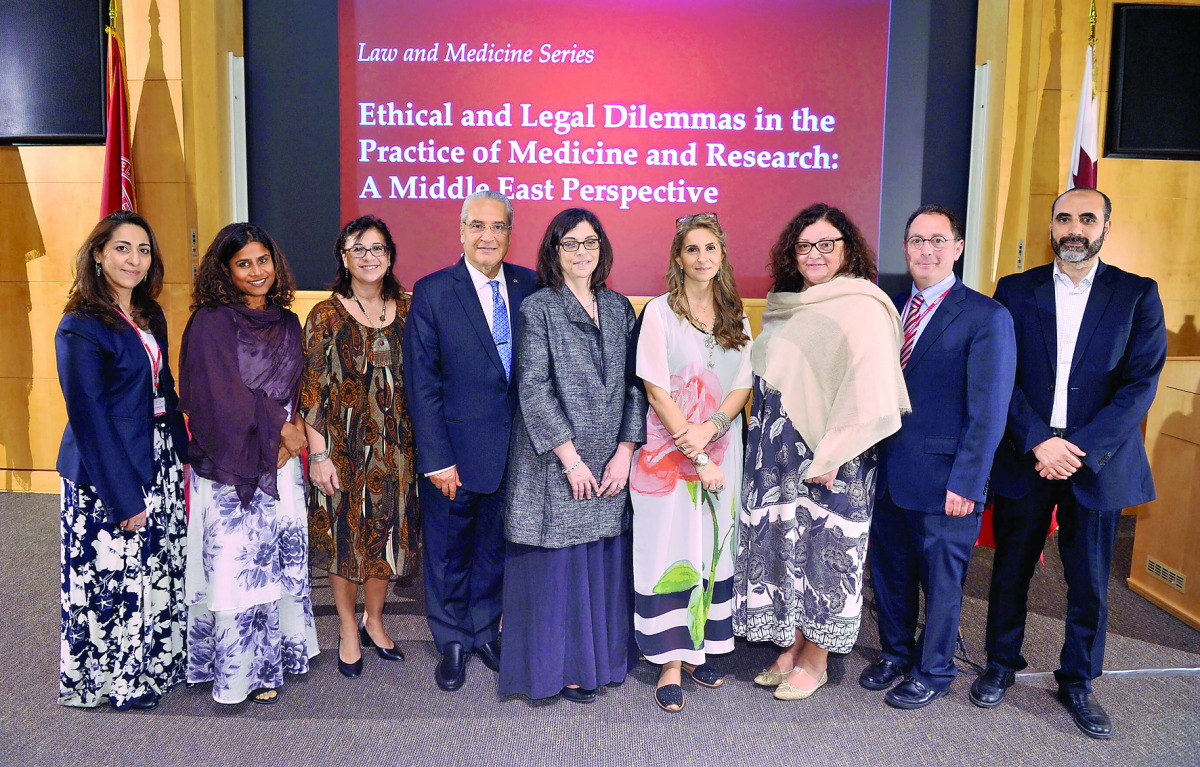
Legal experts and health care professionals from across the MENA region and the USA who attended the seminar at Weill Cornell Medicine-Qatar.
Medical and legal experts from the MENA region and the USA convened at Weill Cornell Medicine-Qatar (WCM-Q) to explore ethical and legal issues that arise in the practice of medicine and biomedical research.
The two-day seminar, which looked at the law and ethics of medicine from a Middle Eastern perspective, was attended by more than 250 health and legal professionals that included nurses, pharmacists, physicians, lawyers and government employees. The event featured presentations on key issues in modern medicine, such as the ethics involved in obtaining informed consent from patients and research subjects, the moral dimensions of organ donation and transplantation, the ethics and laws relating to stem cell research, confidentiality, and Islamic perspectives of medical ethics.
The seminar was a collaboration between WCM-Q and the Salim El-Hoss Bioethics & Professionalism Program of the American University of Beirut Faculty of Medicine, and was the latest in a series of events hosted by WCM-Q that explore the intersection between law and medicine.
Dr. Sunanda Holmes, Associate University Counsel and Assistant Professor of Health Policy & Research at WCM-Q, said: “The significant advances in modern medicine in the past decade in areas such as organ transplantation and stem cell research present health professionals with great new opportunities for healing their patients, but they also present new ethical dilemmas which require a robust legal framework to protect patients, practitioners and communities. This seminar aimed to help enhance understanding of these often highly complex issues and the roles of inter-professional teams such as physicians, nurses, bioethicists, lawyers among others to further patients’ interests while taking into consideration the longer term impact of medical innovation on humanity itself.”
Visiting speaker Dr Jeremy Sugarman, the Harvey M. Meyerhoff Professor of Bioethics and Medicine at the Berman Institute of Bioethics and School of Medicine at Johns Hopkins University, Baltimore, USA spoke about the ethical challenges of obtaining informed consent.
He said: “We have rules and procedures around consent, but these alone are not sufficient because in order for them to work they must be guided by the ethical principles of autonomous authorization and respect for persons. Dr Mohammed Ghaly, Professor of Islam and Biomedical Ethics at Qatar Faculty of Islamic Studies, gave a presentation about the ethics of the physician from an Islamic perspective.