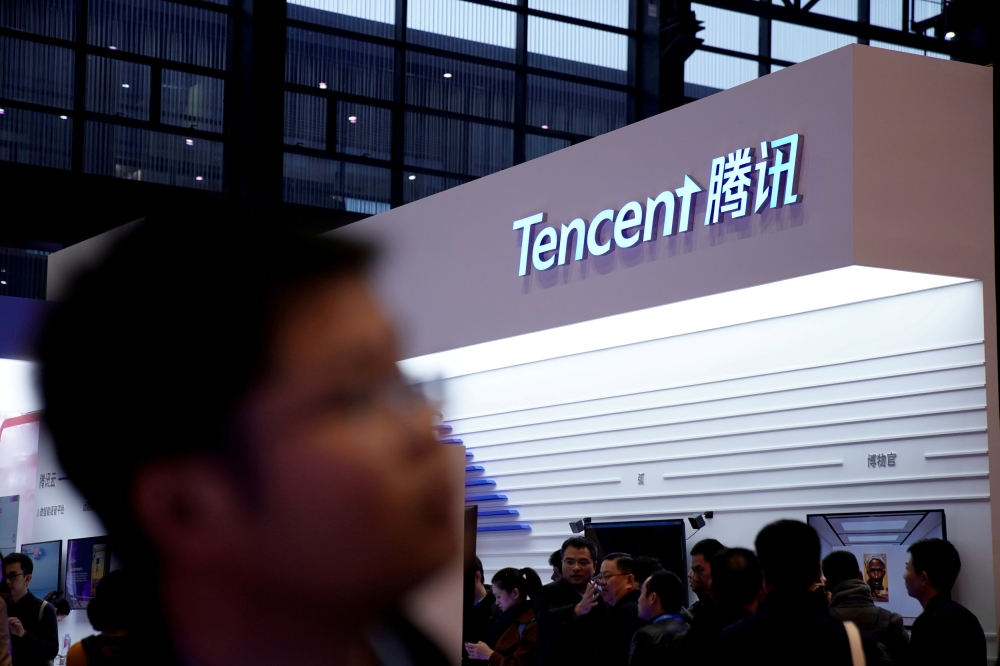
FILE PHOTO: A sign of Tencent is seen during the fourth World Internet Conference in Wuzhen, Zhejiang province, China December 3, 2017. REUTERS/Aly Song
Tencent Holdings Ltd. beat earnings expectations thanks to ads and a whopping one-time gain, buying it time to find an answer for its plateauing core gaming business.
The social media titan posted net income of 23.3 billion yuan ($3.4 billion) for the September quarter after recording a windfall of 8.8 billion yuan from investments, including the debut of Meituan Dianping. But revenue grew at its slowest pace in three years as a Chinese clampdown on gaming licenses continued to hammer its bread-and-butter division.
The government has effectively frozen new game approvals, which means Tencent’s been unable to make money off global hits Fortnite and PlayerUnknown’s Battlegrounds. That’s seen the stock -- the biggest member of the MSCI Asia Pacific Index -- shed more than $240 billion of market value since a January peak. While China is trying to combat gaming addiction and is reshuffling regulators, uncertainty persists with Tencent counting on its WeChat social network, advertising and belt-tightening to tide it over.
"People are just relieved that they didn’t perform even worse, so the shares could open up higher,” said Li Yujie, an analyst at RHB Research Institute in Hong Kong. "But the shares might not hold up for the full day, because if you look beyond the headline figures, you can see its gaming business is under stress.”
Tencent’s earnings also bucked a recent trend of disappointing results from China’s technology companies as a slowdown in the economy dampens the outlook. Alibaba Group Holding Ltd. cut its outlook for annual revenue, while search leader Baidu Inc. also predicted sales below estimates.
Chief Strategy Officer James Mitchell told analysts on a call that a worsening macroeconomic environment would hurt advertising in particular, but said the company was confident of outperforming its peers. Naspers Ltd., the biggest shareholder in Tencent, gained more than 3 percent in Johannesburg.
The profit rise of 30 percent compares with analyst estimates for growth of about 2 percent.
"Advertising growth helped the company in revenue this quarter,” said Benjamin Wu, a Shanghai-based analyst at Pacific Epoch. "Its gaming business wasn’t great, the PC gaming revenue is dropping when the third quarter is supposed to be a strong season, that spells trouble for the full year.”
Tencent still commands a powerful asset in WeChat: the ubiquitous messaging service used by more than a billion people to shop, pay for services and hail rides. That’s a massive population of longer-term consumers not just for games and ads but also fledgling services from video to financial services.
The company is also a key backer of Meituan, a food delivery and local services giant that held its initial public offering in September and provides another avenue to reach consumers.
That sheer reach is helping power its marketing machine. Online advertising jumped 47 percent in the third quarter. In terms of its smaller but fast-growing divisions, cloud revenue more than doubled in the quarter, while daily mobile payment transaction volumes rose more than 50 percent.
The gaming business however still yields the biggest chunk of its revenue, though that proportion’s dropped steadily as Tencent leverages WeChat. President Martin Lau offered little insight on the gaming-approval situation on the earnings call, saying "there’s not a lot of update” on that front.
The Value Added Services division, which includes games, grew just 5 percent. Drilling deeper, revenue from smartphone games climbed just 7 percent, while sales from PC titles dropped 15 percent. In the meantime, Tencent’s keeping its pipeline stocked with games developed by external studios that had already secured commercialization approval, Mitchell said.
Shares of Tencent fell 0.8 percent Wednesday before the earnings were released. The stock has slumped 33 percent this year.
"Tencent’s growth in 3Q smartphone game sales could reverse because of China’s uncertain regulatory environment and typically negative 4Q seasonality,” said Vey-Sern Ling and Tiffany Tam, analysts with Bloomberg Intelligence. "The 11 percent sequential gain was driven by positive seasonality and new titles that received monetization approvals prior to a regulatory freeze.”
(Updates with executives’ comments from the sixth paragraph.)
--With assistance from David Ramli, Jinshan Hong and Peter Elstrom.
To contact the reporter on this story: Lulu Yilun Chen in Hong Kong at [email protected]
To contact the editors responsible for this story: Robert Fenner at [email protected], Edwin Chan
For more articles like this, please visit us at bloomberg.com