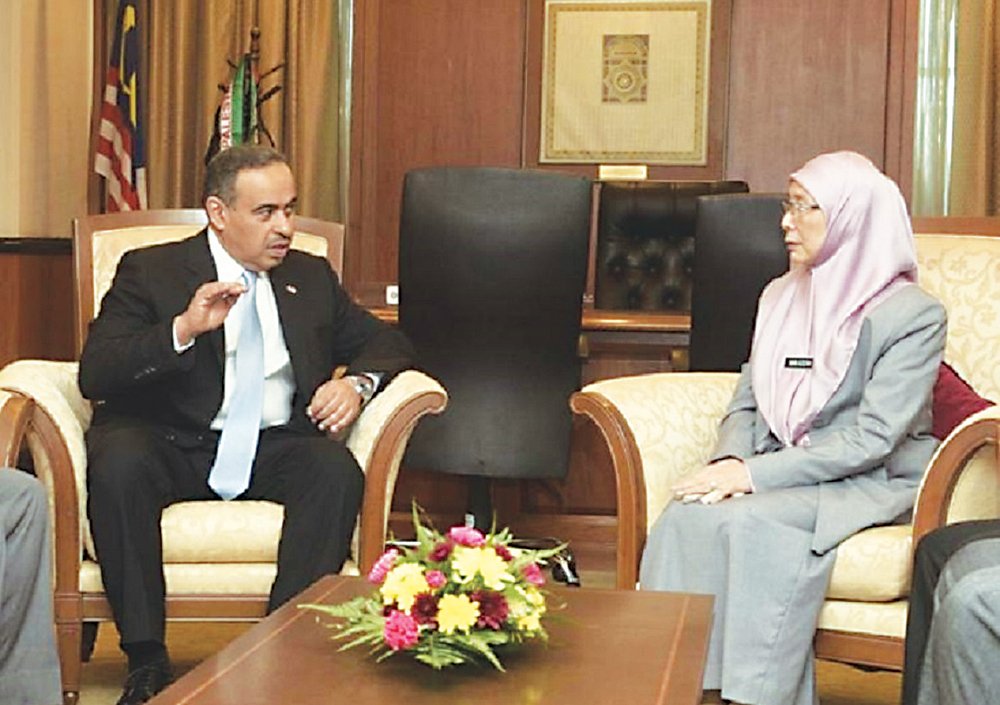
The Minister of Commerce and Industry, H E Ali bin Ahmed Al Kuwari, with the Minister of International Trade and Industry of Malaysia, Darell Leiking, on the sidelines of Qatari-Malaysian Joint Trade Committee in Kuala Lumpur, Malaysia, recently.
Qatar and Malaysia signed agreements to boost investment and trade cooperation between the two countries. A Memorandum of Understanding (MoU) was signed between the Qatar Investment Promotion Agency (IPAQ) and the Malaysian Investment Development Authority (MIDA) to cooperate in the field of investment promotion. Another MoU was signed between Baladna Food Industries Company and Malaysian State Felcra Berhard Company. Both MoUs were signed in the presence of Minister of Commerce and Industry H E Ali bin Ahmed Al Kuwari, and Minister of International Trade and Industry of Malaysia Darell Leiking.
The MoUs were signed on the sidelines of the second session of the Qatari-Malaysian Joint Trade Committee, which was held in the Malaysian capital, Kuala Lumpur from October 8 to 10. At the end of the second session, H E Ali bin Ahmed Al Kuwari and Darell Leiking, signed the minutes of the meeting.
H E Ali bin Ahmed Al Kuwari, in his opening remarks, called for strengthening bilateral cooperation between Qatar and Malaysia and said that he looks forward to bolstering bilateral cooperation and establishing a comprehensive strategic partnership with Malaysia.
Noting the promising prospects of strengthening and expanding bilateral partnerships, H E said that all indicators provide confidence that the future of Qatari-Malaysian cooperation is promising in light of the economic potential of both countries, which will bolster bilateral trade that reached $291m in the first half of 2019.
H E the Minister praised Malaysian companies for contributing to strengthening bilateral economic relations, noting that over 85 Malaysian companies including 13 fully owned Malaysian firms and 72 jointly owned Qatari-Malaysian companies are currently operating in the engineering, construction, oil and gas and information technology sectors.
Malaysia represents an attractive destination for Qatari investments in the tourism, hospitality, financial, real estate, and industrial sectors among other vital economic fields, H E the Minister said, underscoring Qatar’s keenness to invest part of its resources in the economies of its strategic partners.
H E the Minister stressed the need to pursue joint efforts at the governmental level to enhance trade and investment, emphasizing in this context the importance of streamlining negotiations to ratify and implement the agreement on the Mutual Promotion and Protection of Investments which will provide a framework for the promotion of joint investments.
“We are called upon today to strengthen our efforts to establish and activate the Joint business council, adopt effective coordination mechanisms, organize additional economic forums and form joint working groups to develop bilateral relations and hold interactive meetings between Qatari and Malaysian companies to explore and discuss joint cooperation mechanisms including the exchange of investments and expertise in the priority areas of our economies,” H E the Minister stressed.
H E touched on Qatar’s success in recent years in implementing major development projects, which has cemented its position as one of the region’s most stable, competitive and growth-oriented economies.
Quoting the World Bank’s latest report, H E the Minister said Qatar’s economy will grow by 3.4 percent by 2021, driven by higher growth in the services sector as the 2022 FIFA World Cup approaches compared to a constant-price GDP growth rate of 1.43 percent 2018 when economic activity recovered from the impact of the illegal and unjust blockade imposed on our country since 2017.
H E the Minister noted that Qatar’s economy has witnessed a significant boost as new national companies went public and more than 823 Qatari companies was established in the field of food production, services and manufacturing industries in addition to the expansion of industrial cities, which will feature 769 industrial land plots as work continues to complete 337 projects in the manufacturing sector and create promising investment opportunities in non-oil sectors.
These positive indicators are the result of economic policies implemented in accordance with the objectives of our Second National Development Strategy 2018-2022. H E the Minister noted that Qatar has attached great importance to supporting the private sector in line with its belief that it plays a key role in promoting competitiveness and economic diversification.
H E the Minister explained that Qatar has begun to fast-track the implementation of measures aimed at supporting the private sector by offering public-private partnership projects and establishing incentive programs to attract foreign direct investments.
In this context, Qatar has developed business legislations and regulations to allow foreign investors up to 100 percent ownership in all economic and commercial activities, H E the Minister said. Qatar has recently approved a draft law regulating public and private partnerships with the aim of offering new opportunities to the private sector and involving companies in the implementation, construction, financing and operation of the state’s various facilities. Both sides agreed to take the necessary measures to strengthen trade and investment cooperation, with the aim of increasing bilateral trade and streamlining the flow of goods, services and investments between the two countries.