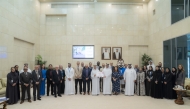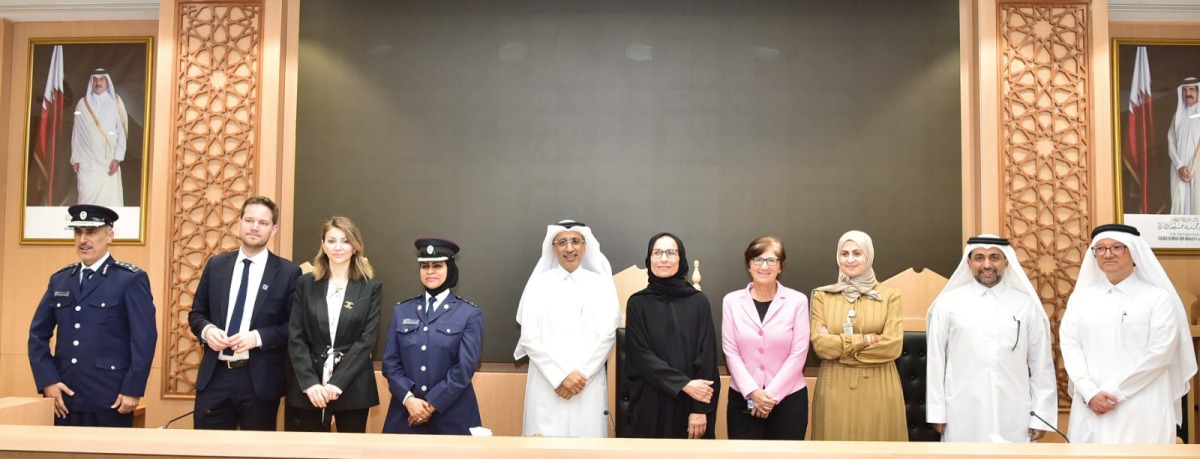
President of the Supreme Judiciary Council and President of the Court of Cassation, H E Dr. Hassan Lahdan Al Mohannadi (sixth right); QU President, Dr. Hassan Al Derham (second right); former President of QU, Prof. Sheikha Abdulla Al Misnad (fifth right); Dean of College of Education, Dr. Hessa bint Hamad bin Khalifa Al Thani (third right); Dean of the College of Law at QU, Dr. Talal Abdullah Al Emadi (first right) and other dignitaries and participants during the conference.
Doha: The International Center for Human Sciences (under the auspices of Unesco and in partnership with the German Konrad Adenauer Foundation – the Rule of Law Program in the Middle East and North Africa) and QU College of Law recently held a regional conference, titled: “Arab Women in the Judiciary: Achievements and Challenges,” at Qatar University (QU).
The event was held in alignment with the United Nations General Assembly resolution No.75/274 on April 28, 2021, with Qatar an active participant in its drafting to celebrate the International Day of Women Judges.

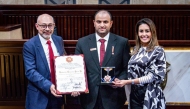
Dr. Talal Abdullah Al Emadi (left), Dean of the College of Law at Qatar University, and Dr. Hessa Al Sulaiti, Qatar's first woman judge during the conference.
The resolution states that “The General Assembly calls upon all its members and the agencies of the United Nations, the other international and regional organisations and civil society including, non-governmental organisations and academic institutions and networks of women judges, wherever they are and all concerned stakeholders to celebrate the International Day of Women Judges every year in the most suitable manner they view, including through cultural and public awareness activities to enhance the full participation of women, as men at all levels of the judiciary.”
It was also passed in response to the UN 2030 Sustainable Development Goals (SDGs).
In a statement, organisers said, “The Qatari experience in women’s leadership in the judiciary has witnessed every success. The participation of a group of Qatari female judges – who are QU alumni – in our conference as a panel was a showcase of which we are proud. Thus, academic institutions, including law schools, are important in framing and motivating women to join judicial institutions.
“In this regard, it is worth noting that the program of “Judges of Tomorrow,” which is implemented by the Supreme Judiciary Council in cooperation with the College of Law at Qatar University, aims at encouraging Qatari students of both genders to join the judiciary, and according to high academic standards. There are also law clinics and moot courts which we think of high importance in this regard, and to promote women’s rights according to international comparative models.”
The statement also added that the Islamic heritage is replete with honourable examples of women assuming high judicial positions and tasks. Women can bring about change from the position of “leadership” to advance the movement of history forward and to benefit society in its various aspects.
“We value our partnership with Dr. Darina Saliba, the Director of the International Center for Human Sciences partnership and Philipp Bremer, the Director of the German Konrad Adenauer Foundation the Rule of Law Program (MENA),” it added.
The event lauded Qatar’s leading educators and champions of education and life-long legal learning, including the Permanent Representative of the State of Qatar to the United Nations, H E Sheikha Alya Ahmed Al Thani, first Qatari judge Court of the Appeal, Dr. Hessa Al Sulaiti, President of the Supreme Judiciary Council and President of the Court of Cassation, H E Dr. Hassan Lahdan Al Mohannadi, QU President, Dr. Hassan Al Derham, QU fifth President and first female President, Prof. Sheikha Abdulla Al Misnad, Dean of QU College of Education Dr. Hessa Hamad Al Thani, and HBKU College of Law Dean, Susan Karamian.