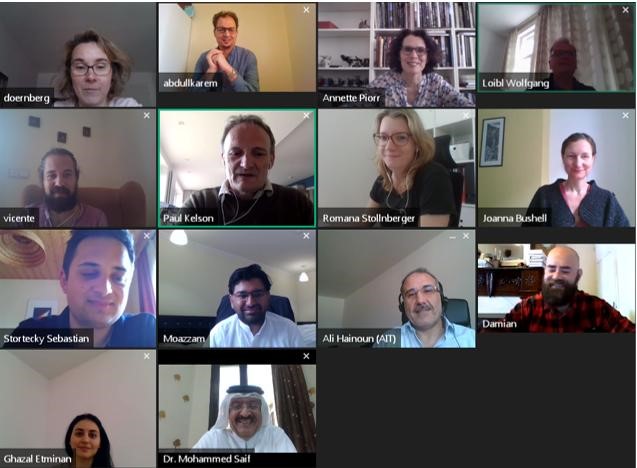
Doha: The Joint Qatari-European-American global research team for food-water-energy (FWE) nexus project (SUNEX) held its fifth meeting recently via video conferencing to discuss the project progress activities, and to reprioritise the research elements within the project to support Qatar and other countries to face the global COVID-19 pandemic.
During the meeting, the scientists shared the results obtained from three analytical models developed, which showed promising data with useful outcomes, said a release.
This meeting was attended by Dr. Muhammed bin Saif Al Kuwari, Director of the Center for Environmental and Municipal Studies, representing the Ministry of Municipalities and Environment (MME), and Dr. Abdulkarem Amhamed, Energy Efficiency Program Director, representing Qatar Energy and Environment Research institute (QEERI) at Hamad Bin Khalifa University.
Dr. Al Kuwari and Dr. Amhamed jointly said that, in the near future, the team will have a food database that will benefit decision makers to strengthen food security system and address any emergency situation such as COVID-19 pandemic.
The scientific team added a new scenario due to global outbreak of coronavirus (COVID-19), and assessed its implications on GDP. This scenario shows some positive indicators to achieve sustainable FWE during COVID-19 pandemic.
The Sustainable Urban FWE Nexus project (SUNEX) offers an integrated systems approach to support decision-making processes used in formulating inclusive urban Food Water Energy (FEW –strategies).
The applied nexus-approach relies on important urban data, stakeholder’s dialogue and consistent development scenarios to address and understand the complex interlinkages between the three systems to maximize their synergies.
SUNEX will be applied for Berlin, Bristol, Doha and Vienna to learn from different consumption patterns and resource use. The SUNEX project jointly funded by the Belmont Forum and the Qatar National Research Fund QNRF.
These models (food, water and energy) were designed to include strategies and scenarios to predict food, water and energy consumption until 2050 for the four cities mentioned above.
These systems will take into account the type of energy consumption, the population and its rate of growth, urban planning and the living patterns of the population. The business as usual and projected scenarios for food, water and energy consumptions were applied.
The food security strategy in Qatar is based on expanding the local production of agricultural and food commodities such as fresh vegetables, dairy, dates, red meat, eggs, fish; storage of agricultural and other basic food commodities that cannot be cultivated locally such as; wheat, sugar, rice.
The National Strategy for Food Security 2019-2023 came up with objectives to unify the efforts of the authorities in the country for optimal use of natural resources to fortify the food security system against emergencies. In addition, the policymakers in Qatar will be strengthened to address crisis like COVID-19 and other unforeseen crises or emergencies in the future.