

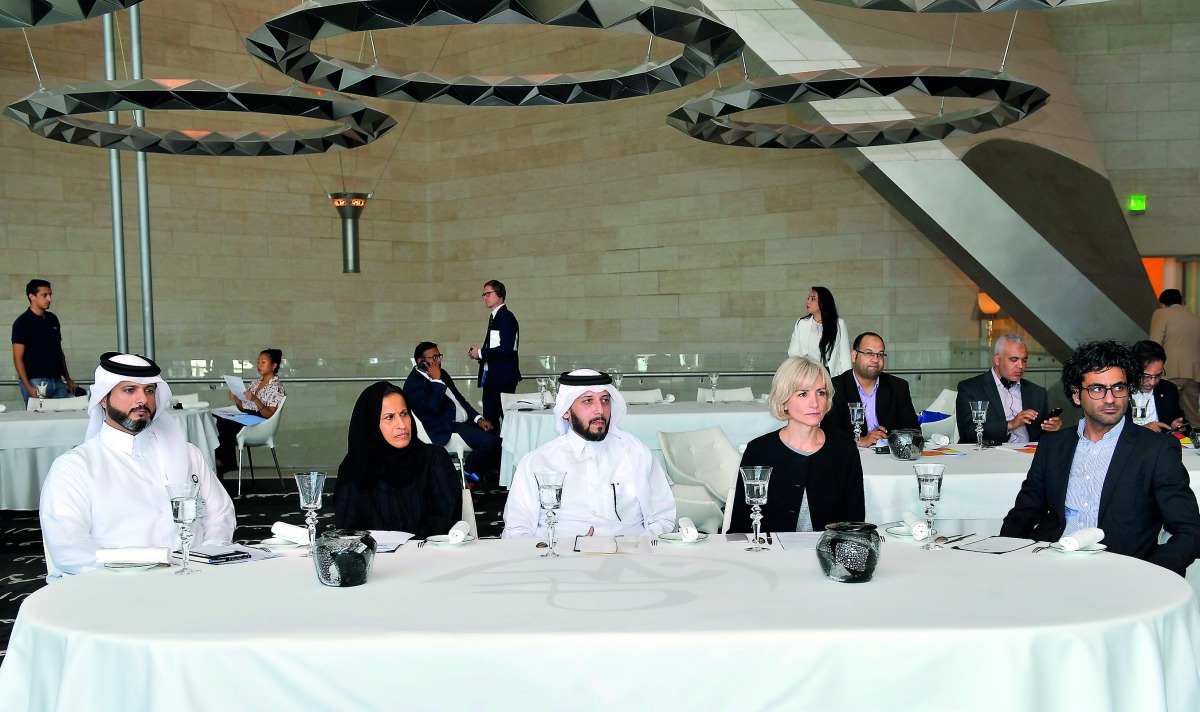
Saif Al Kuwari, Deputy Director for Operations, National Museum of Qatar (NMoQ); Dr Haya Al Thani, Deputy Director of Curatorial Affairs, NMoQ; Mansoor bin Ebrahim Al Mahmoud, Special Advisor to Chairperson of Qatar Museums, H E Sheikha Al Mayasa bint Ham
The National Museum of Qatar (NMoQ), set to officially launch on March 28 next year, will be a feast to the intellect and the senses as an immersive and experiential museum which tells about the country’s past, present and future through an innovative display of multi-layered content.
The innovative museum is organized in three “chapters”—Beginnings, Life in Qatar, and Building the Nation—presented in eleven galleries. The visitor’s chronological journey, which extends through more than 1.5 km of experiences, starts in the geological period long before the peninsula was inhabited by humans and continues to the present day.
The route passes through a succession of impressive, remarkably shaped volumes until it reaches its culmination in the very heart of Qatari national identity, the thoroughly restored Palace of Sheikh Abdullah.
“Each gallery will be an all-encompassing experience of its own, in which photographs, films, texts, oral histories, rare and precious objects, music, digital displays, and even aromas are blended into a seamless whole,” Dr. Karen Exell, NMoQ Senior Museum Development Specialist, said at a press briefing yesterday.
As the much awaited opening nears, the team comprising representatives from Qatar Museums and NMoQ, who are behind the landmark museum, yesterday provided a glimpse into what people can expect when the desert rose inspired museum designed by renowned architect Jean Nouvel opens its doors to the public.
Exell said a rich and multi-layered content was developed in partnership with local and international research centres, universities, museums and individuals.
In Qatar, a wide range of subjects have been developed with experts at Qatar University and HBKU, including botanical, socio-cultural and political history research. Arthropod collections have been developed with the support of the Friends of the Environment Centre.
International examples include geological and natural history research with Leiden Naturalis, paleontological fieldwork with Raimund Albersdoerfer (Germany) to excavate and reconstruct fossil dugong skeleton, and donations of shells from the Houston Museum of Natural History.
“Working with expert craftspeople from around the globe, we have also created over 1,400 beautiful bespoke models for the museum: natural history, architectural, archaeological, document replicas, boat models, tactile models and models for children,” said Exell, adding local and international artists had been commissioned to create site-specific pieces to enhance exhibition experience.
Dr. Haya Al Thani, NMoQ Deputy Director of Curatorial Affairs said information related to oral histories will feature heavily in the museum, bringing to life this critically important aspect of Qatar’s culture and the heritage and traditions of its people.
Dr. Haya said the museum had worked with partners including the Doha Film Institute over five years to record these memories and preserve information about the country.
More than 70 films will be displayed through the museum galleries, bringing the displays of objects to life through shared memories of recent history. In all, more than 300 members of the public participated in the project, she added.
The new museum has many other features such as the 112,000sqm public park with family-friendly interactive learning environments, walkways, a lagoon, landscaped exclusively with drought-resistant native vegetation.







