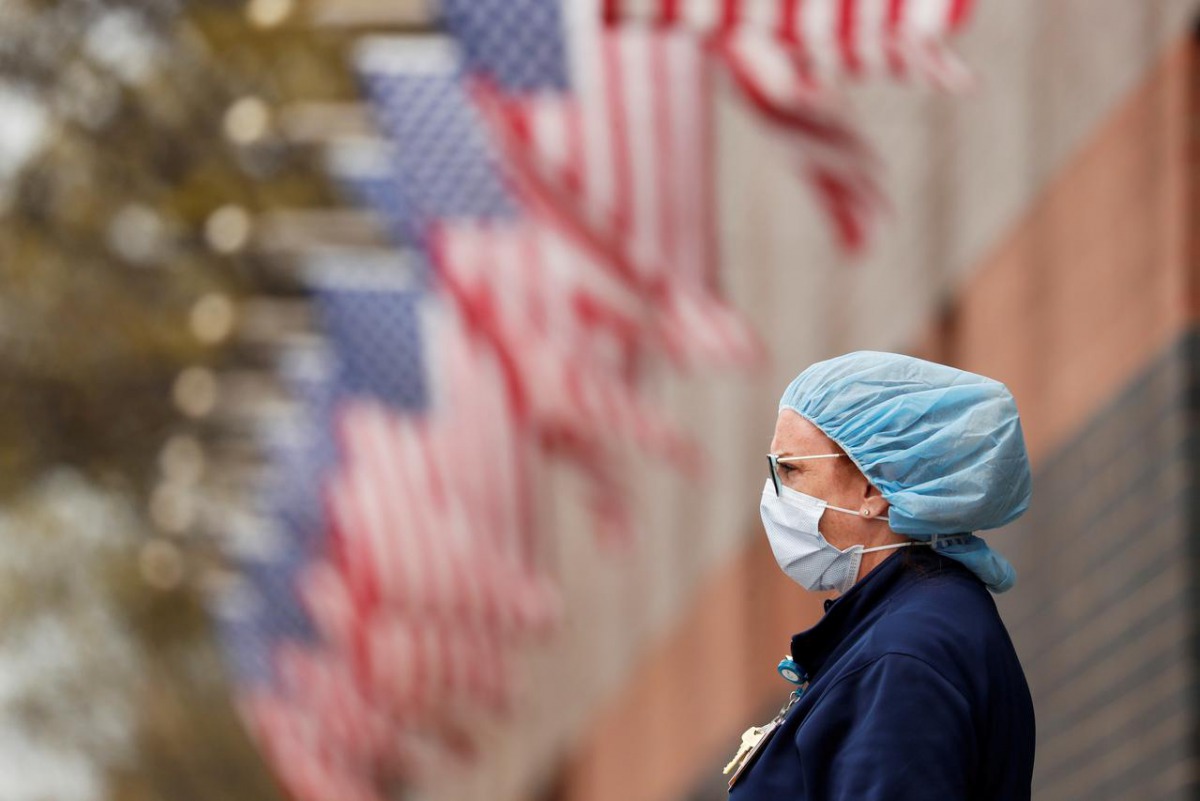
FILE PHOTO: A nurse wearing personal protective equipment watches an ambulance driving away outside of Elmhurst Hospital during the ongoing outbreak of the coronavirus disease (COVID-19) in the Queens borough of New York, U.S., April 20, 2020. REUTERS/Luc
American hospitals are getting a reprieve as a spike of Covid-19 cases in the Sun Belt eases and the Northeast recovers, giving health-care workers a chance to prepare for what September and October may bring.
For the first time in a month, fewer than 50,000 Americans are known to be hospitalized with Covid-19, according to data compiled by the Covid Tracking Project through Sunday.
In Arizona, one of several states to have suffered a brutal July, the coronavirus hospitalization figures have dropped by about half. In Florida, they’re down about a third from their peak last month, partly due to an easing of pressure on the Miami area. And in New York, where the pandemic hit hardest in its first onslaught, Governor Andrew Cuomo said Monday that the numbers fell to their lowest of the pandemic -- 535 hospitalized and 127 in the ICU statewide.
"These are not just blips at this point,” Florida Governor Ron DeSantis said Monday of his state’s Covid-19 trends. "These are sustained movements.”
Tricky to Maintain
In New Jersey, Governor Phil Murphy said Monday that the transmission rate fell below 1 for the first time since July 25, suggesting that the state is slowing the spread of the virus, but "only by a hair.”
Maintaining positive trends may prove tricky. In particular, experts worry that positive data has led to public complacency, perhaps helping to fuel the virus’s resurgence in the Sun Belt in late June and early July. Anthony Fauci, director of the National Institute of Allergy and Infectious Diseases, has also warned that the virus could return in the coming months in a dangerous collision with influenza season.
Michael Osterholm, director of the Center for Infectious Disease Research and Policy at the University of Minnesota, said the drop in hospitalizations is good news. But the key question is how long it will last, said Osterholm, who advocates lockdowns to bring new cases under 1 per 100,000 people a day. They are currently about 14 per 100,000 Americans.
He said the virus naturally ebbs and flows with human behavior, but there’s a real danger of a resurgence -- or much worse -- as schools reopen and North America moves toward winter and indoor-heating season.
"The young-adult population is going to fuel cases when colleges, university and high schools reopen,” he said. "That’s going to spill over in September and October into the general population.”
Even after the most recent reductions, nationwide Covid-19 hospitalizations are elevated compared with June lows. But the data is hard to compare over time. Some states didn’t initially disclose the hospitalization figures, including Florida, which started reporting them only on July 10.