QazCode CEO Oleksii Sharavar during an interview with The Peninsula
Doha, Qatar: Countries in the Middle East are actively developing artificial intelligence, open data, and innovative technology platforms, creating new opportunities for businesses and government institutions. Against this backdrop, Kazakhstan’s experience is particularly noteworthy: several years ago, a major telecommunications company began developing its own IT capabilities, initially to replace external software vendors with in-house solutions. Over time, the team grew into a separate division - QazCode, which has become one of the largest IT companies in Central Asia and implements large-scale AI projects.
According to QazCode CEO Oleksii Sharavar, the company was founded on a simple but strategically important idea: a telecom cannot rely solely on providing communication services. “We strongly believe that simply being a telco and serving customers is not enough,” he told The Peninsula. “You need to offer better products and improve the customer experience. That’s why we need to become an IT company.” Today, QazCode is a rapidly growing technology company with 750 employees, half of whom are software developers. It is part of the international VEON group, based in Dubai and operating across five global markets, and serves all VEON markets in Central and Southeast Asia as well as the UAE.
The catalyst for the company’s pivot into AI came as customer interactions surged past the one-million mark each month within Kazakhstan alone. As Sharavar describes it, the linguistic complexity of these interactions created an immediate challenge. Customers switch spontaneously between Kazakh, Russian, and Uzbek, sometimes beginning a sentence in Kazakh and ending it in Russian. Existing global language models were incapable of understanding this mix, and major AI companies had little incentive to prioritize smaller languages. “Kazakh, Ukrainian, Bangla, Uzbek, these are not the most popular languages in the world,” Sharavar says. “So we understood that no one from the large companies would prioritise them.”

That realization led QazCode to build its own LLM solutions, trained on a uniquely rich dataset assembled in partnership with Kazakhstan’s Ministry of AI and Digital Development, and a consortium of major universities. The model, called KazLLM, is based on 150 billion tokens and represents the largest Kazakh-language model ever published. It also incorporates Russian, Turkish, and English, making it a multilingual model tailored to the region’s linguistic landscape. Published on Hugging Face as open source for non-commercial use, the model marks the first attempt to create a sophisticated LLM capable of understanding Kazakhstan’s dialects, cultural nuances, and mixed-language speech patterns.
The CEO emphasises that the dataset behind the model is unlike anything accessible publicly online. “You will never find it on the internet,” he notes. “It’s all books, studies, materials collected from the biggest universities in the country.” He argues that this makes the model particularly valuable for educational and cultural research, as well as general AI applications. Beyond linguistic fidelity, the model was also trained on local infrastructure, ensuring security, privacy, and full sovereignty over data, an issue of increasing concern for governments and enterprises across the region. QazCode has since begun deploying the model across education, healthcare, enterprise support systems, and lifestyle assistants.
While global AI development can cost hundreds of millions of dollars, Sharavar notes that QazCode was able to develop KazLLM with significantly lower expenses. The collapse in infrastructure and inference costs has opened opportunities for emerging markets to participate in the AI race. Sharavar cites countries like Qatar that have aggressively expanded open data access, saying that such environments enable startups and enterprises “to create agents and LLMs” more easily. The shift has convinced him that a wave of new countries will soon contribute local models, tailored agents, and industry-specific systems.

For QazCode, the next frontier is corporate AI agents - autonomous systems designed to automate routine tasks using intelligent agents and intended to assist professionals in medicine, law, agriculture, education, and corporate operations. The company is developing an agentic platform called Aventa, which will serve both B2B clients and consumer markets. Sharavar envisions corporate agents handling legal reviews, HR tasks, compliance processes, financial analysis, and software development, securely and using localised data. Industry-specific agents are already in development, including an “AI doctor assistant” designed to help physicians diagnose more effectively and an agriculture-focused agent aimed at helping farmers in Pakistan and Bangladesh increase yields, analyse soil, and plan harvest cycles. For Qatar, such technologies demonstrate the potential to transfer industry-specific AI solutions to new markets, including healthcare, corporate services, and data management.
He insists that AI for QazCode is not a technological trend but a fundamental transformation. “AI is not just a hype for us,” he says. “You can easily serve customers, provide them with more services. You can become a better doctor, a better teacher, a better farmer.” His broader vision is for digital assistants that function less like the static apps of the past and more like personalised companions who understand users’ histories and daily needs without overwhelming them with notifications. “We want the application to become your digital friend,” Sharavar says. “Not just another annoying thing in your smartphone.”

The company’s international strategy is also taking shape quickly. QazCode has already expanded into five markets and is now signing agreements that could dramatically broaden its reach. During the Mobile World Congress (MWC) 2025 in Doha, QazCode signed a partnership with a US-based AI company specialising in sovereign AI solutions. The collaboration will enable QazCode to build low-cost, locally deployed LLMs for Bangla, Urdu, Ukrainian, Kazakh, and Uzbek, with the first products expected next year. Another agreement signed with JazzCash, Pakistan’s leading financial app, aims to build a specialised AI agent for customer service. Sharavar believes these partnerships could bring QazCode’s AI tools to more than 70 countries in the coming years.
The strategic shift toward the Middle East is intentional. The official remarks that the region offers unmatched access to investment capital, infrastructure, and a regulatory environment that encourages innovation rather than constraining it prematurely. “In Europe, they started regulation even without having products,” he stated. “Here, you can build a product, and then regulation will come. It’s a risk-accepting approach, which I love.” He identifies Qatar, the UAE, and other Gulf states as benchmarks for Central Asia in terms of digitalisation and innovation. Last year, VEON moved its headquarters from Amsterdam to Dubai to position itself closer to its core markets and the region’s thriving tech ecosystem.
Sharavar stresses that the company has three advantages over global competitors, such as local infrastructure, unique data, and LLM-agnostic flexibility. The company’s infrastructure footprint across its markets enables low-latency performance at lower cost, a valuable benefit for AI inference. Its access to proprietary linguistic and cultural datasets, gathered through academic partnerships and government cooperation, allows the company’s models and agents to behave more naturally than generic open-source systems. And unlike the closed ecosystems of major Big Tech companies, Aventa can operate on any LLM, whether Google, GPT-based, DeepSeek, or KazLLM itself. He describes this flexibility as essential for building an agentic platform tailored to customer needs.
Ethics and safety also play a central role in QazCode’s approach. Sharavar says the company’s collaboration with universities and the government gave it a “cookbook” for building ethical models that avoid the biases and “internet garbage” prevalent in many global datasets. The company’s insistence on local infrastructure ensures that sensitive data never leaves national borders. And its ability to privately fine-tune models on enterprise data allows organisations to build secure, customised agents without exposing proprietary information.
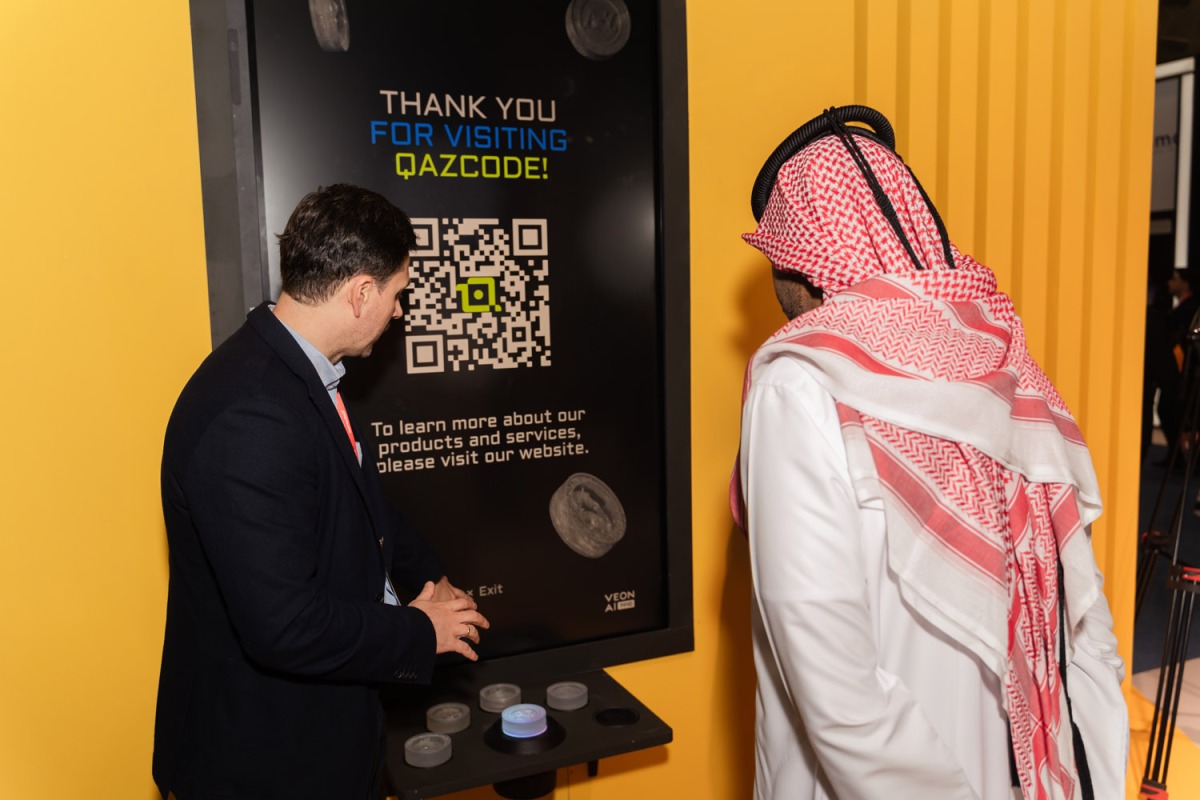
As he walks through the QazCode booth at MWC Doha, Sharavar reflects on the journey from a small Kazakhstani development squad to an emerging global AI contender. He says the excitement at the exhibition and the volume of interest from governments, enterprises, and tech firms confirm the company’s direction. “There is a huge demand for AI solutions,” he says. “It’s good to be here and show that even in a small country like Kazakhstan, we can build innovations and provide them globally.” He hopes QazCode’s story inspires other smaller nations to build their own language models and AI tools instead of relying exclusively on solutions from the world’s largest tech firms.
Highlighting his global ambitions, Sharavar expects QazCode to become an “AI-native operator” across all its markets within three years, delivering digital services powered by agentic AI and local-language models. The company already has contracts in 15 countries and plans to reach more than 70. He sees the IT firm as a “fast track to innovation,” helping underserved markets leapfrog into the AI era with tools designed for their languages, cultures, and needs. He further added, “We started as a telco company and became an innovation leader. Now we want to repeat this success in other markets and help companies in the MENA region become leaders in AI as well.”
For Sharavar, the rise of QazCode is proof that AI innovation is no longer the exclusive domain of Silicon Valley or the world’s largest economies. With the right data, infrastructure, and partnerships, even countries often overlooked by global tech can contribute transformative solutions. And for Kazakhstan, traditionally regarded as far from the technology hubs of the world, the emergence of QazCode marks the start of a new chapter, one in which local languages and regional needs shape the future of artificial intelligence.