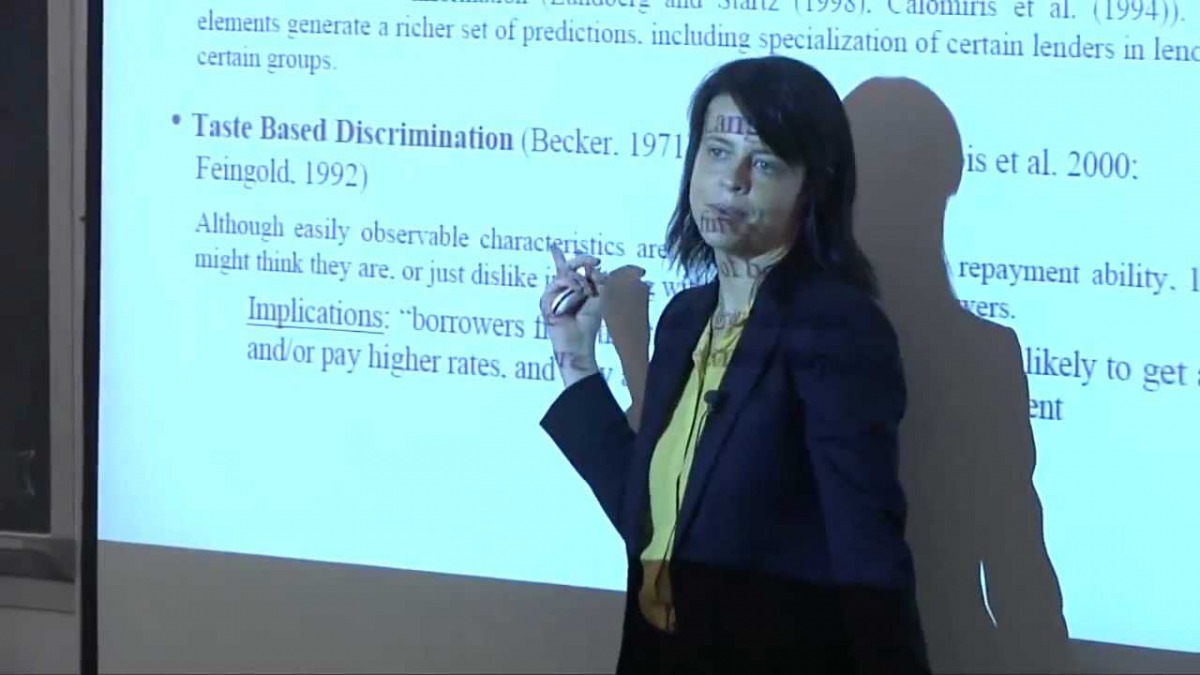
Enrichetta Ravina (Photo courtesy: YouTube/Columbia Business School)
When former Columbia University assistant finance professor Enrichetta Ravina finally agreed to dinner with her mentor and senior colleague after months of dodging his invitations, he ended what she hoped was a platonic meal by touching her backside as she left the cab.
"He passed his hand on my back, and then toward my butt," Ravina told a federal jury Tuesday hearing her sexual harassment suit against Columbia. "I felt my stomach churn. I grew concerned he wanted more, a romantic relationship. I didn’t want a romantic relationship. I wanted to be able to do the work. I was quite concerned, actually."
Ravina’s testimony came in an unusual trial that may shed light on how sexual harassment claims are handled in academia. She claims the university refused to acknowledge her complaints while simultaneously touting its diversity -- allegations that may cast a shadow on one of the nation’s top-tier business schools that boasts alumni such as Warren Buffett and the chief executives of Estee Lauder and Anheuser-Busch.
Columbia denies the allegations, with its lawyer, Bettina Plevan, arguing that Ravina’s performance was subpar and that she was denied tenure because of her slow progress on academic papers.
"Her scholarship was not sufficient in quantity or quality to warrant an award of tenure," Plevan told the federal jury in Manhattan in opening statements on Monday.
Denied Tenure
Ravina, a finance professor with a Ph.D from Northwestern University, was previously a visiting scholar at Harvard Business School and studied at the Federal Reserve Bank of New York. Ravina claims she suffered years of harassment by her mentor, Geert Bekaert, and was then retaliated against by Bekaert and Columbia after she rejected his sexual advances and reported his behavior to officials.
She was denied tenure in 2016 and terminated by the university that June.
Ravina began her testimony Tuesday morning, telling jurors that Bekaert was assigned to coach her after the two began work on research projects on personal finance based on data he had access to through a retirement finance company. Ravina hoped to publish as many as five papers based on the data.
"He was very powerful, he knew a lot of people, he was well established in the profession, and we were working on this set of projects," she testified. "So I thought it was good. I was happy to have him as a mentor."
Then came months of dinner invitations and his fishing for compliments because "he would say he had a frail ego," she testified. To get Bekaert to respond to her inquiries about work, she said she resorted to asking him for music recommendations at the top of emails.
In one email conversation, Bekaert responded within two minutes of her query without answering her work-related questions, instead offering a list of YouTube links to songs such as Roxy Music’s "Love Is the Drug."
Lawyers outlined their cases in opening statements on Monday.
Ravina’s lawyer, David Sanford, told the jury Monday she suffered years of sexual harassment and retaliation.
"He propositioned her," he said. "Right after talking about his sex life, he told her that if she were nicer to him, her papers would move faster."
Bekaert also tried to sabotage Ravina’s career by sending critical emails to academics around the world, Sanford said. At one point, as her complaints against him swirled around the university, he bemoaned in an email "the laws in this country are totally biased against privileged, white males,” Sanford told jurors.
Edward Hernstadt, Bekaert’s lawyer, disputed Ravina’s allegations, saying Bekaert never touched her or talked about pornography and prostitution to her. He didn’t deny the instances in which Bekaert called Ravina a list of pejorative and misogynistic names, including "bitch” and "psycho,” but argued that Bekaert was known among Columbia colleagues as the "blunt Belgian."
Columbia’s lawyer, meanwhile, argued that the university responded appropriately to Ravina’s complaints.
A jury of four women and four men will hear from Ravina, Bekaert and university officials during the trial, which could last as long as three weeks.